Free study guide · no paywall
Don QuixoteStudy Guide
by Miguel de Cervantes Saavedra (1605)
A gentleman who reads himself into knighthood, a squire who names hunger while his master names giants, and a fever that finally makes him sane: mapped across 126 chapters and six lessons.
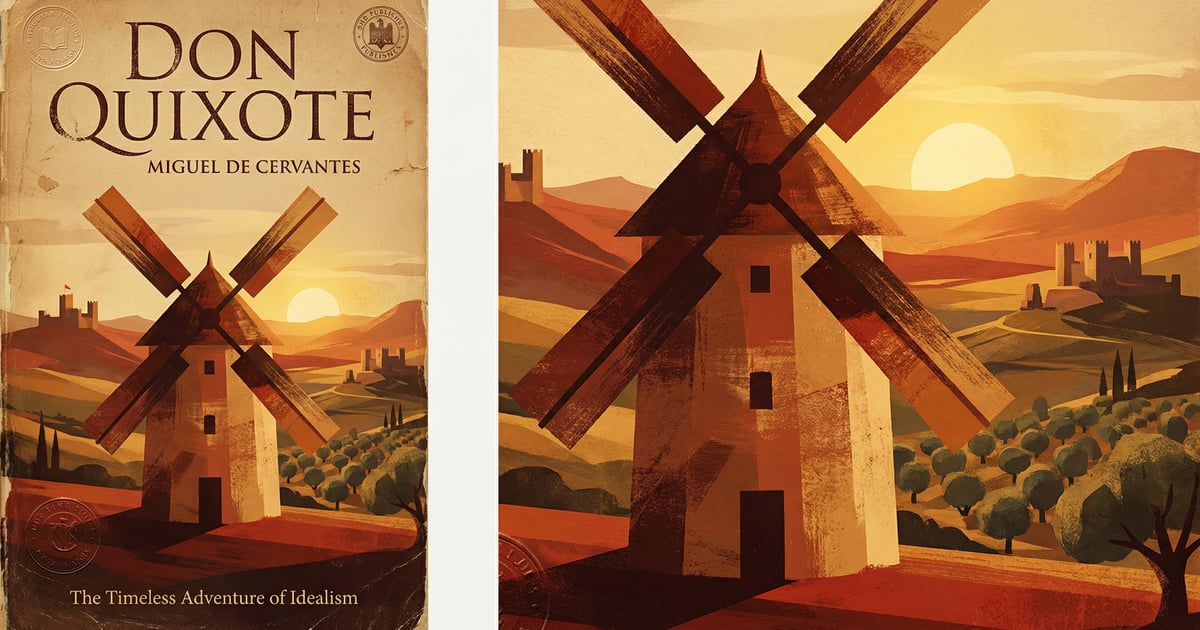
Start here
Plot, characters & chapter jump
126 chapter summaries · 6 key figures · discussion questions · quotes · free
Plot summary
An ageing hidalgo in an unnamed village of La Mancha reads himself out of his senses on romances of chivalry, sells farmland to buy more, and rides out as Don Quixote to revive knight errantry, with the peasant Sancho Panza recruited as his squire on the promise of a governorship. Windmills become giants, a barber's basin becomes a golden helmet, and freed galley slaves repay their rescue with a beating, until the priest and the barber cart him home in a cage to end Part One. Part Two opens on a man already famous: Samson Carrasco has read the first book, the Duke and Duchess turn the knight into elaborate house entertainment on their estate, and Sancho briefly governs the invented island of Barataria before resigning it as a joke that went on long enough. In Barcelona the Knight of the White Moon, a neighbour in disguise, defeats Quixote in single combat and sends him home bound to a year without adventures; a fever finishes what the fall started, and he dies as Alonso Quixano, sane and much poorer for it.
Key characters
Jump to chapter
- Chapter 1Quixote rehearses knighthood before the first mile
- Chapter 8Windmills become giants
- Chapter 22Freed galley slaves stone their rescuer
- Chapter 25The mad penance in the Sierra Morena
- Chapter 52The ox-cart cage ends Part One
- Chapter 61Midnight in El Toboso and the palace that was a church
- Chapter 97Sancho takes possession of Barataria
- Chapter 126Death of Don Quixote and Hamete's farewell
What readers search for
Common questions about Don Quixote
Why does Don Quixote think windmills are giants?
He has already rehearsed knighthood in his head before he ever leaves the village: crowning himself Emperor of Trebizond, reciting a giant's surrender, naming a lady who never agreed to the title. When thirty windmills appear on the plain, the story he arrived with needs an antagonist worthy of the role, so the sails become arms and the towers become giants. After the fall breaks his lance, he does not revise the story; he blames the enchanter Friston for turning the giants into mills at the last second, because the identity survives only if the bruise is sabotage rather than evidence.
Detecting Story-Driven DelusionWhy does Sancho Panza stay with Don Quixote?
Sancho signs on for a governorship that never arrives on schedule, and the contract keeps failing without ending the arrangement. He names hunger while Quixote names giants, corrects his master's enchantments under his breath, and still rides back toward him even after the Barataria governorship turns out to be a staged joke. The novel treats that as the real answer: not the promised island, but the loyalty that survives the promise being broken.
Loyal Friendship Under AbsurdityWhy does Don Quixote think a barber's basin is a helmet?
A travelling barber is caught in the rain and ties a brass basin over his hat to keep dry. Quixote has already sworn an oath about winning a golden helmet, so the basin is assigned that role on sight, and Sancho, who can still see a basin, is told he simply failed to recognise treasure. At the inn the argument becomes a vote among strangers, helmet or basin, because once a relic has been promised, whether an object gets to stay ordinary depends on who benefits from calling it something else.
Reading Appearance vs RealityWhy do the freed galley slaves attack Don Quixote?
Quixote frees a chain of galley slaves by arguing that no one should be forced into service against his will, then orders them to march to El Toboso and report the deed to Dulcinea. They refuse, and when he insists, they stone him and Sancho and steal what they can carry. It is the clearest case in the book of noble intentions missing the target: the men he "rescues" experience an armed stranger delaying men who were already condemned, not a liberation.
When Noble Intentions Miss the TargetWhy do the Duke and Duchess play along with Don Quixote in Part II?
By Part II, Quixote and Sancho are already famous: Samson Carrasco has read Part I and can quote it back to them. The Duke and Duchess, who have also read the book, invite the pair to their estate and stage an entire fake mythology around them, Merlin's lashes, the flying wooden horse Clavileño, and a real appointment for Sancho as governor of a fictional island called Barataria. They are not curing Quixote's delusion. They are producing it as entertainment, because the joke is funnier with a bigger budget.
Living Inside a NarrativeFast track
Short on time? Start here
You do not have to read all 126 chapters in one sprint. These 8 beats hold the book's argument together.
Chapter 1
Quixote rehearses knighthood before the first mile
Chapter 8
Windmills become giants
Chapter 22
Freed galley slaves stone their rescuer
Chapter 25
The mad penance in the Sierra Morena
Chapter 52
The ox-cart cage ends Part One
Chapter 61
Midnight in El Toboso and the palace that was a church
Chapter 97
Sancho takes possession of Barataria
Chapter 126
Death of Don Quixote and Hamete's farewell
Full coverage
Everything in this study guide
The same surfaces readers expect from a traditional study guide — plot, characters, themes, quotes, and homework help — grouped across 4 parts, with audio and the source text on every chapter. Free, no paywall.
Plot overview
Summary, context, and why the book still matters
126 chapter summaries
Every chapter with audio narration
6 key figures
Who drives the plot and what each one does
6 lessons
Themes traced to scenes, not generic labels
15+ important quotes
Verified lines with chapter links and analysis
Discussion questions
Five per chapter, with suggested answers for class and essays
Original text
Author's words beside every summary
This is not a plot cheat sheet. Wide Reads walks Don Quixote as one long argument about what a story is allowed to do to a life, from the first night of chivalry reading to the fever that finally ends it. Use the part-by-part path below to keep your bearings across both published volumes, follow the six lesson deep dives when a scene hooks you, and open individual chapters for summaries, quotes, and audio.
For plot and theme questions about Don Quixote, see Common Questions on the book page.
How to use this guide
How to Read This Book with Wide Reads
Meet the delusion before the road does
Read chapters 1 and 2 for the rehearsal: Quixote crowning himself Emperor of Trebizond in an empty room, naming a farm girl Dulcinea, and riding out the back door before anyone can talk him out of it. The plot is already finished before the first mile.
Follow the first sally home
Chapters 3 through 52 are Part One: the windmills, the barber's basin, the freed galley slaves who stone their rescuer, and the Sierra Morena penance, ending with the priest and the barber carting Quixote home in an ox-cart cage.
Watch fame change the game
Chapters 53 through 126 are Part Two: Quixote and Sancho are already famous, the Duke and Duchess turn the knight into house entertainment, Sancho governs and resigns the invented island of Barataria, and a rival's fake sequel pushes the real one toward Barcelona and a death he chooses on his own terms.
Plot & context
Book Overview
Little sleep and too much reading dry a gentleman's brains in an unnamed village of La Mancha. He sells tillage land for more chivalry books, decides that no history has more reality than the romances on his shelf, and names himself Don Quixote. He polishes his great-grandfather's rusted armour, christens his hack Rocinante, and elevates Aldonza Lorenzo, a farm girl who never knew his love, to Dulcinea del Toboso. Then he rides out by the back door. The first sally ends in a mock knighting at an inn he takes for a castle, a beating on the road, and a cart ride home. Cervantes published the first part in 1605 and the second a decade later. What the book will not settle, across two volumes, is whether the knight is mad, noble, or both at once.
Don Quixote is a hidalgo bordering on fifty: thin, stubborn, and so sure the romances are true that bruises cannot revise him. Sancho Panza, a practical peasant lured by the promise of governing an island, follows on his ass and names hunger while his master names giants. The priest and the barber try to burn the books and later cage the reader. Samson Carrasco, a bachelor who has already read Part I, turns the sequel into a contest he intends to win. The Duke and Duchess, who have also read the book, turn the knight into house entertainment. Innkeepers play along. Galley slaves do not. A farm girl on the road to El Toboso becomes an enchanted Dulcinea because Sancho cannot produce the lady his master demands.
Thirty windmills become giants; Quixote charges, shatters his lance, and blames the enchanter Friston for stealing his glory. A barber's basin becomes Mambrino's helmet. He frees a chain of galley slaves in the name of liberty; they stone him and steal the basin. In the Sierra Morena he performs a mad penance for Dulcinea. The priest and the barber bring him home in an ox-cart cage, and Part I closes. Part II, published in 1615, opens on a man who is already famous. Sancho "enchants" a peasant girl rather than admit Dulcinea is not there. The Duke and Duchess stage Merlin's lashes, the wooden horse Clavileño, and a fake island called Barataria that Sancho governs well until the joke collapses. On a Barcelona beach the Knight of the White Moon, Carrasco in disguise, hurls Quixote and Rocinante to the earth and binds him to a year without adventures. Quixote keeps Dulcinea's honour and loses the road.
Cervantes wrote Don Quixote to bury the books of chivalry and invented the modern novel while doing it. The hero meets readers of his own first part. A rival sequel appears on the road, and Cervantes kills his knight so no false author can revive him. After the defeat a fever takes him. He wakes lucid, renounces Don Quixote of La Mancha for Alonso Quixano the Good, clears Sancho's accounts, and dies in his bed. Sancho begs him to live and take to the fields as shepherds. Quixote answers that in last year's nests there are no birds this year. The ending is not a verdict on madness. It is the cost of living inside a story until the story is the only country left.
Read the full summary on the book page →
Why this book now
People still meet Quixote's exact trap in smaller rooms: a story that makes you necessary and keeps explaining the bruises until you need the story more than you need the road, an audience that has already read the plot and starts writing scenes for you, an intervention that argues inside the delusion's own logic and only adds a scene instead of ending one. Cervantes does not mock this from a safe distance. He built the modern novel out of decades spent inside the gap between the heroic life he wanted and the clerking jobs, debts, and prison stints his real one kept handing him. This guide keeps that argument tied to the windmills, the basin, the freed slaves, and the Duke's estate, not to a summary of chivalric romance.
About Miguel de Cervantes Saavedra
Miguel de Cervantes (1547-1616) lived the kind of life that makes you wonder whether he invented Don Quixote or lived it first. Born in Alcalá de Henares to a family perpetually short of money, he grew up watching noble ideals collide with empty pockets. At 23, he fled Spain after wounding a man in a duel and joined the Spanish navy in Italy. He fought at the Battle of Lepanto in 1571, taking three gunshot wounds and losing the use of his left hand. Fellow soldiers called him el manco de Lepanto, the one-handed man of Lepanto, and he wore the name like a badge. What followed was worse than war. Pirates captured his ship on the return voyage, and Cervantes spent five years enslaved in Algiers. He led four escape attempts that should have earned execution. Prisoners looked to him for courage and order. When a ransom finally bought his freedom in 1580, he returned to Spain expecting a hero's welcome. He got clerical jobs, tax collection, bankruptcy, and a stint in prison over disputed accounts. For twenty years he chased commissions, wrote plays that mostly failed, and watched Spain's golden age ignore a soldier who had given it everything. That gap between heroic past and humdrum present is where Don Quixote was born: a man who cannot stop living inside the books that no longer match the world around him. Part I appeared in 1605, when Cervantes was nearly sixty. Part II followed in 1615. The book made him famous and left him nearly as broke as before. He died in Madrid in 1616, the same month as Shakespeare, having written what many consider the first modern novel.
Themes with proof
Lessons from Don Quixote
Six pressures Cervantes traces from the first night of reading to the fever that ends it: detecting a story-driven delusion before it rewrites what counts as evidence, holding idealism and pragmatism in tension instead of letting one win outright, reading appearance against reality by asking who benefits from an object being called something else, loyal friendship that survives every broken promise, noble intentions that still hurt the people they claim to help, and noticing when you have started living inside a narrative other people are now writing for you.
Deep dives
Chapter-by-chapter breakdowns
Reading Appearance vs Reality
Track how Quixote turns inns into castles and ordinary life into enchantment, and ask what your own filters add.
his craze being stronger than any reasoning, he made up his mind to have himself dubbed a knight by the first one…
Loyal Friendship Under Absurdity
Learn from Sancho's willingness to stay with Quixote through ridicule, beatings, and promises that never arrive on schedule.
without taking leave, Sancho Panza of his wife and children, or Don Quixote of his housekeeper and niece, they sallied forth unseen…
When Noble Intentions Miss the Target
See how Quixote's hunger to right wrongs can still leave real people hurt when the script matters more than the scene.
Nay, God forbid! No, señor, not for the world; for once alone with me, he would flay me like a Saint Bartholomew.
Character guide
Key Figures
Who drives the plot, what each one wants, and why they matter to the argument of the book.
Don Quixote (Alonso Quixano)
A hidalgo bordering on fifty who reads himself out of his senses on chivalry romances and rides out to revive knight errantry; renounces the name and dies sane, and much poorer for it, at the very end.
Sancho Panza
A practical peasant who signs on as squire for the promise of a governorship, names hunger while his master names giants, and stays through every broken promise anyway.
Dulcinea del Toboso
A farm girl named Aldonza Lorenzo who never asked for the title; Quixote's ideal lady exists mainly as a name Sancho has to keep supplying evidence for.
Samson Carrasco
A bachelor who has already read Part One and turns Part Two into a contest he intends to win, eventually defeating Quixote in disguise as the Knight of the White Moon.
The Duke and Duchess
Wealthy readers of Quixote's own story who invite him and Sancho to their estate and stage an entire fake mythology, Merlin's lashes, a flying wooden horse, and a real appointment as governor of a fictional island, purely for their own entertainment.
The priest and the barber
Quixote's neighbours, who burn his library of chivalry books to cure him, then cart him home in an ox-cart cage at the end of Part One when persuasion fails.
Memorable lines
Key Quotes
Verified passages with chapter links — the lines teachers and essays keep returning to.
“what with little sleep and much reading his brains got so dry that he lost his wits”
“saw himself crowned by the might of his arm Emperor of Trebizond at least”
“But scarcely did he find himself upon the open plain, when a terrible thought struck him, one all but enough to make him abandon the enterprise at the very outset.”
“his craze being stronger than any reasoning, he made up his mind to have himself dubbed a knight by the first one he came across”
“From this spot I rise not, valiant knight, until your courtesy grants me the boon I seek, one that will redound to your praise and the benefit of the human race.”
“to make sport for the night he determined to fall in with his humour.”
“I go with him!” said the youth. “Nay, God forbid! No, señor, not for the world; for once alone with me, he would flay me like a Saint Bartholomew.””
“Thus did the valiant Don Quixote right that wrong, and, thoroughly satisfied with what had taken place, as he considered he had made a very happy and noble beginning with his knighthood”
“O noble Marquis of Mantua, My Uncle and liege lord!”
“I know who I am,” replied Don Quixote, “and I know that I may be not only those I have named, but all the Twelve Peers of France and even all the Nine Worthies”
“Here, your worship, señor licentiate, sprinkle this room; don’t leave any magician of the many there are in these books to bewitch us in revenge for our design of banishing them from the world.”
“open the window and fling it into the yard and lay the foundation of the pile for the bonfire we are to make.”
“Here, here, valiant knights! here is need for you to put forth the might of your strong arms, for they of the Court are gaining the mastery in the tourney!”
“He must have said Friston”
“God bless me!” said Sancho, “did I not tell your worship to mind what you were about, for they were only windmills? and no one could have made any mistake about it but one who had something of the same kind in his head.”
Class & essay prep
Discussion Questions
Sample prompts drawn from the chapter guides — each with suggested answers for seminars and written work.
What specific activities does the gentleman abandon as his reading habit grows more intense?
From Chapter 1Why does Cervantes show us the helmet breaking immediately after our hero builds it?
From Chapter 1What terrible thought strikes Don Quixote on the open plain, and how does he resolve to handle this problem?
From Chapter 2Why does Cervantes show us Don Quixote rehearsing his own future biography while riding alone?
From Chapter 2What does the landlord confess about his past adventures, and how does Don Quixote react to hearing about swindling and cheating?
From Chapter 3Why does Cervantes have the landlord read from an account book instead of a prayer book during the knighting ceremony?
From Chapter 3When Don Quixote finds Andres being beaten, what specific command does he give the farmer, and how does the farmer respond?
From Chapter 4Why does Cervantes show us the farmer beating Andres worse after Quixote leaves, rather than ending the scene with the knight's departure?
From Chapter 4When Pedro Alonso finds Quixote and wipes the dust from his face, what does he call him, and why is this significant?
From Chapter 5Why does Cervantes have Quixote switch from the Baldwin story to the Abindarraez tale when Pedro keeps questioning him?
From Chapter 5Why does the housekeeper bring holy water and a sprinkler to the library before the book burning begins?
From Chapter 6What does it reveal that the curate knows these romance books so well he can quote characters and plot details from memory?
From Chapter 6When Don Quixote wakes shouting about a tourney, what does this interrupt and why does the narrator mention specific books going 'unseen and unheard'?
From Chapter 7Why does Cervantes have the housekeeper and niece create such an elaborate lie about a magician stealing the books instead of telling the truth?
From Chapter 7When Sancho tells Don Quixote 'did I not tell your worship to mind what you were about, for they were only windmills?' what does this reveal about their relationship?
From Chapter 8Chapter by chapter
All Chapters
Grouped by 4 sections — the same structure as the book hub.
The First Sally
Chapters 1–52 · Windmills, the freed galley slaves, and the ox-cart cage home
Ch. 1 · The Birth of a DelusionQuixote rehearses knighthood before the first mile
A gentleman bordering on fifty lives quietly in an unnamed village of La Mancha until chivalry books take over his life. He neglects field sports and ...
Ch. 2 · The First Sally
Don Quixote slips out before dawn through the back door, armour on, Rocinante saddled, convinced the world is losing greatness by the hour. On the ope...
Ch. 3 · The Mock Knighting
After supper Quixote kneels before the innkeeper in the stable and refuses to rise until he is dubbed a knight. He asks to watch his armour overnight ...
Ch. 4 · Intervention and Defeat
At dawn Quixote leaves the inn thrilled to be a knight and turns toward home to fetch money, shirts, and a squire. He has barely started when cries le...
Ch. 5 · Coming Home Broken
Unable to rise after the beating, Quixote reaches for his usual remedy: a story from his books. The ballad of Baldwin and the Marquis of Mantua fits s...
Ch. 6 · The Book Burning
While Don Quixote sleeps, the curate, barber, housekeeper, and niece enter the library that poisoned his mind. The housekeeper brings holy water again...
Ch. 7 · The Enchanter's Revenge
Don Quixote wakes shouting about a tourney and stops the curate's scrutiny mid-sentence. That night the housekeeper burns the yard pile and every book...
Ch. 8 · Tilting at WindmillsWindmills become giants
On the plain Don Quixote sees windmills and announces thirty monstrous giants. Sancho names them plainly. Quixote is so sure they are giants that he c...
Ch. 9 · The Manuscript Trick
The chapter opens where Part One left off: Quixote and the Biscayan frozen mid-swing, then the narrator confesses the history broke off and tormented ...
Ch. 10 · The First Real Conversation
Sancho rises bruised from the muleteers' beating and kneels for the island Don Quixote promised. Quixote explains that crossroads adventures pay in br...
Ch. 11 · The Golden Age Speech
The goatherds welcome Don Quixote and Sancho with salted goat, cheese, acorns, and wine. Quixote insists Sancho sit as his equal because knight-errant...
Ch. 12 · The Story of Marcela
A messenger brings news from the village: the student-shepherd Chrysostom has died, rumoured of love for Marcela, the rich orphan who tends sheep in t...
Ch. 13 · Sancho's Rise to Power
At dawn the goatherds rouse Don Quixote for Chrysostom's burial. On the road they meet mourning shepherds and two gentlemen, Vivaldo and his companion...
Ch. 14 · Chrysostom's Verses and Marcela's Entrance
Vivaldo reads Chrysostom's Lay of Despair aloud: jealousy, tyranny, and a stanza where the dead man admits he is self-deluding yet still calls Marcela...
Ch. 15 · The Yanguesan Beating
After the funeral Don Quixote searches the wood for Marcela in vain, then he and Sancho rest by a stream. Sancho does not hobble Rocinante. The horse ...
Ch. 16 · Maritornes and the Blanketing
Need can rewrite what your hands report before your mind admits the gap. Don Quixote arrives battered at an inn he calls a castle. The hostess plaster...
Ch. 17 · The Enchanted Moor and the Balsam
Once a story owns you, every bruise can look like enchantment and every vomit like a cure. Don Quixote wakes at the inn and tells Sancho the lord's da...
Ch. 18 · When Reality Crashes Down
Sancho's body can keep a ledger even when his master keeps rewriting the story. Reaching Quixote after the blanket toss, he insists the tormentors wer...
Ch. 19 · Sancho on Broken Vows and a Dead Body
Sancho can blame the ledger on a broken oath when the bruises keep matching the same pattern. He tells Quixote their mishaps punish the knighting vows...
Ch. 20 · The Pounding Hammers
Fear turns a fulling mill into an epic before dawn proves otherwise. Thirsty after eating the dead man's meat without wine, Sancho reads the grass as ...
Ch. 21 · Mambrino's Helmet
Rename the evidence sharply enough and you can wear your delusion on your head. Avoiding the fulling mills after rain, Quixote sees a barber's brass b...
Ch. 22 · Freeing the Galley SlavesFreed galley slaves stone their rescuer
Mercy without judgment can rob the people you meant to rescue. Quixote meets a chained file of galley slaves, hears each man's crime dressed in euphem...
Ch. 23 · Into the Sierra Morena
Every act of mercy can bill you twice: once on the road and again in the hills. After the galley-slave disaster Quixote admits that doing good to boor...
Ch. 24 · Cardenio's Story Continues
The listener who breaks a promise can stop the wound from finishing its sentence. Cardenio eats, asks them not to interrupt, and begins: love for Lusc...
Ch. 25 · Don Quixote's Mad PenanceThe mad penance in the Sierra Morena
Sancho finally gets leave to speak and asks why Quixote interrupted Cardenio over Queen Madasima when the man was mad anyway. Quixote insists a knight...
Ch. 26 · The Lost Letter on the Road
Alone on the rock, Quixote chooses Amadis's weeping over Roland's wreckage, tears a strip from his shirt for a rosary, and writes verses on bark for D...
Ch. 27 · Cardenio's Story Ends at "I Will"
The curate and barber dress as damsel and squire, swap roles when the priest blushes at the costume, and coach Sancho to lie: Quixote's letter reached...
Ch. 28 · Dorothea in the Sierra
The curate is about to comfort Cardenio when a woman's voice asks the mountains to be her grave. They find a peasant bathing alabaster feet; she drops...
Ch. 29 · Princess Micomicona Lures Quixote Home
Dorothea ends her tale and asks only for a place to hide, not empty comfort. The curate offers his village; Cardenio and Dorothea recognise Fernando's...
Ch. 30 · Dorothea's Address and Pandafilando
The curate's probe about the galley slaves makes Sancho confess and Quixote defend freeing criminals as knightly mercy. Dorothea then plays Princess M...
Ch. 31 · Sancho's Dulcinea Report and Andres Returns
Quixote presses Sancho for every detail of the visit to Dulcinea, and Sancho keeps spinning a lie he is terrified of breaking. She was winnowing red w...
Ch. 32 · Back at the Inn: Books the Landlord Defends
The party reaches the inn Sancho dreads, and Quixote goes straight to the garret to sleep while the others drop the rescue disguises. The landlady sna...
Ch. 33 · The Ill-Advised Curiosity Begins
In Florence, Anselmo and Lothario are so close that everyone calls them "The Two Friends," until Anselmo marries the beautiful Camilla and Lothario wi...
Ch. 34 · Camilla's Closet and the Hoodwinked Husband
Camilla's letter to absent Anselmo compares a wife without her husband to an army without its general, and he reads it as proof the fidelity test is w...
Ch. 35 · Wine-Skins, a Giant's Head, and Anselmo's End
The curate is finishing the novel when Sancho bursts in shouting that Don Quixote has beheaded the Micomicona giant like a turnip. Upstairs Quixote is...
Ch. 36 · The Veiled Riders and Dorothea's Reckoning
Veiled riders arrive at the inn and Dorothea covers her face while Cardenio hides in Quixote's room. The silent lady sighs like a prisoner; her escort...
Ch. 37 · Sancho's Grief and the Captive's Moor
Everyone at the inn celebrates the reconciled lovers while Sancho alone mourns: his county dream is vanishing in smoke, Princess Micomicona has turned...
Ch. 38 · Arms Versus Letters and the Captive's Promise
Don Quixote continues his supper speech on arms and letters by turning to the soldier's poverty: miserable pay, nakedness, winter in the open field, a...
Ch. 39 · The Captive's Life from Leon to the Oar
The captive begins in Leon with a prodigal soldier father who divides his estate among three sons and quotes the proverb: the church, the sea, or the ...
Ch. 40 · Zoraida's Letters and the Escape Plot
Don Fernando recites two sonnets on the fallen Goletta and fort, and the captive, glad for news of his comrade Don Pedro de Aguilar, picks up the tale...
Ch. 41 · The Escape, the Corsairs, and Velez Malaga
The renegade buys a vessel for more than thirty souls and legitimates it with repeated fig runs to Shershel, anchoring in a cove within crossbow range...
Ch. 42 · The Judge, the Brother, and the Curate's Tale
The captive ends his tale and Don Fernando wishes it could begin again tomorrow. Night brings a Judge of appeal with his daughter Doña Clara; Don Quix...
Ch. 43 · The Muleteer's Song and the Halter Trap
The muleteer's song continues at dawn, and Dorothea wakes the Judge's daughter Clara so she will not miss the voice. Clara begs to be left deaf to it:...
Ch. 44 · Don Luis, the Landlord, and Mambrino's Basin
Maritornes cuts Don Quixote down from the halter, and he gallops off challenging anyone who says he was justly enchanted. Four servants arrive hunting...
Ch. 45 · The Helmet Vote, the Inn Brawl, and the Warrant
The basin dispute resumes, and the inn's own barber joins the joke, swearing the piece is no barber's basin but an incomplete helmet missing its beave...
Ch. 46 · Peace at the Inn and the Ox-Cart Cage
The curate persuades the Holy Brotherhood officers that Don Quixote is mad and not worth arresting for freeing the galley slaves; the barber and Sanch...
Ch. 47 · The Ox-Cart Enchantment and the Canon's Verdict
Caged on an ox-cart, Don Quixote complains that real enchantments should move by cloud, chariot, or hippogriff, not at an ass's pace. Sancho answers t...
Ch. 48 · The Canon on Plays and Sancho's Test
The canon tells the curate he once drafted more than a hundred sheets of a chivalry romance that obeyed art's rules, won praise from learned and ignor...
Ch. 49 · Sancho's Trap and the Canon's Plea
Sancho springs the trap from the last chapter: village wisdom says the enchanted neither eat, drink, sleep, nor answer plainly, yet Quixote does all f...
Ch. 50 · Licensed Romances and the Goatherd's Promise
Don Quixote answers the canon's skepticism with royal licences, universal praise, and day-by-day truth in the books. He recites the knight who plunges...
Ch. 51 · Leandra, the Soldier, and the Pastoral Exiles
The goatherd Eugenio tells how Leandra, a rich farmer's dazzling daughter, kept two worthy suitors, Eugenio and Anselmo, hanging while her father defe...
Ch. 52 · The Penitents, the Cart Home, and Part One's EndThe ox-cart cage ends Part One
Pleased by Eugenio's polished goatherd tale, Don Quixote offers to storm the convent and free Leandra from the abbess, swearing by his knightly profes...
Already Famous
Chapters 53–81 · A rival's sequel, El Toboso, and the road toward Aragon
Ch. 53 · The Sanity Test and the Seville Madhouse
Part Two opens a month after the ox-cart homecoming. The curate and barber avoid Don Quixote lest they reawaken his madness, but visit his niece and h...
Ch. 54 · Sancho at the Door and the Village's Verdict
Sancho tries to enter and the niece and housekeeper block the door, blaming him for leading their master astray while Sancho insists Quixote tricked h...
Ch. 55 · Samson Carrasco and the Book of Don Quixote
Quixote waits for Samson Carrasco, unable to believe his deeds are already in print while enemy blood is still fresh on his sword. He fears a Moorish ...
Ch. 56 · Sancho Answers Dapple, Crowns, and the Next Sally
Sancho returns to Don Quixote's house and answers Samson's questions about Dapple. Thieves in the Sierra Morena propped him on four stakes while he sl...
Ch. 57 · Sancho and Teresa Debate Rank, Roots, and Return
The translator calls this chapter apocryphal because Sancho speaks too subtly for a simple squire. Sancho comes home gleeful yet torn: he will ride wi...
Ch. 58 · The Niece, the Housekeeper, and the Third Sally
While Sancho talks with Teresa, the niece and housekeeper see Don Quixote planning a third sally and try every means to stop him. Their warnings are p...
Ch. 59 · Samson, Sancho, and the Third Sally
The housekeeper runs to Samson Carrasco, sure Don Quixote is breaking out into a third sally. Samson sends her home with Santa Apollonia and goes to t...
Ch. 60 · The Road to El Toboso and Dulcinea's Blessing
Hamete Benengeli blesses Allah as Quixote and Sancho ride toward El Toboso and a new round of adventures. Rocinante neighs and Dapple sighs; Quixote m...
Ch. 61 · Midnight in El Toboso and the Palace That Was a ChurchMidnight in El Toboso and the palace that was a church
At midnight Quixote and Sancho enter sleeping El Toboso amid barking dogs and bad omens. Quixote asks Sancho to lead him to Dulcinea's palace; Sancho ...
Ch. 62 · The Crafty Device to Enchant Dulcinea
Cervantes warns that this episode strains belief, yet he records every word because truth, he says, may run fine but will not break. Don Quixote hides...
Ch. 63 · The Cart of "The Cortes of Death"
Don Quixote rides on in mourning for the enchanted Dulcinea, so lost in guilt and enchantment theory that Rocinante stops to graze unchecked. Sancho s...
Ch. 64 · The Bold Knight of the Mirrors
The night after the cart of Death, Don Quixote and Sancho eat under shady trees and replay the missed spoils of the play-actors' cart. Sancho prefers ...
Ch. 65 · The Two Squires' Colloquy
While their masters trade love stories in the grove, Sancho and the Knight of the Grove's squire withdraw and compare the hard life of serving knights...
Ch. 66 · The Knight of the Mirrors Unmasked
The Knight of the Grove resumes his Casildea de Vandalia saga: Giralda stilled, bulls of Guisando lifted, cavern of Cabra searched, and knights across...
Ch. 67 · Who the Knight of the Mirrors Was
Don Quixote rides away triumphant, expecting the vanquished Mirror knight to report to Dulcinea; Samson Carrasco only wants a village where a bone-set...
Ch. 68 · The Discreet Gentleman of La Mancha
Don Quixote rides on after defeating the Knight of the Mirrors, treating every future peril as already solved and every past beating as beneath notice...
Ch. 69 · The Adventure of the Lions
When Don Quixote calls for his helmet, Sancho is buying curds from shepherds and, not knowing where else to put them, pours them into the helmet befor...
Ch. 70 · The House of the Green Gaban
Don Quixote arrives at Don Diego de Miranda's village house, where Toboso wine jars move him to sigh over Dulcinea before he even knows he is speaking...
Ch. 71 · The Enamoured Shepherd
Leaving Don Diego's village, Don Quixote joins two students and two peasants on asses, introduces himself as the Knight of the Lions, and accepts an i...
Ch. 72 · Camacho's Wedding Feast
At dawn Don Quixote wakes Sancho with a long speech on the servant who sleeps while the master lies awake planning how to feed him. Sancho smells frie...
Ch. 73 · Basilio's Wedding Trick
Camacho and Quiteria arrive at the wedding theatre in full pageantry while Sancho rhapsodizes over the bride's jewels and velvet. Before vows can be s...
Ch. 74 · The Cave of Montesinos
Basilio and Quiteria honour Don Quixote for three days, and he justifies Basilio's wedding trick as deception aimed at virtuous ends while preaching m...
Ch. 75 · The Wonders of Montesinos' Cave
In the afternoon shade Don Quixote tells Sancho and the scholar cousin what he saw underground: a recess where rope and weariness led him to sleep, th...
Ch. 76 · A Thousand Trifling Matters
The translator prints Hamete Benengeli's margin note doubting the Montesinos cave: Quixote would not lie, yet the adventure passes reasonable bounds, ...
Ch. 77 · The Braying Adventure and the Divining Ape
Don Quixote will not wait for the arms-bearer's tale and sifts barley for his beast until the man sits down with the cousin, page, Sancho, and landlor...
Ch. 78 · The Puppet Show's Destruction
The boy showman narrates Master Pedro's puppet tale of Don Gaiferos and Melisendra: Charlemagne scolds the idle husband, a Moor kisses the captive, Ma...
Ch. 79 · Master Pedro Unmasked and the Braying Battle
Hamete swears he tells the truth when he reveals Master Pedro as Gines de Pasamonte, the galley slave freed in the Sierra Morena who stole Dapple and ...
Ch. 80 · When the Brave Man Flees
Hamete opens by saying that when the brave man flees, treachery is manifest; Don Quixote has run from the braying troop and left Sancho to be beaten b...
Ch. 81 · The Enchanted Bark
Two days after the grove, Don Quixote and Sancho reach the Ebro, where Quixote still trusts the Montesinos cave more than Sancho or Master Pedro's ape...
The Duke and Duchess's Estate
Chapters 82–109 · Staged enchantments and Sancho's governorship of Barataria
Ch. 82 · The Fair Huntress
Still smarting from the fifty-real bark disaster, Sancho broods on quitting while Don Quixote thinks of Dulcinea, until at sunset they meet a hawking ...
Ch. 83 · Many and Great Matters
Sancho looks forward to ducal feasting while the duke instructs every servant how to receive Don Quixote, and at the castle gate crimson-clad lackeys ...
Ch. 84 · The Reply to the Censurer
Don Quixote rises trembling to answer the churchman who called him a num-skull, saying a gownsman's weapon is the tongue and defending knight-errantry...
Ch. 85 · The Duchess and Sancho's Discourse
Sancho keeps his word not to sleep and visits the duchess, who tells him to sit as governor and talk as squire before asking how he dared invent Dulci...
Ch. 86 · The Way to Disenchant Dulcinea
The duke and duchess, building on Montesinos and Sancho's confession, stage a great hunt where Sancho climbs an oak, tears his green suit, and hangs h...
Ch. 87 · Merlin's Three Thousand Lashes
A triumphal car advances to music, bearing penitents with tapers and a nymph beside Merlin, who rises as Death and recites how Dulcinea's enchantment ...
Ch. 88 · Sancho's Letter and the Distressed Duenna
The majordomo who played Merlin prepares another joke as the duchess asks Sancho whether he has begun his lash penance; he says he gave himself five o...
Ch. 89 · The Duenna Debate
The duke and duchess rejoice that Don Quixote has swallowed their scheme, but Sancho worries the arriving Distressed Duenna may endanger his promised ...
Ch. 90 · The Countess Trifaldi's Tale
Twelve mourning duennas file into the garden behind Countess Trifaldi, whose three-pointed skirt gives her the name Trifaldi; veiled and hoarse, she r...
Ch. 91 · Malambruno and the Bearded Duennas
Sancho's interruptions delight the duchess and madden Don Quixote as Trifaldi continues: the Vicar rules for Don Clavijo, Antonomasia becomes his wife...
Ch. 92 · Clavileño the Swift
Cide Hamete praises his scrupulous narration, then Sancho curses Malambruno for bearding sinners instead of cutting noses; the duennas say they pluck ...
Ch. 93 · The Flight of Clavileño
Night brings four ivy-clad wild-men bearing Clavileño into the garden while Don Quixote grows uneasy that Malambruno delays; Sancho refuses to mount u...
Ch. 94 · Don Quixote Counsels the Governor
Pleased with the Distressed Duenna joke, the duke and duchess instruct their household and tell Sancho to prepare for his island on the morrow; Sancho...
Ch. 95 · The Second Counsels to Sancho
Hamete observes that Don Quixote talks nonsense only on chivalry yet in these second counsels shows both wisdom and folly as Sancho listens to fix the...
Ch. 96 · Sancho Departs; Altisidora's Serenade
Hamete opens with a Moorish complaint that Part Two must stay on Quixote and Sancho without the novels of Part One, requests credit for what he refrai...
Ch. 97 · Sancho Takes Possession of BaratariaSancho takes possession of Barataria
The Sun is invoked to lighten Hamete's wit as Sancho arrives at Barataria with bells, keys, and burlesque ceremony, is seated on the judgment seat, an...
Ch. 98 · Altisidora's Bell and Cat Fright
Sleepless from Altisidora's serenade and burst stockings, Don Quixote dresses for the duke and duchess but meets Altisidora's feigned swoon; he says h...
Ch. 99 · Doctor Recio and the Farmer's Suit
From the justice court Sancho is carried to a palace where clarions sound, pages wash his hands, and Doctor Pedro Recio stands with a whalebone wand, ...
Ch. 100 · Doña Rodriguez and the Midnight Drubbing
Six days indoors, moody and bandaged from the cat, Don Quixote lies awake fearing Altisidora's assault on his chastity and vows Dulcinea stamped in hi...
Ch. 101 · Sancho's Night Round of Barataria
Still angered by the portrait farmer, Sancho tells Doctor Recio that judges must be brass to endure applicants at dinner and bed-time, blames Tirteafu...
Ch. 102 · The Page to Teresa Panza
Hamete explains that a tattling duenna followed Doña Rodriguez to Don Quixote's room; the duchess and Altisidora overheard the leg-issue gossip at the...
Ch. 103 · The Bridge Case and Sancho's Letters
After the governor's round the head-carver cannot sleep for love and the majordomo reports Sancho's mixture of shrewdness and simplicity; Doctor Recio...
Ch. 104 · Doña Rodriguez's Challenge and Teresa's Letters
Cured of his cat scratches and longing for Saragossa, Don Quixote is about to ask leave when Doña Rodriguez and her shamed daughter enter in mourning;...
Ch. 105 · The Fall of Sancho's Government
Hamete says nothing stays in the same state and Sancho's government vanished in smoke; on the seventh night, after judgments and laws, bells and trump...
Ch. 106 · Tosilos, Ricote, and Sancho on the Road
The duke substitutes the Gascon lacquey Tosilos for the farmer's son fled to Flanders and tells Don Quixote his opponent will maintain the damsel lied...
Ch. 107 · Sancho in the Pit and the Farewell Speech
Delayed by Ricote half a league from the castle, Sancho and Dapple fall into a deep pit at night; he bewails his fall from governor to buried sinner, ...
Ch. 108 · Tosilos Yields and the Substitute Groom
The majordomo's report amuses the duke and duchess; the day fixed for Tosilos's combat arrives, lance heads are removed in the name of Christian chari...
Ch. 109 · Quixote Takes Leave and Altisidora's Serenade
Don Quixote asks the duke and duchess for leave to quit castle idleness; they consent sadly, the duchess gives Teresa's letters to Sancho, who weeps a...
Barcelona and the Ending
Chapters 110–126 · The Knight of the White Moon, the homecoming, and Alonso Quixano's death
Ch. 110 · Freedom, Saints, Arcadia, and the Bull Stampede
Leaving the castle, Quixote tells Sancho that freedom is one of the most precious gifts heaven has bestowed, that captivity is the greatest evil, and ...
Ch. 111 · The Spurious Quixote at the Inn
A spring in a cool grove washes off the bull dust; Quixote, vexed and fasting, says he was born to live dying while Sancho eats, citing let Martha die...
Ch. 112 · Roque Guinart and Claudia Jeronima
Quixote quits the inn for Barcelona by the direct road avoiding Saragossa to expose the lying historian; after six quiet days he broods in a thicket t...
Ch. 113 · Entering Barcelona on Saint John's Eve
Quixote passes three days and three nights with Roque's weary miserable life of spies, sentinels, and secret paths; Roque embraces him on Saint John's...
Ch. 114 · The Enchanted Head and Don Antonio's House
Don Antonio Moreno hosts Quixote to harmless sport in Barcelona, saying jests that give pain are no jests and no sport is worth anything if it hurts a...
Ch. 115 · Galleys, Sancho's Whirling, and Ana Felix
Quixote broods on the enchanted head's promise of Dulcinea's disenchantment while Sancho still misses giving orders even in jest; Don Antonio brings t...
Ch. 116 · Ana Felix, the Renegade, and the Knight of the White Moon
Don Antonio's wife welcomes Ana Felix with great kindness, and the city flocks to see the fair Morisco. Don Quixote argues that he should land in Barb...
Ch. 117 · Samson Carrasco Unmasked and Don Gregorio's Return
Don Antonio follows the Knight of the White Moon to a city hostel until he reveals himself as the bachelor Samson Carrasco, who once fought Quixote as...
Ch. 118 · Here Troy Was, Sancho's Wager, and Tosilos on the Road
Leaving Barcelona, Don Quixote gazes at where he fell and cries Here Troy was, blaming ill-luck not cowardice for dimming his glory, while Sancho call...
Ch. 119 · Shepherd Quixotize, Arcadia, and the Proverb War
Under a tree after his fall, thoughts crowd Don Quixote like flies on honey about Dulcinea's disenchantment and enforced retirement while Sancho prais...
Ch. 120 · The Bristly Pig Drive and Capture at the Duke's Castle
On a dark night when Diana strolls to the antipodes, Don Quixote wakes Sancho and demands three or four hundred lashes for Dulcinea's disenchantment b...
Ch. 121 · Altisidora's Catafalque and Sancho's Martyrdom
Captors carry Don Quixote and Sancho into the duke's blazing court where a catafalque holds Altisidora's lovely corpse, two crowned kings sit as Minos...
Ch. 122 · Hamete Explains the Plot and Altisidora's Hell
Sancho would rather sleep alone after his martyrdom, but Don Quixote keeps him awake praising the power of cold-hearted scorn that slew Altisidora unt...
Ch. 123 · Sancho's Priced Lashes and the Trees That Bled
The vanquished Don Quixote is downcast over defeat yet pleased by the virtue Sancho showed when Altisidora revived, while Sancho grieves her unpaid sm...
Ch. 124 · Don Álvaro Tarfe and the True Knight's Declaration
Don Quixote and Sancho spend the day at a village inn waiting for night so Sancho can finish his scourging penance in the open country. A traveller ar...
Ch. 125 · Omens, Homecoming, and Shepherd Quixotize
At the village entrance Don Quixote hears a boy say Periquillo will never see something again as long as he lives and reads the words as proof he will...
Ch. 126 · Death of Don Quixote and Hamete's FarewellDeath of Don Quixote and Hamete's farewell
After his defeat a fever keeps Don Quixote in bed for six days while the curate, Samson, the barber, and Sancho try to cheer him with pastoral plans, ...
Using this guide
Study Guide FAQ
How to use Wide Reads for class, essays, and revision — and how this guide compares to traditional study sites.
Why Wide ReadsWhat makes this different from SparkNotes or CliffsNotes?
Traditional study guides summarise what happens to Quixote chapter by chapter. This guide gives you that coverage: all 126 chapters, six key figures, and a three-part path from the first sally to the Duke's estate to Barcelona and home. Wide Reads adds Detecting Story-Driven Delusion and Living Inside a Narrative traced through named scenes like the windmills and Barataria, not a plot summary alone. Summaries include audio; the original translation sits beside every chapter. Free, no paywall.
Is Don Quixote hard to read?
Don Quixote is rated intermediate difficulty. Our chapter-by-chapter analysis breaks down complex passages, explains historical context, and highlights key themes to make the text more accessible. Each chapter includes summaries, character analysis, and discussion questions to deepen your understanding.
Can I use this study guide for essays and homework?
Yes — use this reading guide alongside Don Quixote, not instead of it. Wide Reads exists to show you why the book still matters: lessons, chapter summaries with audio, and life skills you can carry into real life. That context can sharpen essays on themes, characters, and quotes. Always read Miguel de Cervantes Saavedra's original text, though. We are the guide at the trailhead; the classic is still the point.
Begin with the first night of reading
Chapter 1 opens with a man practising surrenders in an empty room, not a battle. Each chapter adds summaries, quotes, audio, and the Lesson thread that turns 126 chapters of chivalry and consequence into a working map of what a story is allowed to do to a life.
Wide Reads is different.
Plot, characters, and themes — plus audio, source text, and patterns you can use after class
Two ways in
Read & listen to the summary
Chapter by chapter, with audio. The meaning arrives because you experienced it — not because someone listed bullet points.
Start with this.
Read the original text
The actual words the author wrote, alongside every summary. Use the guide, then step into the source.
Then step into the source.
Either way, the door opens inward.
— and most of all, Why does this matter?
Continue Exploring
Guides, life skills, and the full library.More ways to read Don Quixote: guides, life skills, and the wider library.