Wide Reads
Literature MattersLife IndexEducators
Sign in
Where to Begin
Don Quixote - Tilting at Windmills

Miguel de Cervantes Saavedra

Don Quixote

Tilting at Windmills

Home›Books›Don Quixote›Chapter 8
Previous
8 of 126
Next

Summary

Tilting at Windmills

Don Quixote by Miguel de Cervantes Saavedra

0:000:00
Listen to Next Chapter

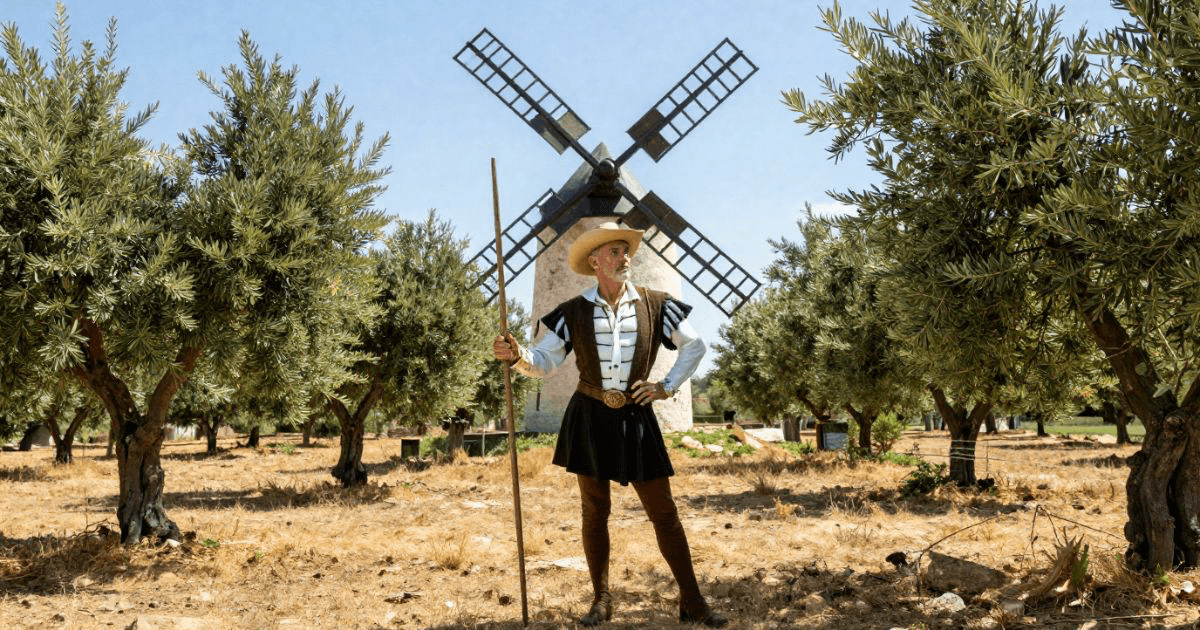
The most famous scene in all of literature: Don Quixote sees windmills and declares they are giants with arms two leagues long. Sancho, in what will become his eternal role, states the obvious: "What we see there are not giants but windmills." This is the perfect encapsulation of their dynamic—Quixote announces fantasy, Sancho points to reality, Quixote dismisses him as inexperienced in adventures. When Sancho identifies the sails as the parts "turned by the wind that make the millstone go," he's being perfectly literal and practical. But Quixote is so positive they're giants that "he neither heard the cries of Sancho, nor perceived, near as he was, what they were." This is the critical detail: he's not seeing windmills and imagining they're giants—he's actually perceiving giants. His brain has completed the perceptual transformation. A breeze starts the sails moving, and to Quixote this is the giants flourishing their many arms. He charges at full gallop with lance ready, commending himself to Dulcinea. The lance catches in the sail. The windmill's rotating power—designed to grind grain—instead shatters his lance and flings both horse and rider onto the ground. Sancho rushes over. Quixote can't move. Sancho delivers what should be the final reality check: "Did I not tell your worship to mind what you were about, for they were only windmills? And no one could have made any mistake about it but one who had something of the same kind in his head." Perfect diagnosis. But watch what Quixote does. Instead of admitting error, he immediately generates an explanation that preserves his narrative: the sage Friston (his magical enemy from Chapter 7) transformed the giants into windmills specifically to rob him of victory. The enchanter is so threatened by Quixote's power that he altered reality itself. What Sancho sees as obvious mistake, Quixote sees as magical sabotage. This introduces the pattern that will sustain the entire novel: Quixote will charge at reality, reality will win, Sancho will say "I told you so," and Quixote will explain it was enchantment. Then they continue. The chapter reveals that having a voice of reason present (Sancho) doesn't prevent disaster—it just provides commentary on it. Sancho is right about everything and it changes nothing. This is the eternal frustration of being the pragmatist attached to an idealist: you can see what's coming, you warn them, they ignore you, disaster happens, and somehow you're still there for the next round.

Coming Up in Chapter 9

From imaginary giants to a real opponent: Don Quixote will challenge a Biscayan squire to combat. This time his enemy has an actual sword and isn't playing along. And Cervantes will interrupt the battle with one of literature's most clever narrative devices.

Share it with friends

Previous ChapterNext Chapter
GO ADS FREE — JOIN US
Original text
complete·3,104 words

OF THE GOOD FORTUNE WHICH THE VALIANT DON QUIXOTE HAD IN THE TERRIBLE AND UNDREAMT-OF ADVENTURE OF THE WINDMILLS, WITH OTHER OCCURRENCES WORTHY TO BE FITLY RECORDED At this point they came in sight of thirty or forty windmills that there are on that plain, and as soon as Don Quixote saw them he said to his squire, “Fortune is arranging matters for us better than we could have shaped our desires ourselves, for look there, friend Sancho Panza, where thirty or more monstrous giants present themselves, all of whom I mean to engage in battle and slay, and with whose spoils we shall begin to make our fortunes; for this is righteous warfare, and it is God’s good service to sweep so evil a breed from off the face of the earth.”

“What giants?” said Sancho Panza.

“Those thou seest there,” answered his master, “with the long arms, and some have them nearly two leagues long.”

“Look, your worship,” said Sancho; “what we see there are not giants but windmills, and what seem to be their arms are the sails that turned by the wind make the millstone go.”

1 / 18

Master this chapter. Complete your experience

Purchase the complete book to access all chapters and support classic literature

Read Free on GutenbergBuy at Powell'sBuy on Amazon

As an Amazon Associate, we earn a small commission from qualifying purchases at no additional cost to you.

Available in paperback, hardcover, and e-book formats

GO ADS FREE — JOIN US

Why This Matters

Connect literature to life

Skill: Identifying Unfalsifiable Claims

This chapter teaches you to recognize when a belief has been structured so that no evidence can disprove it. If every challenge gets explained away, you're dealing with faith, not reason.

Practice This Today

This week, test your strong beliefs by asking: What evidence would prove me wrong? If the answer is 'nothing could change my mind' or 'any evidence against me is fake/corrupted,' you've made your belief unfalsifiable.

GO ADS FREE — JOIN US

Now let's explore the literary elements.

Key Quotes & Analysis

"What giants?"

— Sancho Panza

Context: Responding to Quixote's announcement about giants

Two words that encapsulate the entire novel. The perfect question from practical reality to pure delusion. Sancho isn't arguing or explaining—he's just asking for clarity about what Quixote claims to see. The question hangs in the air, unanswered in any meaningful way.

In Today's Words:

What are you even talking about?

"He was so positive they were giants that he neither heard the cries of Sancho, nor perceived, near as he was, what they were."

— Narrator

Context: Quixote charging the windmills despite warnings

This is the mechanism of closed-system belief. Not 'he disagreed with Sancho'—he literally couldn't hear him or perceive reality. When conviction is complete, contradictory information doesn't register at all. The brain blocks input that would challenge the belief.

In Today's Words:

He believed so strongly that he couldn't hear anyone telling him otherwise or see what was actually there.

"Did I not tell your worship to mind what you were about, for they were only windmills? And no one could have made any mistake about it but one who had something of the same kind in his head."

— Sancho Panza

Context: After Quixote crashes

Sancho delivers perfect diagnosis: you have windmills in your head, so you see windmills as giants. The internal state determines external perception. And he's saying this to someone lying injured on the ground as a direct consequence of that perceptual error. You'd think evidence this immediate would penetrate.

In Today's Words:

I warned you! They were obviously windmills! Only someone crazy would mistake them for giants!

"That same sage Friston who carried off my study and books, has turned these giants into mills in order to rob me of the glory of vanquishing them, such is the enmity he bears me."

— Don Quixote

Context: Explaining the windmill disaster

Instant narrative protection. Not 'I was wrong about the giants'—they WERE giants, but an enchanter transformed them. This explanation is genius because it's unfalsifiable: any evidence you were wrong becomes proof of magical opposition. Perfect delusion defense.

In Today's Words:

They WERE giants, but my magical enemy transformed them into windmills at the last second to make me look bad!

Thematic Threads

Identity

In This Chapter

Quixote's identity as knight requires him to see giants and charge them—the identity determines perception, not the other way around

Development

Reaching the point where identity completely overrides sensory input

In Your Life:

You might notice times when your identity (activist, victim, winner) determines what you see rather than what you see determining your identity

Class

In This Chapter

Sancho's practical peasant wisdom (they're windmills) versus Quixote's noble idealism (they're giants)—class shapes how you see the world

Development

The dynamic of practical lower-class realism versus upper-class fantasy

In Your Life:

You might notice how people from different economic backgrounds see the same situation completely differently

Social Expectations

In This Chapter

Quixote follows the expected knight script (charge at giants) even when all evidence says it's wrong—social role overrides individual judgment

Development

Showing how role expectations can make you act against your own interests

In Your Life:

You might recognize times when you did something stupid because your role/identity 'required' it

Personal Growth

In This Chapter

Zero learning—Quixote is injured charging windmills, blamed enchantment, and continues on ready for more adventures. The pattern is set.

Development

Demonstrating how unfalsifiable beliefs prevent any learning from experience

In Your Life:

You might notice patterns where you keep making the same mistake because you've built an explanation system that prevents you from seeing it as a mistake

GO ADS FREE — JOIN US

You now have the context. Time to form your own thoughts.

Discussion Questions

  1. 1

    What exactly does Don Quixote see when he looks at the windmills, according to the text?

    analysis • surface
  2. 2

    Why can't Quixote hear Sancho's warnings even though Sancho is right next to him shouting?

    analysis • medium
  3. 3

    How does Quixote's enchanter explanation make his belief unfalsifiable—impossible to disprove?

    analysis • deep
  4. 4

    Have you ever been in Sancho's position—clearly seeing what's coming and unable to stop someone from doing it anyway?

    reflection • medium
  5. 5

    How do you know if you're fighting real giants or just tilting at windmills? What's the test?

    application • deep

Critical Thinking Exercise

10 minutes

Falsifiability Test

Choose a belief you hold strongly—political, personal, professional, or spiritual. Write it down clearly. Then write: 'I would know this belief is wrong if I observed: ___________.' Fill in the blank with specific, observable evidence that would disprove your belief. If you can't think of anything, or if every example you think of can be explained away, your belief is unfalsifiable. That doesn't make it wrong—but it means you're not reasoning about it, you're having faith in it.

Consider:

  • •Be specific—'evidence would have to show X' not vague 'if it turned out to be wrong'
  • •Notice if you immediately think of reasons why that evidence would be fake or manipulated
  • •Ask whether you're actually open to being wrong or just going through this exercise

Journaling Prompt

Write about a time when you realized you were wrong about something you'd defended strongly. What evidence finally got through? What made you able to admit error? What would have had to be different for you to recognize it sooner?

GO ADS FREE — JOIN US

Coming Up Next...

Chapter 9: The Manuscript Trick

From imaginary giants to a real opponent: Don Quixote will challenge a Biscayan squire to combat. This time his enemy has an actual sword and isn't playing along. And Cervantes will interrupt the battle with one of literature's most clever narrative devices.

Continue to Chapter 9
Previous
The Enchanter's Revenge
Contents
Next
The Manuscript Trick

Continue Exploring

Don Quixote Study GuideTeaching ResourcesEssential Life IndexBrowse by ThemeAll Books
Identity & Self-DiscoveryMoral Dilemmas & EthicsLove & Relationships

You Might Also Like

Jane Eyre cover

Jane Eyre

Charlotte Brontë

Explores identity & self

Great Expectations cover

Great Expectations

Charles Dickens

Explores identity & self

The Strange Case of Dr Jekyll and Mr Hyde cover

The Strange Case of Dr Jekyll and Mr Hyde

Robert Louis Stevenson

Explores identity & self

The Odyssey cover

The Odyssey

Homer

Explores identity & self

Browse all 47+ books
GO ADS FREE — JOIN US

Share This Chapter

Know someone who'd enjoy this? Spread the wisdom!

TwitterFacebookLinkedInEmail

Read ad-free with Prestige

Get rid of ads, unlock study guides and downloads, and support free access for everyone.

Subscribe to PrestigeCreate free account
Intelligence Amplifier
Intelligence Amplifier™Powering Wide Reads

Exploring human-AI collaboration through books, essays, and philosophical dialogues. Classic literature transformed into navigational maps for modern life.

2025 Books

→ The Amplified Human Spirit→ The Alarming Rise of Stupidity Amplified→ San Francisco: The AI Capital of the World
Visit intelligenceamplifier.org
hello@widereads.com

WideReads Originals

→ You Are Not Lost→ The Last Chapter First→ The Lit of Love→ Wealth and Poverty→ 10 Paradoxes in the Classics · coming soon
Arvintech
arvintechAmplify your Mind
Visit at arvintech.com

Navigate

  • Home
  • Library
  • Essential Life Index
  • How It Works
  • Subscribe
  • Account
  • About
  • Contact
  • Authors
  • Suggest a Book
  • Landings

Made For You

  • Students
  • Educators
  • Families
  • Readers
  • Literary Analysis
  • Finding Purpose
  • Letting Go
  • Recovering from a Breakup
  • Corruption
  • Gaslighting in the Classics

Newsletter

Weekly insights from the classics. Amplify Your Mind.

Legal

  • Privacy Policy
  • Terms of Service
  • Cookie Policy
  • Accessibility

Why Public Domain?

We focus on public domain classics because these timeless works belong to everyone. No paywalls, no restrictions—just wisdom that has stood the test of centuries, freely accessible to all readers.

Public domain books have shaped humanity's understanding of love, justice, ambition, and the human condition. By amplifying these works, we help preserve and share literature that truly belongs to the world.

A Pilgrimage

Powell's City of Books

Portland, Oregon

If you ever find yourself in Portland, walk to the corner of Burnside and 10th. The building takes up an entire city block. Inside is over a million books, new and used on the same shelf, organized by color-coded rooms with names like the Rose Room and the Pearl Room. You can lose an afternoon. You can lose a weekend. You will find a book you have been looking for your whole life, and three you did not know existed.

It is a pilgrimage. We cannot find a bookstore like it anywhere on earth. If you read the classics, and you ever get the chance, go. It belongs on every reader's bucket list.

Visit powells.com

We are not in any way affiliated with Powell's. We are just a very big fan.

© 2026 Wide Reads™. All Rights Reserved.

Intelligence Amplifier™ and Wide Reads™ are proprietary trademarks of Arvin Lioanag.

Copyright Protection: All original content, analyses, discussion questions, pedagogical frameworks, and methodology are protected by U.S. and international copyright law. Unauthorized reproduction, distribution, web scraping, or use for AI training is strictly prohibited. See our Copyright Notice for details.

Disclaimer: The information provided on this website is for general informational and educational purposes only and does not constitute professional, legal, financial, or technical advice. While we strive to ensure accuracy and relevance, we make no warranties regarding completeness, reliability, or suitability. Any reliance on such information is at your own risk. We are not liable for any losses or damages arising from use of this site. By using this site, you agree to these terms.