
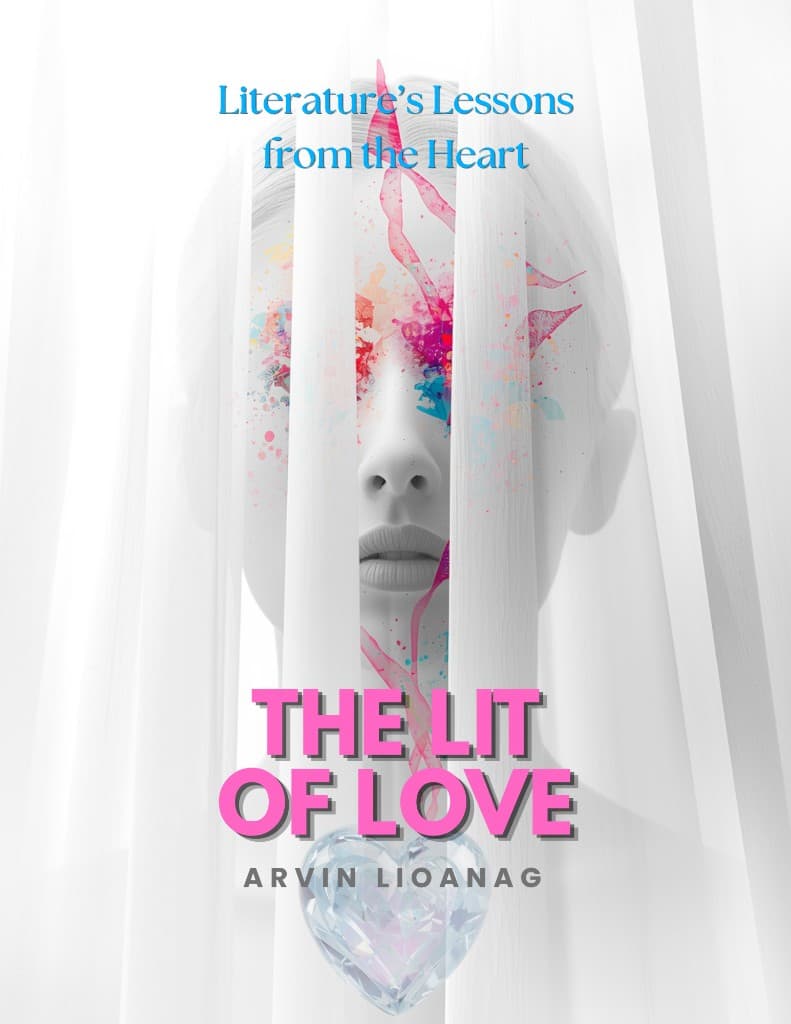
Book Three
Understanding Love Through the Greatest Stories Ever Told
Through literature, love lasts.
by Arvin Lioanag
“You have loved badly.”— The Lit of Love, opening line
About This Book
This is not a manual. Not for romance, not for breakups, not for the management of a relationship. Those books assume you already know what love is, and only need a method. Most of us do not. We inherited one word for a whole country of the heart, then treated the word as if it were a technique.
What follows is an explanation of the thing itself, the all of love. Not the dating plot we have mistaken for the whole, but the full range the classics never collapsed — desire and friendship, kinship and charity, the love of self and the love that outlasts the first fire. Romance is one room in that house. It is not the house.
Lit means three things. Literature: the canon that has lasted because it tells truths that remain true. Illumination: the flash when darkness lifts and you see what was always there. Permanence: the claim that organizes everything, which is that through literature, love lasts.
A definition cannot hold the all of love. A story can. Philosophy names the kinds; the novel puts a body in each of them and lets you watch what happens. You see desire climb from a face to a soul, and you see it curdle into possession. You see friendship outrank romance, then become the form romance must take if it intends to last. You see kinship grow from nearness rather than blood, charity remake the one who receives it, self-love become either a foundation or a prison. Literature does not tell you what to do with a person. It shows you the thing itself, from every room in the house, until the single word we inherited starts to mean what it always meant.
That is why the old books still work. Customs change. The arranged match, the courtship letter, the dating app. The heart beneath them does not. Desire, jealousy, the fear of being seen, the ache of words unspoken. These are not period costume. Literature carries love across centuries — love letters from the dead to the living — and in the same motion it teaches which loves endure within a single life and which destroy. The classics are not advice. They are the instruments by which we learn what love is.
The Seven Loves
Our moment reserves the word love almost exclusively for romance. The classical tradition named several, and watching how each survives, or fails to, is how the argument for permanence is made. The loves bound to sensation or convenience fade when the sensation does; the loves fixed on the person endure.
Eros
ἔρως
Desire that awakens, and the illusions that wear its face
Romantic love at its first fire. Attraction, recognition, the climb from body to soul. The classics teach that eros lasts only when it grows beyond intensity into attention, courage, and self-command. They show, without flinching, what happens when it becomes possession, fever, or fantasy instead.
Darcy & Elizabeth · Anna · Heathcliff · Wentworth
Philia
φιλία
Friendship, the love the ancients ranked highest
The bond of character, not convenience. Aristotle held that without friends no one would choose to live; Montaigne could explain his love only as “because it was he, because it was I.” The book’s quiet claim is that the romances that endure are the ones in which the lover and the friend become the same person.
Aristotle · Montaigne · Seneca · Darcy & Elizabeth
Storge
στοργή
The love of the familiar. Blood, kinship, and chosen family
Affection that grows from nearness and time, not from admiration. It asks for no qualifications and attaches itself to what is given, or to what we slowly make given. Blood proposes; kinship confirms; chosen family proves the mechanism was never about blood in the first place.
Little Women · King Lear · Valjean & Cosette
Agape
ἀγάπη
Charity that asks nothing and remakes the one who receives it
Love aimed outward at the stranger, the undeserving, the one who cannot repay. Dickens names its ripple; Dostoevsky names its cost: “Love in action is a harsh and dreadful thing compared with love in dreams.” Of all the loves, it is the least contingent, and the nearest to permanence.
Scrooge · Bishop Myriel · Sonia · Zossima
Philautia
φιλαυτία
Self-love, the foundation or the prison
The Greeks knew this inward turn could go two ways. Corrupt, it is Narcissus and Dorian, the face preserved downstairs while the ledger rots in the attic, beauty without biography, permanence without love. Healthy, it is Jane Eyre’s “I care for myself,” a self-respect that frees you to love without needing to possess or be possessed. The one relationship no one can leave.
Dorian Gray · Jane Eyre · Emerson · Epictetus
Pragma
πρᾶγμα
Weathered devotion, love re-chosen on ordinary days
Beyond the first fire, fidelity sustained not by feeling but by attention. Anne and Wentworth after eight years of loss; the long marriages of War and Peace and Middlemarch. The least glamorous love, and the most demanding, since it must be practiced when no lightning strikes.
Persuasion · War and Peace · Middlemarch
Transcendent
τὸ καλόν
Love turned toward the whole. Beauty, fate, the good itself
At the summit of Plato’s ladder, love ascends beyond any particular person toward Beauty itself. Contemplation, devotion, amor fati, the acceptance that lets us love more fully because it will end. The final counsel is not argument but practice. Waste no more time deciding what love should be. Love.
Plato · Marcus Aurelius · Teresa of Ávila
Contents
PART ONE
THE LIT OF LOVE
LITERATURE, ILLUMINATION, PERMANENCE
PART TWO
EROS
THE AWAKENING AND ITS ILLUSIONS
PART THREE
PHILIA
THE LOVE WE UNDERRATE
PART FOUR
STORGE
BLOOD, KINSHIP, AND CHOSEN FAMILY
PART FIVE
AGAPE
THE LOVE THAT ASKS NOTHING
PART SIX
PHILAUTIA
THE LOVE OF SELF
PART SEVEN
PRAGMA AND THE TRANSCENDENT
THE LOVE THAT LASTS