Wide Reads
Literature MattersLife IndexEducators
Sign in
Where to Begin

The Adventure of the Lions — Don Quixote

Don Quixote - The Adventure of the Lions

Miguel de Cervantes Saavedra

Don Quixote

The Adventure of the Lions

Home›Books›Don Quixote›Chapter 69: The Adventure of the Lions
Previous
69 of 126
Next

Analysis by the Wide Reads editorial team·Reviewed against the source text·Updated December 3, 2025

Summary

The Adventure of the Lions

Don Quixote by Miguel de Cervantes Saavedra

0:000:00
Listen to Next Chapter

When Don Quixote calls for his helmet, Sancho is buying curds from shepherds and, not knowing where else to put them, pours them into the helmet before handing it over. Quixote thrusts it on in haste, and whey runs down his face until he discovers the white mash and roars that Sancho has filled his helmet with curds. Sancho blames enchanters who persecute him as a limb of his master, and Diego de Miranda watches the scene with growing amazement.

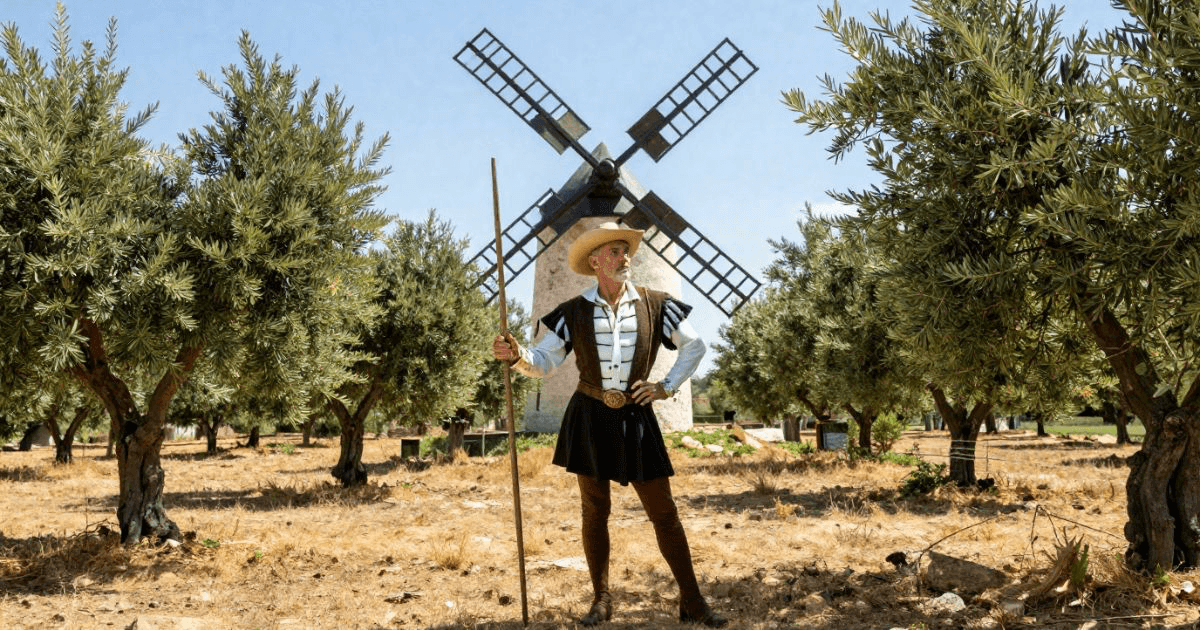
A cart flying royal flags approaches, carrying caged lions bound as a gift from the governor of Oran to the King. Diego assumes it is royal treasure; Quixote treats it as adventure summoned for him alone. He orders the keeper to open the cages and turn the beasts loose in the plain, saying he is ready to try conclusions with Satan himself. Diego urges knightly prudence; Sancho weeps and points through the bars to the paw of a real lion bigger than a mountain. The carter unyokes his mules, everyone flees, and Quixote dismounts to fight on foot rather than risk Rocinante's panic.

The narrator breaks into praise of Quixote standing alone with a plain sword before Africa's fiercest lions. The keeper opens the first cage under protest; the enormous lion stretches, yawns, looks around, then turns its hind-quarters to Quixote and lies down again. Quixote demands the keeper provoke it; the keeper refuses. Quixote accepts the victory of having challenged his enemy and waited on the field, then has the event certified and signals the fugitives back with the cloth he used to wipe off the curds.

Sancho learns the lion never came out; Quixote declares enchantments cannot prevail against true valour and renames himself the Knight of the Lions. Diego, who has not read the printed first part of the history, decides Quixote is by turns rational and mad. Quixote answers with a long defense of knight-errantry and valour as the virtue between cowardice and temerity, arguing it is better to lose by a card too many than by one too few. Diego finds the speech proved by reason itself, and by two in the afternoon they reach his village.

In this chapter: Terms Characters Key Quotes Themes Modern Story

Why This Matters

Connect literature to life

Skill: Reading Courage That Outruns the Danger

Some people do not step aside when a flagged cart of lions approaches, even if curds are running down their faces and every sane companion begs them to stop. Don Quixote opens the argument, survives because the lion turns its back and lies down, and renames himself the Knight of the Lions while Diego de Miranda tries to decide whether he is mad or brilliantly rational. See when courage becomes performance, when anticlimax still counts as victory, and when a new name matters more than the fight you expected.

Coming Up in Chapter 70

At Don Diego's village house, wine jars from El Toboso remind Don Quixote of Dulcinea, and the Knight of the Green Gaban welcomes his strange guest indoors.

Share it with friends

PreviousPrevious ChapterNextNext Chapter
Original text
4,095 wordscomplete

Chapter 69

The Adventure of the Lions

WHEREIN IS SHOWN THE FURTHEST AND HIGHEST POINT WHICH THE UNEXAMPLED COURAGE OF DON QUIXOTE REACHED OR COULD REACH; TOGETHER WITH THE HAPPILY ACHIEVED ADVENTURE OF THE LIONS The history tells that when Don Quixote called out to Sancho to bring him his helmet, Sancho was buying some curds the shepherds agreed to sell him, and flurried by the great haste his master was in did not know what to do with them or what to carry them in; so, not to lose them, for he had already paid for them, he thought it best to throw them into his…

Public-domain chapter text, formatted for reading.

Master this chapter. Complete your experience

Purchase the complete book to access all chapters and support classic literature

Buy at Powell'sBuy on Amazon

Available in paperback, hardcover, and e-book formats

Now let's explore the literary elements.

Key Quotes & Analysis

"He who is prepared has his battle half fought; nothing is lost by my preparing myself, for I know by experience that I have enemies, visible and invisible"

— Don Quixote

Context: Dismissing Don Diego's guess that the flagged cart carries treasure

Quixote treats every road object as a summons to arms before he knows what it carries.

In Today's Words:

Ready is half the fight. I have seen visible and invisible enemies before The same dynamic turns up in offices, relationships, and public life today, wherever someone bends circumstances to fit a story they cannot put down The same dynamic turns up in offices, relationships, and public life today, wherever someone bends circumstances to fit

"By the life of my lady Dulcinea del Toboso, but it is curds thou hast put here, thou treacherous, impudent, ill-mannered squire!"

— Don Quixote

Context: After discovering Sancho's curds crushed inside his helmet

The chapter opens with comedy that will collide with Quixote's gravest display of courage.

In Today's Words:

Dulcinea save me, you put curds in my helmet, you impossible squire The same dynamic turns up in offices, relationships, and public life today, wherever someone bends circumstances to fit a story they cannot put down The same dynamic turns up in offices, relationships, and public life today, wherever someone bends circumstances to fit a

"between the bars and chinks of the cage I have seen the paw of a real lion, and judging by that I reckon the lion such a paw could belong to must be bigger than a mountain."

— Sancho Panza

Context: Begging Don Diego to stop his master before the cages open

Sancho uses plain evidence while Quixote converts fear into duty.

In Today's Words:

I saw a real lion's paw through the bars. That beast is bigger than a mountain The same dynamic turns up in offices, relationships, and public life today, wherever someone bends circumstances to fit a story they cannot put down The same dynamic turns up in offices, relationships, and public life today, wherever someone bends

"you must say THE KNIGHT OF THE LIONS; for it is my desire that into this the name I have hitherto borne of Knight of the Rueful Countenance be from this time forward changed"

— Don Quixote

Context: Instructing the keeper how to report the exploit to the King

Quixote renames himself from the exploit, turning waiting into heraldic fame.

In Today's Words:

Tell the King I am the Knight of the Lions now, not the Knight of the Rueful Countenance The same dynamic turns up in offices, relationships, and public life today, wherever someone bends circumstances to fit a story they cannot put down The same dynamic turns up in offices, relationships, and public life today, wherever

Thematic Threads

When You Refuse to Step Aside

In This Chapter

When Don Quixote calls for his helmet, Sancho is buying curds from shepherds and, not knowing where else to put them, pours them into the helmet before...

Development

This chapter pushes the pattern into visible action and consequence.

In Your Life:

You may recognize this pattern when stress removes the polite version of a situation.

Identity

In This Chapter

Characters defend who they are or who they pretend to be when challenged.

Development

Fantasy and reality collide around name, rank, and role.

In Your Life:

You might cling to a version of yourself that no longer matches your choices.

Class

In This Chapter

Rank, money, and reputation decide who is heard, protected, or punished.

Development

Social order shapes every rescue, betrayal, and humiliation here.

In Your Life:

You see this when status decides whose account of events becomes official.

You now have the context. Time to form your own thoughts.

Discussion Questions

This is not a test. Five prompts guide you through the chapter, from how it opens to how it closes, so you notice context and rhythm rather than facts to memorize. Sit with each question in your own words. When you see "One way to read it," treat it as a starting point, not the only answer.

  1. 1

    When Don Quixote discovers curds in his helmet, why does Sancho blame enchanters rather than admit his mistake?

    ▶One way to read it

    Sancho knows his master believes in enchanters and magic, so blaming them protects him from punishment while fitting Quixote's worldview.

    analysis • surface
  2. 2

    Why does Cervantes have the lion simply turn around and lie down instead of attacking or fleeing?

    ▶One way to read it

    The lion's indifference deflates the heroic moment while still allowing Quixote to claim victory, showing how reality rarely matches our dramatic expectations.

    analysis • medium
  3. 3

    Where do you see people today refusing to back down from unnecessary confrontations like Quixote with the lions?

    ▶One way to read it

    Social media arguments, workplace disputes, or family feuds where people escalate conflicts that could easily be avoided or ignored.

    application • medium
  4. 4

    How might someone apply Quixote's philosophy that it's better to lose by a card too many than too few?

    ▶One way to read it

    Taking risks in career moves, relationships, or creative projects rather than playing it safe and regretting missed opportunities later.

    application • deep
  5. 5

    What does Quixote's renaming himself Knight of the Lions reveal about how we construct our identities?

    ▶One way to read it

    We often define ourselves by our most dramatic moments rather than everyday reality, choosing the stories that make us feel heroic.

    reflection • deep

Critical Thinking Exercise

10 minutes

Name the When You Refuse to Step Aside Move

Re-read the chapter summary and write down where when you refuse to step aside first appears, who pays for it, and who benefits from keeping it going. Then write one sentence you could say to interrupt the pattern without shaming the person caught in it.

Consider:

  • •Separate the person's worth from the pattern's cost
  • •Notice who has power to stop or fuel the scene
  • •Ask what truth would require someone to give up

Journaling Prompt

Write about a time when you saw when you refuse to step aside in your own life. What finally made the pattern impossible to ignore?

Coming Up Next...

Chapter 70: The House of the Green Gaban

At Don Diego's village house, wine jars from El Toboso remind Don Quixote of Dulcinea, and the Knight of the Green Gaban welcomes his strange guest indoors.

Continue to Chapter 70
Previous
The Discreet Gentleman of La Mancha
Contents
Next
The House of the Green Gaban
Keep exploring

Continue Exploring

Study guides, teaching tools, themes, and the full library.More ways to read Don Quixote: study guides, teaching tools, and the wider library.

  • Don Quixote Study Guide
  • Teaching Resources
  • Essential Life Index
  • Browse by Theme
  • All Books

Life-skill deep dives in Don Quixote

  • ChivalryExplore how Don Quixote examines what happens when outdated codes of honor meet modern reality—and what remains valuable.
  • FriendshipExplore how the friendship between Don Quixote and Sancho Panza reveals what true companionship means across differences.
  • Idealism vs RealityExplore how Don Quixote teaches the tension between noble ideals and practical reality—when to hold onto your vision and when to adapt.
  • Living Inside a NarrativeExplore Part II
  • Madness and SanityExplore how Don Quixote blurs the line between madness and sanity—questioning who truly sees the world more clearly.
  • The Power of StoriesExplore how Don Quixote reveals how stories shape identity, reality, and action—for better and worse.
Identity & Self-DiscoveryMoral Dilemmas & EthicsLove & Relationships

You Might Also Like

The Blue Castle cover

The Blue Castle

L. M. Montgomery

Explores identity & self

The Strange Case of Dr Jekyll and Mr Hyde cover

The Strange Case of Dr Jekyll and Mr Hyde

Robert Louis Stevenson

Explores identity & self

Emma cover

Emma

Jane Austen

Explores identity & self

Evelina, Or, the History of a Young Lady's Entrance into the World cover

Evelina, Or, the History of a Young Lady's Entrance into the World

Fanny Burney

Explores identity & self

Browse all 106+ books

Share This Chapter

Know someone who'd enjoy this? Spread the wisdom!

TwitterFacebookLinkedInEmail

Go further with Prestige

Unlock study guides and downloads, early access, and exclusive content — and support free access for everyone.

Subscribe to PrestigeCreate free account
Intelligence Amplifier
Intelligence Amplifier™Powering Wide Reads

Exploring human-AI collaboration through books, essays, and philosophical dialogues. Classic literature transformed into navigational maps for modern life.

2025 Books

→ The Amplified Human Spirit→ The Alarming Rise of Stupidity Amplified→ San Francisco: The AI Capital of the World
Visit intelligenceamplifier.org
hello@widereads.com

WideReads Originals

→ You Are Not Lost→ The Last Chapter First→ The Lit of Love→ Wealth and Poverty→ Wisdom for the Wounded
Arvintech
arvintechAmplify your Mind
Visit at arvintech.com

Navigate

  • Home
  • Library
  • Essential Life Index
  • How It Works
  • Subscribe
  • Account
  • About
  • Contact
  • Authors
  • Suggest a Book
  • Landings

Made For You

  • Trending
  • Students
  • Educators
  • Families
  • Readers
  • Literary Analysis
  • Finding Purpose
  • Letting Go
  • Recovering from a Breakup
  • Corruption
  • Gaslighting in the Classics

Newsletter

Weekly insights from the classics. Amplify Your Mind.

Legal

  • Privacy Policy
  • Terms of Service
  • Editorial Standards
  • Cookie Policy
  • Accessibility

Why Public Domain?

We focus on public domain classics because these timeless works belong to everyone. No paywalls, no restrictions—just wisdom that has stood the test of centuries, freely accessible to all readers.

Public domain books have shaped humanity's understanding of love, justice, ambition, and the human condition. By amplifying these works, we help preserve and share literature that truly belongs to the world.

A Pilgrimage

Powell's City of Books

Portland, Oregon

If you ever find yourself in Portland, walk to the corner of Burnside and 10th. The building takes up an entire city block. Inside is over a million books, new and used on the same shelf, organized by color-coded rooms with names like the Rose Room and the Pearl Room. You can lose an afternoon. You can lose a weekend. You will find a book you have been looking for your whole life, and three you did not know existed.

It is a pilgrimage. We cannot find a bookstore like it anywhere on earth. If you read the classics, and you ever get the chance, go. It belongs on every reader's bucket list.

Visit powells.com

We are not in any way affiliated with Powell's. We are just a very big fan.

© 2026 Wide Reads™. All Rights Reserved.

Intelligence Amplifier™ and Wide Reads™ are proprietary trademarks of Arvin Lioanag.

Copyright Protection: All original content, analyses, discussion questions, pedagogical frameworks, and methodology are protected by U.S. and international copyright law. Unauthorized reproduction, distribution, web scraping, or use for AI training is strictly prohibited. See our Copyright Notice for details.

Disclaimer: The information provided on this website is for general informational and educational purposes only and does not constitute professional, legal, financial, or technical advice. While we strive to ensure accuracy and relevance, we make no warranties regarding completeness, reliability, or suitability. Any reliance on such information is at your own risk. We are not liable for any losses or damages arising from use of this site. By using this site, you agree to these terms.