
Don Quixote
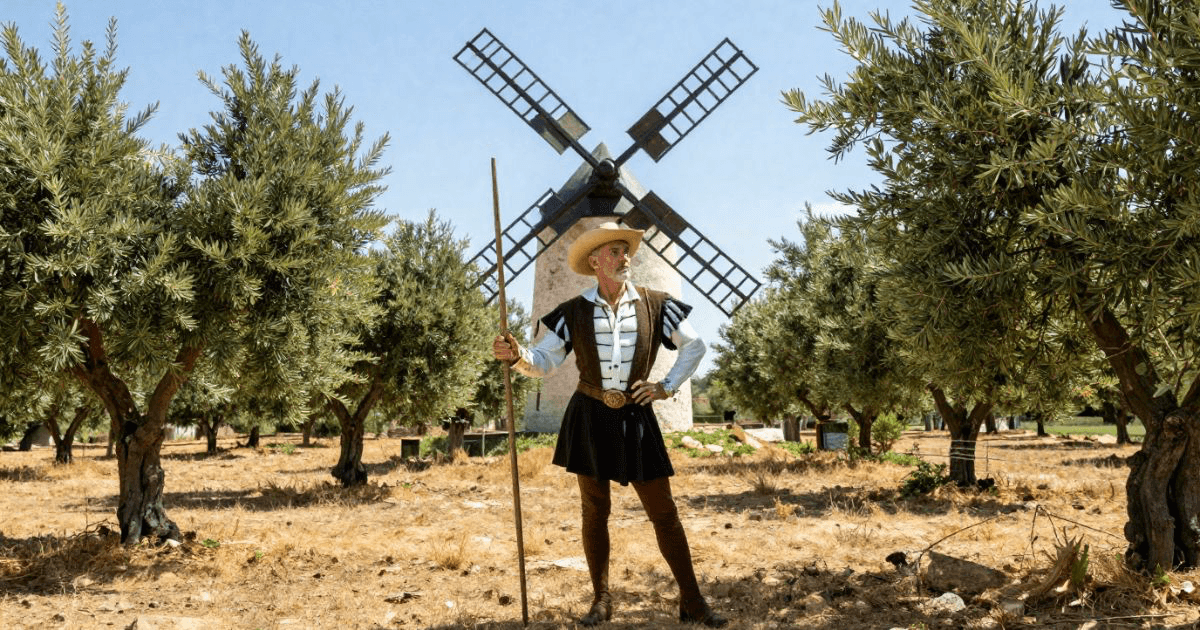
Don Quixote
A Brief Description
Alonso Quixano is a quiet gentleman in La Mancha until chivalry books take over his life. He sells land for more volumes, loses sleep over their ornate prose, and renames himself Don Quixote de la Mancha. Convinced the world still needs knights-errant, he cleans rusted armor, names his horse Rocinante, invents a lady called Dulcinea del Toboso, and rides out before reality has voted on the plan. Sancho Panza, a practical peasant lured by promises of governing an island, becomes his squire.
The novel runs on one collision repeated a hundred ways: Quixote reads the world through a story he cannot put down, and the world answers with bruises, laughter, and occasional awe. Windmills become giants. Inns become castles. Sancho's hunger and common sense keep grounding the quest while his master keeps elevating it. By Part II, published a decade later in 1615, Quixote is already famous. Other people have read about him. Then the book turns meta: fiction imitated in life, life rewritten into fiction, cruelty and tenderness arriving side by side.
Defeat, return home, illness, and death close the arc, but Cervantes never lets you pick one label. Was Quixote mad? Noble? Both at once? Wide Reads follows all 126 chapters through that question, with Daniel, a former corporate lawyer turned public defender, as the modern thread: a man who gave up wealth to fight windmills in the justice system and must learn whether idealism is courage or delusion when the cases will not bend to his script.
Essential Life Skills Deep Dive
Explore chapter-by-chapter breakdowns of the essential life skills taught in this classic novel.
Idealism vs Reality
9 chapters exploring the tension between noble ideals and practical reality—when to hold onto your vision and when to adapt.
Madness and Sanity
10 chapters blurring the line between madness and sanity—questioning who truly sees the world more clearly.
The Power of Stories
10 chapters revealing how stories shape identity, reality, and action—for better and worse.
Friendship
10 chapters showing the evolution of Don Quixote and Sancho Panza's friendship—true companionship across differences.
Essential Skills
Life skills and patterns this book helps you develop—drawn from its themes and characters.
Detecting Story-Driven Delusion
Notice when deep narrative immersion starts rewriting what you treat as real, as Quixote does from his first night of chivalry reading.
Balancing Idealism and Pragmatism
Hold Quixote's vision and Sancho's earthiness in tension instead of choosing one as the only sane option.
Reading Appearance vs Reality
Track how Quixote turns inns into castles and ordinary life into enchantment, and ask what your own filters add.
Loyal Friendship Under Absurdity
Learn from Sancho's willingness to stay with Quixote through ridicule, beatings, and promises that never arrive on schedule.
When Noble Intentions Miss the Target
See how Quixote's hunger to right wrongs can still leave real people hurt when the script matters more than the scene.
Living Inside a Narrative
Follow Part II's metafiction as Quixote becomes famous for a story others have already read, and ask when your own role is performance.
Table of Contents
The Birth of a Delusion
A gentleman bordering on fifty lives quietly in an unnamed village of La Mancha until chivalry books...
The First Sally
Don Quixote slips out before dawn through the back door, armor on, Rocinante saddled, convinced the ...
The Mock Knighting
After supper Quixote kneels before the innkeeper in the stable and refuses to rise until he is dubbe...
Intervention and Defeat
At dawn Quixote leaves the inn thrilled to be a knight and turns toward home to fetch money, shirts,...
Coming Home Broken
Unable to rise after the beating, Quixote reaches for his usual remedy: a story from his books. The ...
The Book Burning
While Don Quixote sleeps, the curate, barber, housekeeper, and niece enter the library that poisoned...
The Enchanter's Revenge
Don Quixote wakes shouting about a tourney and stops the curate's scrutiny mid-sentence. That night ...
Tilting at Windmills
On the plain Don Quixote sees windmills and announces thirty monstrous giants. Sancho names them pla...
The Manuscript Trick
The chapter opens where Part One left off: Quixote and the Biscayan frozen mid-swing, then the narra...
The First Real Conversation
Sancho rises bruised from the muleteers' beating and kneels for the island Don Quixote promised. Qui...
The Golden Age Speech
The goatherds welcome Don Quixote and Sancho with salted goat, cheese, acorns, and wine. Quixote ins...
The Story of Marcela
A messenger brings news from the village: the student-shepherd Chrysostom has died, rumoured of love...
Sancho's Rise to Power
At dawn the goatherds rouse Don Quixote for Chrysostom's burial. On the road they meet mourning shep...
Chrysostom's Verses and Marcela's Entrance
Vivaldo reads Chrysostom's Lay of Despair aloud: jealousy, tyranny, and a stanza where the dead man ...
The Yanguesan Beating
After the funeral Don Quixote searches the wood for Marcela in vain, then he and Sancho rest by a st...
Maritornes and the Blanketing
Need can rewrite what your hands report before your mind admits the gap. Don Quixote arrives battere...
The Enchanted Moor and the Balsam
Once a story owns you, every bruise can look like enchantment and every vomit like a cure. Don Quixo...
When Reality Crashes Down
Sancho's body can keep a ledger even when his master keeps rewriting the story. Reaching Quixote aft...
Sancho on Broken Vows and a Dead Body
Sancho can blame the ledger on a broken oath when the bruises keep matching the same pattern. He tel...
The Pounding Hammers
Fear turns a fulling mill into an epic before dawn proves otherwise. Thirsty after eating the dead m...
Mambrino's Helmet
Rename the evidence sharply enough and you can wear your delusion on your head. Avoiding the fulling...
Freeing the Galley Slaves
Mercy without judgment can rob the people you meant to rescue. Quixote meets a chained file of galle...
Into the Sierra Morena
Every act of mercy can bill you twice: once on the road and again in the hills. After the galley-sla...
Cardenio's Story Continues
The listener who breaks a promise can stop the wound from finishing its sentence. Cardenio eats, ask...
Don Quixote's Mad Penance
Sancho finally gets leave to speak and asks why Quixote interrupted Cardenio over Queen Madasima whe...
The Lost Letter on the Road
Alone on the rock, Quixote chooses Amadis's weeping over Roland's wreckage, tears a strip from his s...
Cardenio's Story Ends at "I Will"
The curate and barber dress as damsel and squire, swap roles when the priest blushes at the costume,...
Dorothea in the Sierra
The curate is about to comfort Cardenio when a woman's voice asks the mountains to be her grave. The...
Princess Micomicona Lures Quixote Home
Dorothea ends her tale and asks only for a place to hide, not empty comfort. The curate offers his v...
Dorothea's Address and Pandafilando
The curate's probe about the galley slaves makes Sancho confess and Quixote defend freeing criminals...
Sancho's Dulcinea Report and Andres Returns
Quixote presses Sancho for every detail of the visit to Dulcinea, and Sancho keeps spinning a lie he...
Back at the Inn: Books the Landlord Defends
The party reaches the inn Sancho dreads, and Quixote goes straight to the garret to sleep while the ...
The Ill-Advised Curiosity Begins
In Florence, Anselmo and Lothario are so close that everyone calls them "The Two Friends," until Ans...
Camilla's Closet and the Hoodwinked Husband
Camilla's letter to absent Anselmo compares a wife without her husband to an army without its genera...
Wine-Skins, a Giant's Head, and Anselmo's End
The curate is finishing the novel when Sancho bursts in shouting that Don Quixote has beheaded the M...
The Veiled Riders and Dorothea's Reckoning
Veiled riders arrive at the inn and Dorothea covers her face while Cardenio hides in Quixote's room....
Sancho's Grief and the Captive's Moor
Everyone at the inn celebrates the reconciled lovers while Sancho alone mourns: his county dream is ...
Arms Versus Letters and the Captive's Promise
Don Quixote continues his supper speech on arms and letters by turning to the soldier's poverty: mis...
The Captive's Life from Leon to the Oar
The captive begins in Leon with a prodigal soldier father who divides his estate among three sons an...
Zoraida's Letters and the Escape Plot
Don Fernando recites two sonnets on the fallen Goletta and fort, and the captive, glad for news of h...
The Escape, the Corsairs, and Velez Malaga
The renegade buys a vessel for more than thirty souls and legitimates it with repeated fig runs to S...
The Judge, the Brother, and the Curate's Tale
The captive ends his tale and Don Fernando wishes it could begin again tomorrow. Night brings a Judg...
The Muleteer's Song and the Halter Trap
The muleteer's song continues at dawn, and Dorothea wakes the Judge's daughter Clara so she will not...
Don Luis, the Landlord, and Mambrino's Basin
Maritornes cuts Don Quixote down from the halter, and he gallops off challenging anyone who says he ...
The Helmet Vote, the Inn Brawl, and the Warrant
The basin dispute resumes, and the inn's own barber joins the joke, swearing the piece is no barber'...
Peace at the Inn and the Ox-Cart Cage
The curate persuades the Holy Brotherhood officers that Don Quixote is mad and not worth arresting f...
The Ox-Cart Enchantment and the Canon's Verdict
Caged on an ox-cart, Don Quixote complains that real enchantments should move by cloud, chariot, or ...
The Canon on Plays and Sancho's Test
The canon tells the curate he once drafted more than a hundred sheets of a chivalry romance that obe...
Sancho's Trap and the Canon's Plea
Sancho springs the trap from the last chapter: village wisdom says the enchanted neither eat, drink,...
Licensed Romances and the Goatherd's Promise
Don Quixote answers the canon's skepticism with royal licences, universal praise, and day-by-day tru...
Leandra, the Soldier, and the Pastoral Exiles
The goatherd Eugenio tells how Leandra, a rich farmer's dazzling daughter, kept two worthy suitors, ...
The Penitents, the Cart Home, and Part One's End
Pleased by Eugenio's tale, Don Quixote offers to storm the convent and free Leandra. The goatherd ca...
About Miguel de Cervantes Saavedra
Published 1605
Miguel de Cervantes (1547-1616) lived the kind of life that makes you wonder whether he invented Don Quixote or lived it first. Born in Alcalá de Henares to a family perpetually short of money, he grew up watching noble ideals collide with empty pockets. At 23, he fled Spain after wounding a man in a duel and joined the Spanish navy in Italy. He fought at the Battle of Lepanto in 1571, taking three gunshot wounds and losing the use of his left hand. Fellow soldiers called him el manco de Lepanto, the one-handed man of Lepanto, and he wore the name like a badge.
What followed was worse than war. Pirates captured his ship on the return voyage, and Cervantes spent five years enslaved in Algiers. He led four escape attempts that should have earned execution. Prisoners looked to him for courage and order. When a ransom finally bought his freedom in 1580, he returned to Spain expecting a hero's welcome. He got clerical jobs, tax collection, bankruptcy, and a stint in prison over disputed accounts.
For twenty years he chased commissions, wrote plays that mostly failed, and watched Spain's golden age ignore a soldier who had given it everything. That gap between heroic past and humdrum present is where Don Quixote was born: a man who cannot stop living inside the books that no longer match the world around him. Part I appeared in 1605, when Cervantes was nearly sixty. Part II followed in 1615. The book made him famous and left him nearly as broke as before. He died in Madrid in 1616, the same month as Shakespeare, having written what many consider the first modern novel.
Why This Author Matters Today
Reading Miguel de Cervantes Saavedra is an act of self-discovery — one that tends to be more unsettling, and more rewarding, than you expect. Their work doesn't offer easy answers. It offers something rarer: the right questions. Questions about what we owe each other, what we owe ourselves, and what kind of person we are quietly becoming through the choices we make every day.
What makes Miguel de Cervantes Saavedra indispensable isn't just their insight into human nature — it's their honesty about its contradictions. They understood that people are capable of extraordinary courage and ordinary cowardice, often in the same breath. That we can hold convictions firmly and abandon them the moment they cost us something. That the gap between who we think we are and who we actually are is where most of life's real drama lives.
In an age of noise, distraction, and the constant pressure to perform certainty we don't feel,Miguel de Cervantes Saavedra is a corrective. Their pages slow you down and ask you to look more carefully — at the world, yes, but especially at yourself. Few writers have done more to show us that thinking well is not an academic exercise but a survival skill, and that the examined life is not a luxury but the only honest way to live.
Wide Reads is different.
not a sparknotes, nor a cliffnotes
Two ways in
Read & listen to the summary
Walk with the characters. Hear the story told completely — chapter by chapter, with audio. Feel what they feel. The meaning arrives because you experienced it, not because someone listed bullet points. Every chapter has a summary that speaks.
Start with this.
Read the original text
The manuscript. The actual words the author wrote. Every book on Wide Reads includes the original text alongside the summary — so you can read Austen as Austen wrote her, Dostoevsky as he wrote his. Use the summary as a guide, then step into the source.
Then step into the source.
Either way, the door opens inward.
As you enter the realm — each chapter goes deeper
— and most of all, Why does this matter?
Get the Full Book
Purchase the complete book to access all chapters and support classic literature
Available in paperback, hardcover, and e-book formats
You Might Also Like

Free to read • No account required