
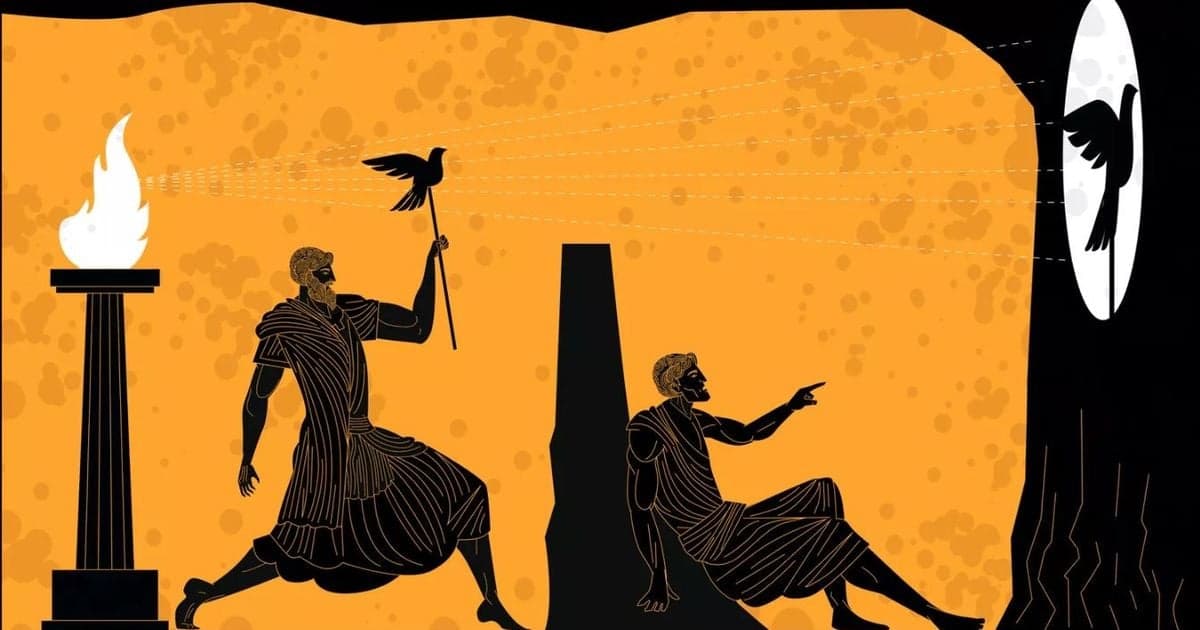
The cave is usually sold as a poster about enlightenment. Plato wrote a hostage situation. The prisoners are not lazy. They are experts. They have names for shadows, rankings for who predicts the next shape, honors for the person with the best eye for the wall. Their world is complete. That is the problem. A complete world made of copies does not feel like a copy. It feels like competence.
The one who is dragged up does not float into wisdom. He is in pain. Fire first, then sun. Each light ruins the previous eyesight for a while. When he comes back, he looks clumsy at the only game the cave still scores. They do not thank him. They diagnose him. If they can get hold of the person who pulled him out, they kill him. Plato is not guessing. He is writing after a jury treated Socrates the same way: as a man who came back from a better light and spoiled the contest.
The life skill is not collecting secret knowledge. It is noticing which contests you have become proud of, and whether those contests only work if nobody turns around. The ship of fools is the same picture in daylight: sailors fighting for a helm while the person who can read the stars looks unemployed. You will spend years getting good at a wall. The question is whether you can bear the season when a better light makes you look stupid.
The Central Lesson
The cave is not a story about stupid people. It is a story about skilled people whose skill is aimed at the wrong surface. Education is a turning of the whole soul, not an extra fact poured in. The turn costs you status in the only contest your room still runs, and the room may punish you for spoiling it. Plato's question is not whether you can describe the sun. It is whether you will keep competing for wall-prizes after you know what they are made of.
Applying This to Your Life
Audit the Contest You Are Winning
Ask what game you are currently ranked in: a feed, a workplace metric, a family story. If the prize requires everyone to keep facing the same wall, you are not seeing. You are scoring. Winning a shadow contest is still winning. It is also still a shadow.
Expect the Ugly Middle
Turning hurts before it clarifies. New evidence, a hard book, a conversation that wrecks a slogan: your first days will feel like bad eyesight. Do not treat that clumsiness as proof the old wall was true. It is how light arrives.
Return Without Performing Guru
The freed prisoner goes back. He does not stay on the hillside giving speeches to people who cannot hear them yet. If you have seen something the room has not, your job is not contempt. It is patience, and the knowledge that they may still call you blind.
Other lessons in this book
More life-skill deep dives from the same classic.
How Good People Become Bad Systems
Catch the moment a real virtue (honor, thrift, freedom) stops governing and starts colonizing everything else.
2 chapters·Explore AnalysisOwning the Life You Choose
Read the Tuesday inside the prize before you grab it, and stop transferring the blame for the pick.
4 chapters·Explore AnalysisRuling Yourself First
Read reason, spirit, and appetite as offices in an inner city, and notice which one is writing tonight's laws.
3 chapters·Explore AnalysisWhat Makes a Leader Worth Following
Separate the fight for the helm from the craft of reading weather, and follow the person who can steer without milking the chair.
4 chapters·Explore AnalysisWhy Be Good When You Could Get Away With It
Treat Glaucon's ring as a weekly test: would this still be your rule if no one could check, and the just man still went to the rack?
5 chapters·Explore Analysis
Continue exploring
Explore this theme
The same lessons in other books
See how other books teach the same life skills.
Les Misérables: Essential Edition
Navigating Poverty and Social ClassTrace Fantine from 1817 hope to factory gossip, and the class that treats need as indictment.
The Jungle
Reading Graft as Everyday GovernmentStay with Duane's cell and chapter 25: votes, inspectors, and a city that prices justice.
Hard Times
Understanding Worker DignityWatch Stephen refuse both mill-owner and union when each side treats him as a unit, and see what integrity costs when neither camp will have you.
Where the lesson lives in the book
Education as a Turn, Not a Pour
Before the cave, Socrates is already arguing about what stories do to a young guardian. Music and gymnastic are not decorations. They tune the soul before it can do math. The claim underneath is named later in Book 7: the power of learning is already in us. Teaching is not stuffing a vessel. It is turning the whole body away from what sparkles toward what is.
Key Insight:
If education is pouring, the student is empty and the teacher is a jug. If education is turning, the student already has a faculty, and the work is orientation. That is why bad content is not a side issue. It points the eyes. You cannot later add critical thinking on top of a diet of flattery and still call it seeing.
The Ship Where the Navigator Looks Useless
Adeimantus asks why philosophers look so useless in actual cities. Socrates answers with a ship. The owner is a bit deaf and short-sighted. Sailors quarrel over the helm, drug him, throw rivals overboard, and call the person who studies year, season, sky, and wind a stargazer. The true pilot's knowledge cannot be displayed as a shout. So the crowd prefers the person who can win a vote.
Key Insight:
The cave is not only a picture of ignorance. It is a picture of a market in which shadows are easier to score than stars. Expertise that takes years looks like idleness to people whose test is immediate usefulness. If your culture only rewards what can be performed in the noise, it will keep calling the navigator useless.
“The true pilot must give his attention to the year and seasons and sky and stars and winds.”
Prisoners, Fire, Sun
Prisoners have been chained since childhood, facing a wall. Behind them a fire. Between fire and necks, puppeteers carry objects. The prisoners name the shadows and run contests in predicting which shape comes next. One is dragged up. The fire hurts. The sun hurts more. Slowly he sees things, then the light that makes things visible. He remembers the prizes in the cave. He goes back. His eyes are wrecked for darkness. The prisoners say the ascent ruined him. If they could catch the person who tried to free them, they would kill him.
Key Insight:
The allegory is not a compliment to people who see the truth. It is a cost accounting. Turning hurts. Returning looks like incompetence. The community of shadow-namers has a vested interest in the wall remaining the world. Plato is writing after Athens killed Socrates. The prisoners' murder is not a metaphor he invented for drama. It is a memory.
“If they could lay hands on the man who was trying to set them free and lead them up, they would kill him.”
The Line Under the Picture
The cave sits on the divided line: images, visible things, mathematical thought, and the forms, with the Good as the last thing seen, and only with effort. The prisoner does not jump from wall to sun. There are stages, and each stage has a kind of blindness: too much fire, then too much sun, then too little fire on the way back. Education has a sequence. Skipping it produces a person who talks about the sun and still cannot walk.
Key Insight:
People love the cave as a slogan for wake up. Plato is more annoying. He thinks you have to get used to each kind of light. A sudden conversion that skips the in-between is another shadow: a story you tell about having arrived.
“In the world of knowledge, the idea of the good appears last of all, and is seen only with an effort.”
Images After the Ascent
Book 10 sends the tragic poets out of the city because they work three removes from what is: a form, a craftsman's copy, a painter's copy of the copy. The cave is still running. Homer is loved. The just man may still look ruined. Er comes back from the dead with a story, which is itself an image, used to point at a choice. Plato does not pretend the wall has been abolished. He pretends you can know what you are looking at.
Key Insight:
Leaving the cave is not a one-time graduation. You will keep meeting copies, including noble ones, including this dialogue. The skill is not contempt for stories. It is knowing when a story is doing the work of a shadow and when it is trying to turn your neck.