
The Republic
Plato
0:00 / 0:00
Socrates is walking back from a festival for Bendis in the Piraeus when Polemarchus sends a slave to catch his cloak. They will not let him leave until he has seen the torch race and sat down to talk. In Cephalus's house the first question is small enough to look safe: what is justice? Tell the truth and pay your debts, the old man says, and goes off to a sacrifice. A borrowed sword in a mad friend's hand already ruins that answer. Plato wrote The Republic in the decades after Athens made Socrates drink hemlock. Ten books refuse to let the question stay polite.
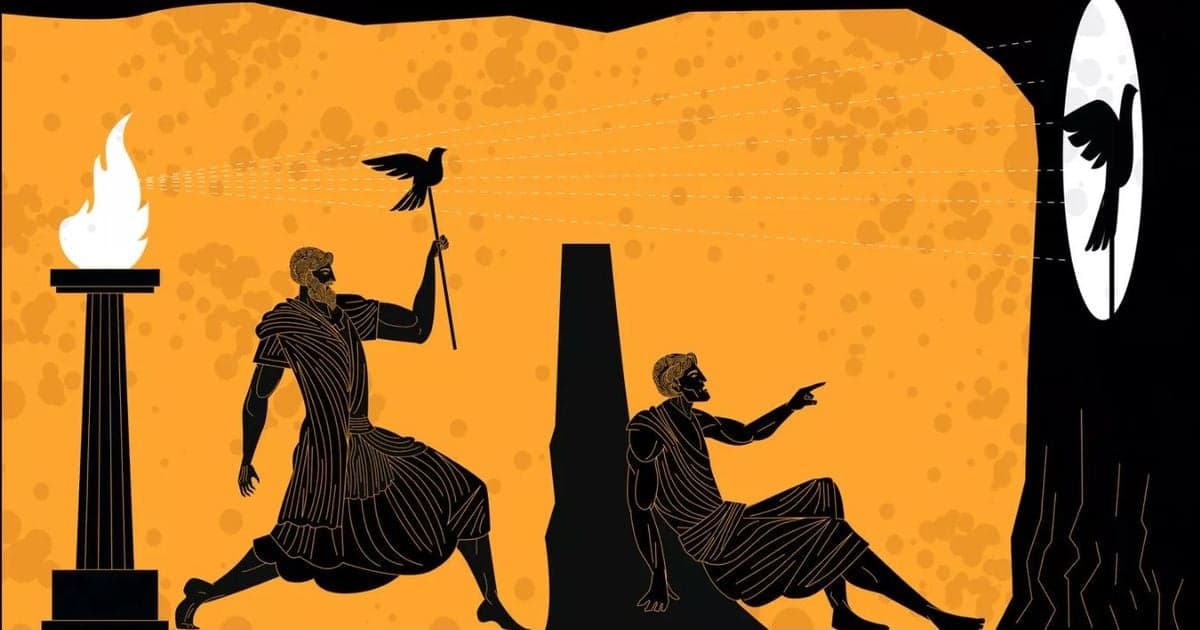
Socrates is the guest who will not stop. Cephalus wants a quiet old age and a clean ledger. Polemarchus inherits the argument: help friends, harm enemies. Thrasymachus slams in and names the real prize. Justice is the advantage of the stronger, and the unjust man with power lives better than the honest one. Glaucon will not accept a win on points. He wants the just man stripped of reputation, put on the rack, and still proven happier than the successful fraud. Adeimantus adds that poets and priests praise justice for its pay, not for itself. The prisoners facing a wall, and the navigator mocked on a ship of fools, arrive later as the same pressure in pictures. Most people live by what they are shown. The one who has seen more looks useless.
Book 1 breaks the household answers. Book 2 is the hinge. Gyges finds a ring that makes him invisible and takes a kingdom. Glaucon asks what anyone would do with that ring, then demands that justice be shown as good even when it looks like ruin. Socrates starts a city in speech so the virtue can be seen large: guardians, a noble lie, a soul in three parts. Book 5 sends the third wave. Philosophers must rule, or kings must philosophize. Book 6 is a ship whose owner is half deaf. Sailors fight for the helm and call the man who studies the stars a stargazer. Book 7 chains prisoners facing a wall. Shadows of puppets are their world. One is dragged up to the sun and comes back looking ridiculous to the people still watching the fire. Book 8 lets the just city decay: honor, then wealth, then freedom, then a champion who becomes a tyrant. Book 9 locks that tyrant inside a many-headed beast standing over a lion standing over a man. Book 10 sends Homer out of the city and ends with Er, a soldier who watches souls choose their next lives.
Plato is not drafting a constitution for Athens to adopt. He is writing a night-long argument after the city that killed his teacher. The city in speech is a magnifying glass for a soul. The ending refuses a civic victory. Homer is still loved. The just man may still look ruined. Er comes back from the dead to say the choice of a life is the chooser's, and God is justified.
The first pressure is already in that borrowed sword: a rule that works until it costs you. Why Be Good When You Could Get Away With It is Gyges' ring and the just man on the rack, the demand that justice pay even when nobody is watching. The Cave is the same dare in another room: a wall of shadows, a fire you were not allowed to turn toward, and the hostility waiting when you come back. What Makes a Leader Worth Following is the ship, the stargazer they mock, and the claim that those who want the helm least are the ones who should take it. How Good People Become Bad Systems is Book 8's slide from honor to money to freedom to a champion, each value pushed past its limit until the tyrant of Book 9 is locked inside his own beast.
The torch race was the excuse to stay. Ten books later, a soldier named Er walks back from the pyre. Wide Reads holds summaries, quotes, and audio on all ten books. The last weather is a meadow where souls pick the lives they will not be allowed to blame on anyone else.
Lessons from The Republic
Theme-by-theme chapter breakdowns of the essential skills in this classic work.
Lessons from The Republic
Theme-by-theme chapter breakdowns of the essential skills in this classic work.Deep dives
Chapter-by-chapter breakdowns
What Makes a Leader Worth Following
Separate the fight for the helm from the craft of reading weather, and follow the person who can steer without milking the chair.
We are not aiming to make one class especially happy, but to make the whole city as happy as possible.
How Good People Become Bad Systems
Catch the moment a real virtue (honor, thrift, freedom) stops governing and starts colonizing everything else.
Decay starts as loyalty to something genuinely good. Honor is not a vice. Honor as the only scoreboard is. When a culture…
Table of Contents
The Festival and the First Question
The Republic begins at a festival for Bendis in the Piraeus, where Socrates and Glaucon are persuade...
The Challenge of Justice
Thrasymachus is silenced, but Glaucon refuses to let the argument rest. He sorts goods into three ki...
The Noble Lie and the Education of Guardians
Socrates turns from defending justice in the abstract to designing the education that would produce ...
The Soul's Three Parts
Adeimantus interrupts with a practical objection: Socrates' guardians live like ascetic soldiers, wi...
The Great Wave of Equality
Having outlined classes and education, Socrates provokes his friends with a first wave of paradox: w...
The Ship of Fools
Socrates must explain what philosophers are and why cities reject them. A philosopher loves learning...
The Cave and the Light
Socrates continues by asking who should learn philosophy and when. The young should not be thrown in...
The Decline of States and Souls
Adeimantus asks how the ideal city could fall, and Socrates answers that even good constitutions dec...
The Tyrant's Prison
Socrates argues that the tyrannical soul is the most unjust and therefore the least happy, reversing...
The Cave's Exit and Soul's Journey
The final book returns to poetry, pleasure, and immortality. Socrates renews his attack on tragic an...
Common Questions About The Republic
Trending search questions mapped to the six lessons in this dialogue—what readers actually ask Google about justice, the Allegory of the Cave, the Ring of Gyges, the philosopher king, and how democracies decay into tyranny.
What is The Republic about?
Socrates is stopped on the road home from a festival and pressed into a night-long argument in Cephalus's house. The question looks small: what is justice? Book 1 breaks the household answers. Book 2 gives Gyges an invisibility ring. By Book 7 prisoners face a wall of shadows. By Book 10 a soldier named Er walks back from the dead to choose a life. Plato is not drafting a constitution. He is magnifying a soul after the city that killed his teacher.
Explore Why Be Good When You Could Get Away With ItWhat is Plato's Allegory of the Cave in The Republic?
Book 7 chains prisoners who have known only shadows cast by a fire they cannot see. One is dragged up toward the sun, blinded, then mocked when he returns to describe what is real. The wall is not ancient decoration. It is the feed, the consensus, the contest you are ranked in because nobody turned toward the fire. Education, in this image, is not pouring facts into an empty vessel. It is turning the whole person toward a light the room will resist.
Explore The CaveWhat is justice in The Republic?
Cephalus says tell the truth and pay your debts until a borrowed sword in a mad friend's hand ruins the rule. Thrasymachus names the prize most rooms actually chase: justice is the advantage of the stronger. Glaucon will not accept a win on points. He wants the just man stripped of reputation, put on the rack, and still proven happier than the successful fraud. The dialogue refuses a slogan. It builds a city in speech so the virtue can be seen large enough to test.
Explore Why Be Good When You Could Get Away With ItWhat is the Ring of Gyges in The Republic?
Book 2 tells how a shepherd finds a ring that makes him invisible, murders the king, seduces the queen, and takes the throne. Glaucon asks what anyone would do with that power, then demands that justice be shown as good even when nobody is watching and the just man still goes to the rack. The ring is the weekly test: would this still be your rule if reputation, punishment, and reward were all removed from the scale?
Explore Why Be Good When You Could Get Away With ItWhat is the philosopher king in The Republic?
Book 5 sends the third wave: philosophers must rule, or kings must philosophize, because those who love the sight of truth are the ones least likely to treat the helm as a prize. Book 6 sets the ship whose owner is half deaf while sailors fight for the wheel and call the navigator who reads the stars a useless stargazer. Plato is not flattering philosophers. He is asking who can steer when everyone else is bidding for the chair.
Explore What Makes a Leader Worth FollowingHow does democracy become tyranny in The Republic?
Book 8 lets the just city decay step by step: from honor to wealth to freedom pushed past its limit until a champion rises who promises to fix the chaos and becomes the tyrant Book 9 locks inside a many-headed beast. Each stage is a real virtue turned into a monopoly. The warning is not that democracy is wicked. It is that any value, once it stops governing and starts colonizing everything else, breeds the man who will sell rescue.
Explore How Good People Become Bad SystemsAbout Plato
Published -375
Plato (428-348 BC) was born into an Athens that had just lost a generation-long war and watched its civic life turn brutal. He came from one of the city's most distinguished families, was groomed for politics, and might have taken his place among the powerful until he saw something that changed the course of Western thought. In 399 BC, his teacher Socrates was tried on charges of impiety and corrupting the youth, convicted by a jury of his fellow citizens, and sentenced to drink hemlock. Plato was about thirty. He left public life, founded the Academy, the Western world's first sustained institution of higher learning, and spent the next fifty years writing.
What he produced was unlike anything before it: philosophy cast as conversation, not lecture. In his dialogues, Socrates walks through the streets, argues in private houses, catches his companions in contradictions, and refuses to let comfortable answers stand unexamined. Plato gives you the scene, the personalities, the stakes, and the moment when someone's certainty cracks. You are not reading conclusions handed down from a podium. You are watching a mind think in real time.
The Republic is his most ambitious dialogue: a single night-long conversation that begins with a simple question about justice and expands into an entire city, a theory of the soul, the Allegory of the Cave, and a warning about how free societies decay into tyranny. It asks whether you would still choose to be good if you could get away with anything, and whether the people who want power most are the ones who should hold it.
Why Plato Matters Today
Plato speaks to the moment when the institutions you trusted stop making sense: the election that rewards performance over judgment, the workplace where the loudest voice wins, the comfortable belief you inherited and never examined. His answer is not cynicism. It is questioning. What is justice, really? Who should lead? What do you call knowledge when you have only ever seen shadows on a wall?
What makes him indispensable is that he never wrote philosophy as a finished system handed down from above. He wrote scenes. Socrates in a house in Piraeus, pressed by friends who want a clear answer and cannot get one. The Republic is not a blueprint for utopia. It is a stress test for every assumption you carry about fairness, education, power, and the good life. The Cave is not ancient metaphor. It is the feed, the algorithm, the consensus you mistake for reality because everyone around you mistakes it too.
Political philosophy is often reduced to slogans about freedom or order. Plato is the correction. He shows how good cities decay step by step, how the soul mirrors the state, and why the person who craves power is the last one you should give it to. Augustine, Machiavelli, and every modern debate about who deserves to govern still circle back to him. If you have ever wondered whether you would still do the right thing when no one was watching, Plato is the teacher who makes that question impossible to dodge.
More by Plato in Our Library
Wide Reads is different.
Plot, characters, and themes — plus audio, source text, and patterns you can use after class
Two ways in
Read & listen to the summary
Chapter by chapter, with audio. The meaning arrives because you experienced it — not because someone listed bullet points.
Start with this.
Read the original text
The actual words the author wrote, alongside every summary. Use the guide, then step into the source.
Then step into the source.
Either way, the door opens inward.
— and most of all, Why does this matter?
Get the Full Book
Purchase the complete book to access all chapters and support classic literature

Available in paperback, hardcover, and e-book formats
You Might Also Like
Free to read • No account required