
Lessons
Lessons from The Republic
Six lessons from this classic work, traced chapter by chapter.
0:00 / 0:00
Socrates is walking back from a festival for Bendis in the Piraeus when Polemarchus sends a slave to catch his cloak. They will not let him leave until he has seen the torch race and sat down to talk. In Cephalus's house the first question is small enough to look safe: what is justice? Tell the truth and pay your debts, the old man says, and goes off to a sacrifice. A borrowed sword in a mad friend's hand already ruins that answer. Plato wrote The Republic in the decades after Athens made Socrates drink hemlock. Ten books refuse to let the question stay polite.
Continue the summary
Socrates is the guest who will not stop. Cephalus wants a quiet old age and a clean ledger. Polemarchus inherits the argument: help friends, harm enemies. Thrasymachus slams in and names the real prize. Justice is the advantage of the stronger, and the unjust man with power lives better than the honest one. Glaucon will not accept a win on points. He wants the just man stripped of reputation, put on the rack, and still proven happier than the successful fraud. Adeimantus adds that poets and priests praise justice for its pay, not for itself. The prisoners facing a wall, and the navigator mocked on a ship of fools, arrive later as the same pressure in pictures. Most people live by what they are shown. The one who has seen more looks useless.
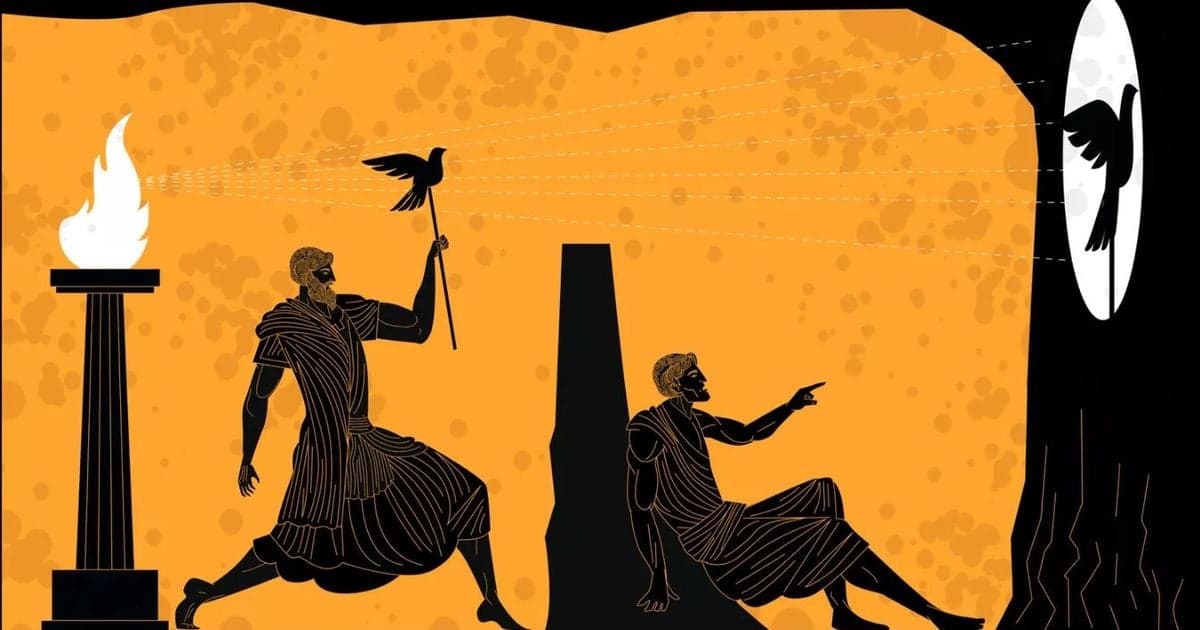
Book 1 breaks the household answers. Book 2 is the hinge. Gyges finds a ring that makes him invisible and takes a kingdom. Glaucon asks what anyone would do with that ring, then demands that justice be shown as good even when it looks like ruin. Socrates starts a city in speech so the virtue can be seen large: guardians, a noble lie, a soul in three parts. Book 5 sends the third wave. Philosophers must rule, or kings must philosophize. Book 6 is a ship whose owner is half deaf. Sailors fight for the helm and call the man who studies the stars a stargazer. Book 7 chains prisoners facing a wall. Shadows of puppets are their world. One is dragged up to the sun and comes back looking ridiculous to the people still watching the fire. Book 8 lets the just city decay: honor, then wealth, then freedom, then a champion who becomes a tyrant. Book 9 locks that tyrant inside a many-headed beast standing over a lion standing over a man. Book 10 sends Homer out of the city and ends with Er, a soldier who watches souls choose their next lives.
Plato is not drafting a constitution for Athens to adopt. He is writing a night-long argument after the city that killed his teacher. The city in speech is a magnifying glass for a soul. The ending refuses a civic victory. Homer is still loved. The just man may still look ruined. Er comes back from the dead to say the choice of a life is the chooser's, and God is justified.
The first pressure is already in that borrowed sword: a rule that works until it costs you. Why Be Good When You Could Get Away With It is Gyges' ring and the just man on the rack, the demand that justice pay even when nobody is watching. The Cave is the same dare in another room: a wall of shadows, a fire you were not allowed to turn toward, and the hostility waiting when you come back. What Makes a Leader Worth Following is the ship, the stargazer they mock, and the claim that those who want the helm least are the ones who should take it. How Good People Become Bad Systems is Book 8's slide from honor to money to freedom to a champion, each value pushed past its limit until the tyrant of Book 9 is locked inside his own beast.
The torch race was the excuse to stay. Ten books later, a soldier named Er walks back from the pyre. Wide Reads holds summaries, quotes, and audio on all ten books. The last weather is a meadow where souls pick the lives they will not be allowed to blame on anyone else.
Why this matters
People still arrive when institutions they trusted stop making sense, when a comfortable belief inherited from the room will not survive one honest question, or when the person who wants the helm most is the last one fit to steer. Plato does not offer a blueprint for utopia. He magnifies a soul. This guide keeps Gyges, the Cave, the ship, and Er's meadow tied to choices you can still name.
Prestige deep dive
A Psychological Reading of The Republic
The Republic studies a soul that must want justice when no witness remains, and it builds a city in speech so that soul, including the tyrant inside it, can be seen large.
Read the full psychological readingTheme breakdowns
Explore the lessons
The Republic is Plato's dialogue after Athens made Socrates drink hemlock: Book 1 breaks Cephalus's ledger and Thrasymachus's claim that justice is the advantage of the stronger, Book 2 gives Gyges an invisibility ring and demands justice be good on the rack, Book 5 sends the wave that philosophers must rule, Book 6 sets the ship whose sailors mock the stargazer, Book 7 chains prisoners to a wall of shadows before the drag toward the sun, Book 8 slides from honor to wealth to freedom to a champion who becomes a tyrant, Book 9 locks that tyrant inside a many-headed beast, and Book 10 ends with Er choosing a life no god will choose for him.
Each card traces a pattern through named chapters — summaries, quotes, and key insights tied to the scenes that prove it. Start with the featured lessons, then open the deep dives below.
Deep dives
Chapter-by-chapter breakdowns
What Makes a Leader Worth Following
Separate the fight for the helm from the craft of reading weather, and follow the person who can steer without milking the chair.
How Good People Become Bad Systems
Catch the moment a real virtue (honor, thrift, freedom) stops governing and starts colonizing everything else.
Continue Exploring
Guides, life skills, and the full library.More ways to read The Republic: guides, life skills, and the wider library.