
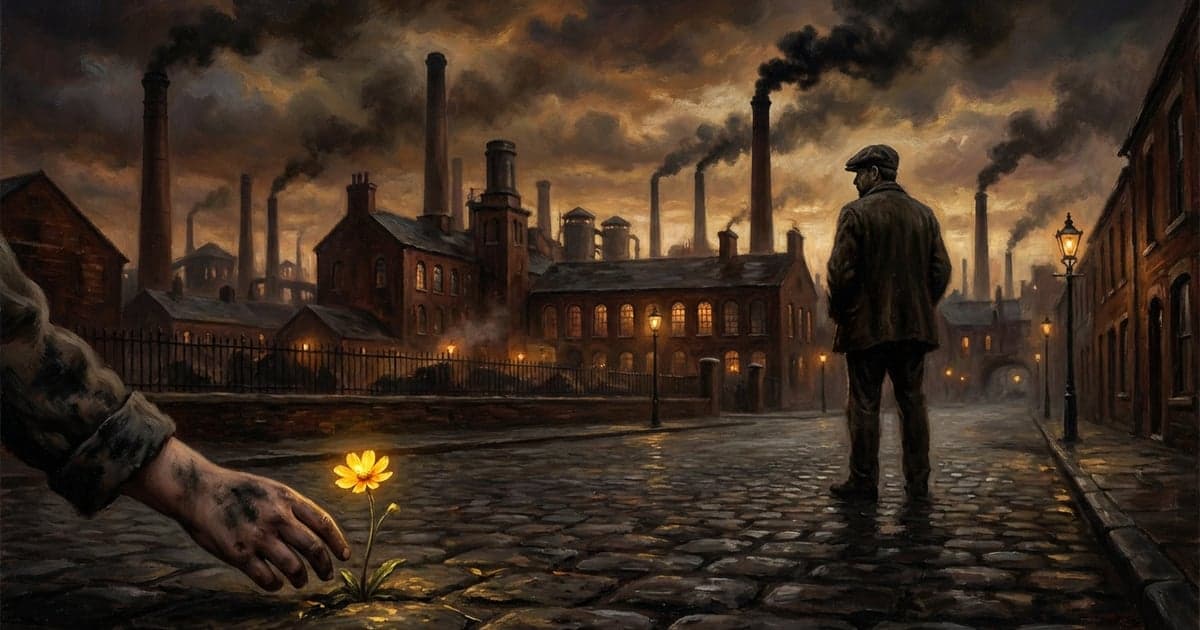
Stephen is useful until he keeps a reason the mill cannot inventory. He weaves well. He keeps his word. He will not join Slackbridge, and he will not feed Bounderby a villain from the men who shunned him. That is enough to make him a defect in both ledgers. Dickens does not turn him into a saint of the union or a mascot of the master. He turns him into a person, which is the one thing Coketown is not staffed to process.
The law that might free him from a ruined marriage exists, and Bounderby can recite it. Recitation is not help. Help is priced. Rachael keeps a chair until the bells go three, which is the other half of dignity: unpaid care the factory never lists. Slackbridge's meeting has real wounds and a method that still needs a unit. Stephen looks at faces he has known since he was young and will not become a vote. The mill answers by stopping his wage. Isolation is not a plot twist. It is what a categorized town does with a name that will not sit down.
The placard offers twenty pounds for the weaver who would not flatten. The pit has already taken fathers and sons. Stephen lives long enough to ask that his name be made good, and to point Gradgrind at Tom without a speech about reform. If you have ever been recruited as a function, a headcount, or a yes, you already know both shirts. Worker dignity is not picking the winning camp. It is keeping the fact about yourself that neither camp can use, and paying what that costs without calling the cost a misunderstanding.
The Central Lesson
Worker dignity is not a slogan about labor. It is a name that will not become a Hand or a vote. Stephen is inconvenient because he has a private moral life both camps need to flatten. The mill recites a law he cannot buy. The meeting recites a cause he will not join. Isolation, a placard, and a pit follow, and still he asks that the name be made good. Do not romanticize the cost. Do not call the cost proof that he should have picked a shirt. If a camp requires you to erase the fact about yourself it cannot use, you are being recruited as inventory. Keep the fact. Know what it may cost. That is the weaver's lesson, and it is not cheap.
Prestige deep dive
A Psychological Reading of Hard Times
Hard Times is the psychology of a mind that treats feeling as contamination, then meets the daughter, the false past, and the weaver that this defence cannot file.
Read the full psychological readingApplying This to Your Life
Watch Both Recruiters
Management wants compliance. A movement wants a vote. A person who will not become either is treated as a defect. Ask which of your loyalties still leaves room for a reason you have not outsourced.
Hear Recitation as Refusal
When the official remedy exists and you cannot afford it, do not confuse fluency with aid. Bounderby knows the law. Stephen still has no exit. Dignity includes saying the door is locked, even when the plaque is polished.
Count the Night Watch
Rachael's chair is part of the wage the mill never pays. If your workplace runs on care it will not name, the Hands are larger than the roster. Protect the people doing that work, including yourself.
Other lessons in this book
More life-skill deep dives from the same classic.
Breaking Free from Rigid Thinking
Track Gradgrind from Facts-only certainty to the study after the storm, when Bitzer quotes the catechism back at the man who wrote it.
6 chapters·Explore AnalysisSeeing Through Productivity Obsession
Identify when efficiency culture has colonized your sense of self-worth, and find your way back to a life that measures more than output.
6 chapters·Explore AnalysisRecognizing Dehumanizing Systems
See when organizations treat people as interchangeable units and understand the real cost to everyone inside them.
6 chapters·Explore AnalysisReclaiming Imagination
Understand why creativity and play are not luxuries but necessities, and how to restore them after years of purely rational living.
6 chapters·Explore AnalysisRecovering from Emotional Suppression
Heal from being raised to ignore your feelings and intuition, and learn to trust your inner life as a source of wisdom, not weakness.
6 chapters·Explore Analysis
Continue exploring
Explore this theme
The same lessons in other books
See how other books teach the same life skills.
The Jungle
Reading Graft as Everyday GovernmentStay with Duane's cell and chapter 25: votes, inspectors, and a city that prices justice.
The Idiot
Maintaining Goodness Without NaivetySit with Myshkin on the train in chapter 1: honesty with no angle, and a city that can only call it idiocy.
Jude the Obscure
When Desire Becomes a TrapTrack the pig, the dimple, the false pregnancy, and the second marriage arranged over gin.
Where the lesson lives in the book
Perfect Integrity
Stephen walks home through Coketown after the loom. Dickens gives him what the mill never asked for: a ruined marriage, a love he will not act on, and a habit of keeping his word. He is a good power-loom weaver and a man of perfect integrity. The town's census still says Hand.
Key Insight:
Dignity starts before any speech about rights. It starts when a story refuses to let a worker exist only as output. If you can be fully described by the shift you work, you are already inside the mill's grammar, whatever your title.
“He was a good power-loom weaver, and a man of perfect integrity.”
There Is Such a Law
Stephen asks how a poor man leaves a marriage that is destroying him. Bounderby recites the law as if reciting it were help. There is such a law. Stephen cannot buy it. The rain falls. The smoke-serpents trail. The refusal is polite, complete, and delivered as common sense.
Key Insight:
A system can stay respectable while it traps the people it depends on. When the official remedy is priced out of reach, 'that's the process' is a locked door with a plaque. Dignity includes noticing the plaque.
“There is such a law.”
Till the Bells Go Three
Rachael sits with Stephen's wrecked wife until the bells. She will not cast the first stone. She has no surplus and still has a private moral life the factory cannot inventory. Dignity here is not a speech. It is a chair kept through the night.
Key Insight:
Worker dignity is not only what a man refuses at a meeting. It is also the unpaid care that keeps a life from becoming only the mill. If your workplace never counts the night watches, it is still using them.
“I will stay here, Stephen, till the bells go Three.”
Men and Brothers
Slackbridge needs every operative inside one cause. The grievances are real. The method flattens. Stephen listens to faces he has known since he was young and lighter-hearted, then will not join. A holdout is processed as a traitor before he is heard as a man with a reason.
Key Insight:
Collective action can restore a name or replace one flattening with another. The test is whether a movement can stand a person it cannot use as a vote. If dissent is betrayal, the mill's logic has only changed shirts.
“Monny's the pleasant word as soom heer has spok'n wi' me; monny's the face I see heer, as I first seen when I were yoong and lighter heart'n than now.”
Nowt to Sen
Before Bounderby, Stephen will not denounce the men who shunned him. Not rebels, not rascals. He will not become useful to the master by feeding him a villain. Bounderby withdraws the work. A man who will not be a unit is inconvenient to owners and organizers alike.
Key Insight:
Integrity looks like disloyalty when every camp needs you categorized. If keeping your reasons costs you both sides, you are not confused. You are expensive. Dignity is the refusal to sell the name that made you expensive.
“Wi' yor pardon, sir, I ha' nowt to sen about it.”
Clear Me
Stephen is found in Old Hell Shaft, a pit that has already taken hundreds. He lives long enough to ask that his name be made good, and to send Gradgrind to his own son. He makes no charges. He leaves none behind him except the truth the placard could not hold.
Key Insight:
Worker dignity in this book is not a promotion. It is the insistence that a Hand had a reason and a death that should not be filed as an industrial accident of character. If your institution only remembers people when they become a problem, you are still reading Bounderby's twenty pounds.
“Sir, yo will clear me an' mak my name good wi' aw men. This I leave to yo.”