
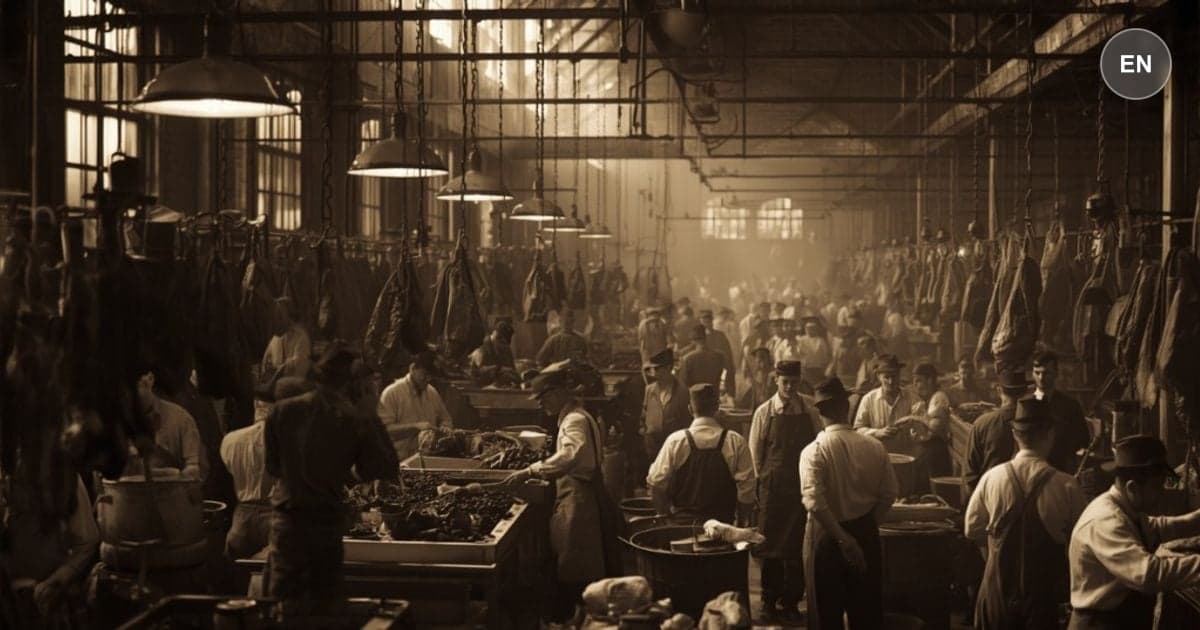
The union hall can feel like the whole republic. Every man's affairs are every man's, Jurgis thinks, and night school looks like a ladder into citizenship. Sinclair will not leave that feeling uncorrected. In the same stretch of the book, the parties are two rival sets of grafters, and the office goes to whoever buys the most votes. An honest room is not a disproof of a sold city. It is a small state sitting next to a packing house that has learned to process ballots.
The sergeant's desk is where the other government becomes personal. Connor does not have to stand in the cell. The charge of assault and battery is already a product. Duane, who smells the fertilizer Jurgis cannot wash off, treats the yards as news and the law as a trade. Respectable Chicago would call him a thief. He is also the first person who describes the price list without the civics vocabulary. Later Jurgis will see civilization plainly: the same efficiency that packs a steer can pack a precinct.
Coming out ahead on a deal is the joke that is not a joke. A hundred-dollar bill he cannot change without being robbed is government as a second packing house: you can win the night and still have nowhere safe to sleep. Eleven dollars a week and a greasy red necktie feel like arrival until the strike asks him to cross the line. Graft, in this novel, is not a scandal you read about after dinner. It is the ordinary invoice for a vote, a charge, a lodging house, an inspector, a necktie. Learn to read the city the way Jurgis finally reads the yards. The cut is already priced.
The Central Lesson
Government in The Jungle is not a separate moral universe from the plant. Two grafter sets call themselves parties. A desk writes a charge a boss needed. A thief names the trade. A man comes out ahead on a deal and cannot change the bill without being robbed. Eleven dollars and a necktie still belong to the strike that is coming. Read graft as the ordinary day, not as an exception. If you only study the statute, you will miss the invoice.
Applying This to Your Life
Hold the Honest Room and the Sold Office
A union, a church, a volunteer board can be real democracy. It does not cancel a captured permit office, a donor-owned vote, or a police desk that already knows who can file. Keep both maps.
Ask Who Could File the Complaint
Neutrality at a desk is a costume. If only one party can afford the charge, the lawyer, the delay, you are not in a courtroom. You are in a shop.
A Win You Cannot Cash Is Still a Leash
A bonus, a favor, a vote that pays once and leaves you unable to change the bill: that is Jurgis's hundred dollars. Easy money from a machine will come back as a demand to cross someone else's line.
Other lessons in this book
More life-skill deep dives from the same classic.
Understanding Reform Movements
Hear the union hall, the socialist meeting, and the night the country reached for the plate.
6 chapters·Explore AnalysisSeeing Systemic Exploitation
Sit with the house contract and the killing floor: the trap is design, not bad luck.
6 chapters·Explore AnalysisHolding a Family Together Under Scarcity
Watch Ona, Elzbieta, and the children keep a household when the wage cannot cover the winter.
6 chapters·Explore AnalysisImmigrant Perspective
Name the veselija, the English they cannot read, and the promise that never covered the ledger.
6 chapters·Explore AnalysisSurviving After the System Breaks You
Follow Jurgis from the sprain and the fertilizer mill through jail, the road, and the fall.
6 chapters·Explore Analysis
Continue exploring
Explore this theme
The same lessons in other books
See how other books teach the same life skills.

Les Misérables: Essential Edition
Navigating Poverty and Social ClassTrace Fantine from 1817 hope to factory gossip, and the class that treats need as indictment.
Hard Times
Understanding Worker DignityWatch Stephen refuse both mill-owner and union when each side treats him as a unit, and see what integrity costs when neither camp will have you.
A Tale of Two Cities
Loving Without PossessionTell Lucie you would give your life to keep a life she loves, after you already know she will marry Darnay.
Where the lesson lives in the book
A Little Republic Beside a Sold City
The union looks like democracy to Jurgis: a miniature republic where every man's affairs are every man's. He goes to night school when he can. Sinclair already shows the other government in the same breath: two rival sets of grafters, known as political parties, and the one that buys the most votes gets the office. An honest room can sit beside a captured city and still feel like the whole country.
Key Insight:
Hold both pictures. A place where your voice counts is real. So are the offices that have already been sold. Civics class is not a map of Packingtown.
“There were two rival sets of grafters, known as political parties, and the one got the office which bought the most votes.”
The Desk That Writes the Charge
Jurgis is driven in a patrol wagon, stands before a sergeant, and watches assault and battery entered against him. Connor's power does not need to appear in the cell. It is already in the charge, the watchers, and the fertilizer the officers will not stand near. Law looks neutral at a desk.
Key Insight:
Ask who could file the complaint and who could not. A charge is often the first product the captured city sells you.
“Then he stood before the sergeant's desk and gave his name and address, and saw a charge of assault and battery entered against him.”
Duane Treats the Law as a Trade
Jack Duane meets Jurgis in the cell, smells the fertilizer that will not wash, and treats the yards as news. He is a thief who already understands that the official story has a price list. Jurgis is still learning that the cage is part of the same plant. The useful teacher is sometimes the person the respectable city calls a criminal.
Key Insight:
Duane's lesson is not that crime pays. It is that the forms already belong to someone. If you only study the statute, you will miss the invoice.
“What are you? I work in the stockyards—at least I did until the other day.”
Civilization Seen Plain
Jurgis looks at the world of civilization more plainly than he ever has: a world that can pack a steer and pack a vote with the same efficiency. The city is no longer a backdrop for the yards. It is the larger machine. Graft is easier to miss when you still think government is a different industry.
Key Insight:
Once the packing house and the precinct share owners, the ballot is another cut. Do not file politics as a separate moral universe.
“He saw the world of civilization then more plainly than ever he had seen it before.”
Ahead on That Deal
Jurgis works inside the election machine and comes out ahead on a deal. Then he holds a bill he cannot change without being robbed or murdered. Politics, lodging houses, and inspectors run on the same arithmetic: you can win a night and still have nowhere safe to sleep. Playing the game can pay once and still leave you outside the protection the game sells.
Key Insight:
Graft is not a scandal at the edge of government. It is how the ordinary day is priced. A win that you cannot cash is still a leash.
“He had come out ahead on that deal!”
Eleven Dollars and a Red Necktie
Jurgis has shed the fertilizer clothes, put on a greasy red necktie, and is making about eleven dollars a week in politics. Force of habit keeps him at an easy job. When the strike comes, the same machine that paid him will ask him to cross the line. The costume changed. The owner of the week did not.
Key Insight:
A raise that arrives through graft is still a leash. Watch what the easy job will require when the plant needs bodies more than loyalty.
“He had some reason for thinking of his dress, for he was making about eleven dollars a week.”