
Justice Without a Witness
The Republic is not a charter for a perfect city. It is a night of talk after Athens made Socrates drink hemlock. The psyche it studies is implied: a soul that has to want justice when nobody is watching, and a city used as a magnifying glass so that soul can be seen large. Cephalus offers a clean ledger and leaves. Thrasymachus names the prize the room wants, justice as the advantage of the stronger. Glaucon hides the wearer with a ring and has the just man die thought the worst. Socrates answers by building a city in speech. The prisoners facing a wall, he will say later, are ourselves. The ending is not a government adopted. It is a meadow where souls pick the next life, and the responsibility stays with the chooser.
The Witness Who Can Be Removed
The originating anxiety is not ignorance. It is the witness. Glaucon sorts goods into what we want for themselves, what we want for themselves and their results, and what we want only for the pay. Most people, he says, put justice in the last class. They praise it in public and wish, in private, for the strength to cheat without consequence. Then he tells of Gyges' ring. The wearer disappears. With that power, even a decent person would steal, seduce, and kill, because no one remains who can hold them to account. He offers two rings, one for the just person and one for the unjust, so that no difference will show. Everyone, he says, will do evil if he can.
This is a psychology of reputation, stated as a dare. Goodness, on this account, is what the room can see. Remove the room and the rule collapses into appetite. The wound under the dare is older than the ring. Cephalus wanted a clean ledger and a quiet old age. Polemarchus inherited a proverb: help friends, harm enemies. Both answers work until they cost something a witness would notice. The ring is the cost with the witness deleted. Plato writes this after a city watched his teacher and still voted for the cup. The fear is not abstract. A public that can see you can also misname you, and a public that cannot see you may be the only test that counts.
The Man Who Must Look Ruined
Glaucon will not accept a win on silence. He sets two portraits side by side. The unjust man is master of his craft, seldom mistaken, easily corrected, gifted in money, speech, and strength: the greatest villain bearing the highest character. Beside him stands the just man in nobleness and simplicity, being and not seeming, without name or reward, clothed in his justice only. He is the best of men and thought the worst, and he is to die as he has lived. Adeimantus adds the poets and the priests, who praise justice for its pay and not for itself. The demand is brutal and precise. Prove that justice is worth wanting when it looks like ruin.
The portrait is a self that cannot use applause as evidence. If the just man must be thought the worst, every social proof is disqualified in advance. Cephalus has already left. Thrasymachus has been talked into a corner and is not persuaded in his bones. Glaucon wants the feeling of justice under humiliation, not a score. The stake is whether a person can keep a rule that makes them look guilty. A reading that skips this pair and starts at philosopher-kings has already taken the reward Glaucon removed.
A City So a Soul Can Be Read
Socrates does not answer with a law. He proposes to look for justice in a city before he looks for it in one person, because the pattern is easier to see when it is large. Guardians, a story the city tells about metals in the soul, an education that edits what the young are allowed to admire: these are not a constitution handed to Athens. They are a diagram. Book 4 then says the diagram was always about the person. Reason plans. Spirit fuels honour and anger. Appetite wants food, drink, sex, and money. The classes in the city map onto those parts. Justice, in the soul, is each part doing its work, with reason ruling and appetite not writing the laws.
The formal trick is the whole psychology. A dialogue that begins with a household rule ends by treating a state as a portrait of a committee inside one chest. That is why the famous line arrives as a shock, not as a bill. In Book 5 the friends will not let women and children pass. Three waves follow: women trained as guardians, families held in common among the guardians, and this, that until kings are philosophers, or philosophers are kings, cities will not cease from ill, and the ideal polity will not come into being. The sentence is a condition inside a city made of speech. Read as a party platform, it flatters the reader who already thinks they are the one who should rule. Read as a magnifying glass, it says the part of you that wants the helm is the part least fit to hold it.
Leontius and the Committee
The divided soul is not a theory until it has a body that loses. Leontius wants to stare at the corpses of executed men and hates himself for wanting it. He curses his own eyes, and he looks. Appetite and spirit are at war inside one person while reason watches and does not win. Socrates uses that ugly minute to show that we are not a single voice. The parent who knows the right sentence and still says the cruel one, the colleague who plans a small revenge and is disgusted while planning it: the dialogue's claim is that this is the same shape as a badly ruled city.
Spirit is the dangerous ally. It can back reason, and it can side with appetite and call the siding honour. Book 8's decay follows that slide. A love of honour becomes a love of winning. A love of wealth colonises the rest. A love of freedom, with no office left that can say no, invites a champion. Each regime educates people to want what the next regime will reward. The part that shouts loudest starts to sound like the self.
The Wall That Punishes Return
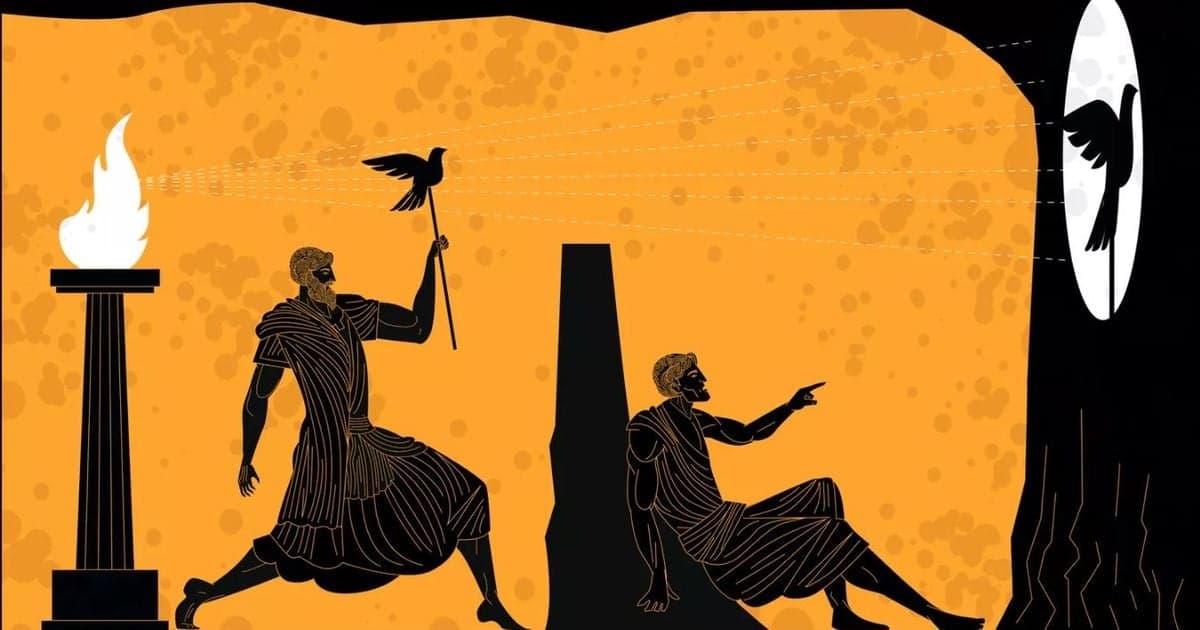
The cave is not a compliment to people who have woken up. Prisoners have been chained since childhood, facing a wall, naming shadows and running contests over the next shape. Socrates says they are ourselves. One is dragged up into the sun and blinded. On the way back, eyes that learned the light are useless in the dark. If they could catch the person who tried to free them, they would kill him.
The ship in Book 6 is the same group with a helm. The owner is half deaf. Sailors fight for the wheel, drug the captain, and call the navigator who studies seasons and stars a stargazer. Expertise that cannot be performed as a shout looks like idleness. The psychological point is not that truth is rare. It is that a shared world punishes the return. A person who has seen something the contest cannot score becomes a threat to the prizes. Athens had already done the killing. The cave is the memory, drawn so the reader has to stand among the prisoners and not only among the saved.
The Beast That Wears the Crown
The defence that power will make you happy breaks in Book 9. Socrates reverses Glaucon's wager. The tyrannical soul is the most unjust and therefore the least happy. Appetite is a many-headed beast. Spirit is a lion. Reason is the human figure that should rule both. Injustice feeds the beast and starves the person. The drunk, the lover of honour, and the thinker each claim to live best, and only the one who can see all three is in a position to judge. The tyrant is not a villain in a distant palace. He is the committee with the beast in the chair: sleepless, surrounded, unable to trust the people he rules because he is already ruled.
This is the shift the night was built to reach. Glaucon asked what anyone would do if the ring made them invisible. Book 9 answers with a misery that does not need an audience to be real. The successful fraud of Book 2, honoured to the end, is reread as a man whose pleasures have no judge but the loudest head. The city in speech was never the prize. It was a way to make that inner lock visible. A reader who stops at the ideal state misses the lock, and keeps the fantasy the ring was meant to test.
The Life You Cannot Blame
Book 10 does not close on a signed city. Socrates returns to poetry with love of Homer still making the words falter. Imitation, he says, copies appearances and trains the hearer to weep, laugh, and surrender judgment in a way that would be shameful in the street. Even Homer, the teacher of Greece, is sent out of the just city. The banishment is not contempt. It is a fear of stories that feed the lower parts and call the feeding noble. Then Er, a soldier, comes back from the dead. Souls choose their next lives. The responsibility is with the chooser, and the god is justified. Odysseus, who has had fame, picks a quiet private life.
The ending refuses the civic victory the popular summary wants. Homer is still loved. The just man may still look ruined. What remains is a meadow and a pick that cannot be handed to fate, to the poets, or to the ring. That is suppression and resolution at once. The tension of being unseen is not cured by a better constitution. It is returned to a person who has to choose a life in full view of the alternatives, including the quiet one that fame would sneer at. The dialogue's last defence against Glaucon is not a king. It is a choice you will not be allowed to blame on anyone else.
Why It Resonates Now
The anxiety the book keeps feeding is the fear that goodness is only a performance for a witness, and the twin fear that a group will punish anyone who stops performing. Readers reach for The Republic when institutions they trusted start rewarding the person who can win the contest on the wall. The philosopher-king line is easy to steal as a licence for the already confident. The page is colder. It asks whether the part that wants the chair is the part that should have it, and whether a just life can survive being thought the worst.
What travels is not a plan for government. It is the picture of a committee that calls its loudest member the self, and of a wall that would rather kill the messenger than lose the prizes. A culture that treats visibility as proof will recognise Gyges and miss Er. The meadow does not soothe the fear of being unseen. It says the life is still yours when the audience is gone, and that a quiet choice can be the one fame would not make. The book does not tell you how to choose. It shows what a soul looks like when appetite has already chosen, and called the result a city.
Limits of This Reading
A political reading is not a mistake. The dialogue really does design classes, censorship, a breeding story, and a condition for rule. Karl Popper heard a programme for closing an open society, and that hearing has evidence in the waves of Book 5 and the exile of the poets. This essay treats the city as a magnifying glass because Socrates says he is looking at the large pattern in order to find the small one, and because the night ends on a chooser rather than a ratified charter. That emphasis can underplay how much of the book is willing to rearrange other people's lives in speech. The noble lie, the common nurseries, the ban on grief in Homer: these are not only metaphors. They are proposals, even if the proposals live inside an argument.
The historical limit is as plain. This is a fourth-century dialogue written in the decades after 399 BC, in a city that had lost a war and killed the teacher. Modern words for the inner committee, for reputation anxiety, for a tyrannical character, are a lens, not Plato's. The hosted text is Benjamin Jowett's rendering, often analytic rather than a full line-by-line translation, so a sharp sentence may be his compression. The forms, the divided line, and the Good are claims about knowing, not moods, and this essay does not pretend to cover them. It stays with the psyche the night keeps returning to: a witness who can be removed, a soul that can be misruled, and a life that cannot be blamed on the god.
Across the Shelf
The Apology is the room this night is written after. There the defendant is already the man thought the worst, and he will not buy the verdict with weeping children. The Republic takes that ruined just man and asks whether his life was still the one to want once the city has done the killing. The Prince stays in the other portrait, the villain with the highest character, and treats appearance as a tool a ruler must manage. Plato will not leave the tool as the last word. He builds an inner city so the successful fraud can be counted as miserable without waiting for the audience to turn. Read together, the three books are one argument about power and the witness: what a court does to a man it can see, what a prince does when he controls what is seen, and what a soul does when the ring has made the seeing impossible.