
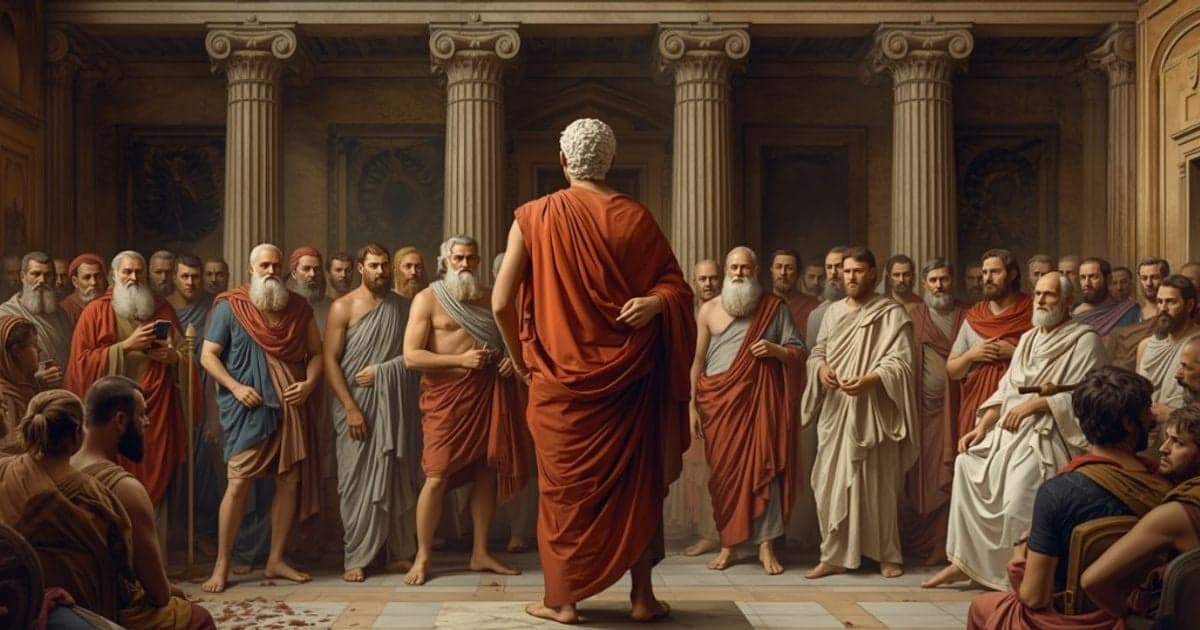
The Apology
The Gadfly Under Fire
Stay with Potidaea, the illegal trial of the generals, and Leon of Salamis, and treat the sting as a job the city needs more than it wants.
The Sting the City Needs
Socrates does not call himself a hero. He calls himself a fly. Athens is a large, slow horse. The god assigned the irritation. The metaphor is comic until you notice the record behind it: a soldier who held his post, a councilor who voted against an illegal mass trial, a private citizen who walked away from the Thirty rather than fetch a man for killing.
Under fire the gadfly is offered a bargain that sounds like mercy: stop examining and live. He refuses. He will not turn the sting into theater either. After the vote he tells them that killing him injures the horse more than the fly.
The skill is recognizing when your actual work is to keep a sluggish system awake, and what it costs to stay at that post after the room has decided the waking is the crime.
The Central Lesson
A sluggish system will call the person who wakes it a nuisance, then a danger, then a file. The Apology asks whether you can keep the sting without turning it into a performance, and whether you understand that swatting the fly does not make the horse any faster.
Chapter-by-Chapter Analysis
A Mission That Makes Enemies
The oracle sends Socrates looking for a wiser man. Each interview leaves a powerful person exposed. Young men enjoy the show. The stung begin to call him a corrupter because they cannot answer the question.
Key Insight:
A gadfly is not hired for comfort. The same work that keeps a system honest also manufactures the coalition that wants the sting gone.
“I found that the men most in repute were all but the most foolish; and that others less esteemed were really wiser and better.”
Hatred as Occupational Hazard
Socrates says the prejudice against him rose from telling the truth about pretenders. The stock charges follow because a stung expert needs a label that sounds civic.
Key Insight:
When your job is to wake a room, expect the room to call the waking an attack. The label is not a diagnosis. It is a way to stop the interview.
“what is their hatred but a proof that I am speaking the truth?”
Obey God Rather Than the Offer to Go Quiet
Anytus says they should never have indicted him if they meant to let him go. Socrates agrees. He will obey God rather than the jury and will not cease examining lives, even if a thousand deaths await him.
Key Insight:
The gadfly's real test is the offer to stop. A city will often tolerate the sting until it becomes a habit. The skill is knowing which post you will not leave when silence is the bargain.
“I shall obey God rather than you, and while I have life and strength I shall never cease from the practice and teaching of philosophy”
The Steed and the Two Public Stands
Socrates calls himself a gadfly on a great and noble steed that is tardy in its motions. He reminds them of the illegal trial of the generals and of the Thirty's order to fetch Leon. He voted no. He went home.
Key Insight:
The metaphor is not decoration. The sting has a record: two moments when the city or the junta wanted compliance and he spent his body instead. A gadfly who has never paid is only a talker.
“I am a sort of gadfly, given to the state by God; and the state is a great and noble steed who is tardy in his motions owing to his very size, and requires to be stirred into life.”
No Theater, Still on Duty
He will not bring his sons to petition for acquittal. The job is not to survive by spectacle. The job is to keep the examination honest, including the jury's oath.
Key Insight:
Under fire, the temptation is to become a performer so the sting looks like a plea. Socrates keeps the role even when the role will not save him.
“I will not bring any of them hither in order to petition you for an acquittal.”
Killing the Fly Does Not Wake the Horse
He prophesies younger, harsher accusers. If they think death stops censure, they are mistaken. The honorable escape is not disabling others but improving themselves.
Key Insight:
A system can swat the person and still need the function. The gadfly lesson after the verdict is that silence by force multiplies the questions it was meant to end.
“if you kill such an one as I am, you will injure yourselves more than you will injure me.”
Applying This to Your Life
Know Which Post You Will Not Leave
Socrates names philosophy as the assignment he will not drop. Before a retaliation cycle starts, decide what question you are actually there to keep asking. If you cannot name it, you will bargain it away.
Keep a Record of the Cost
The generals and Leon are not anecdotes. They are proof he has already paid. If you speak as a gadfly, be able to point to the quieter refusals, not only the public speeches.
Do Not Confuse Survival with the Job
The offer to go quiet will sound like wisdom. Sometimes it is. Socrates' test is whether the horse still needs waking and whether you are the one assigned. If both are true, living smaller is not a strategy. It is a resignation.