
Lessons
Lessons from The Apology
Six lessons from this classic work, traced chapter by chapter.
0:00 / 0:00
Chaerephon asks the Delphic oracle if any man is wiser than Socrates, and the god says no. Socrates spends years trying to refute that answer by questioning politicians, poets, and craftsmen, and the men he exposes become his enemies. Plato wrote the speech after the trial of 399 BC, present in the court, later naming himself among the sureties. The old rumor had already done the work. The formal charge only had to finish it. The man Athens calls a corrupter is the only person in the courtroom who will not lie to stay alive.
Continue the summary
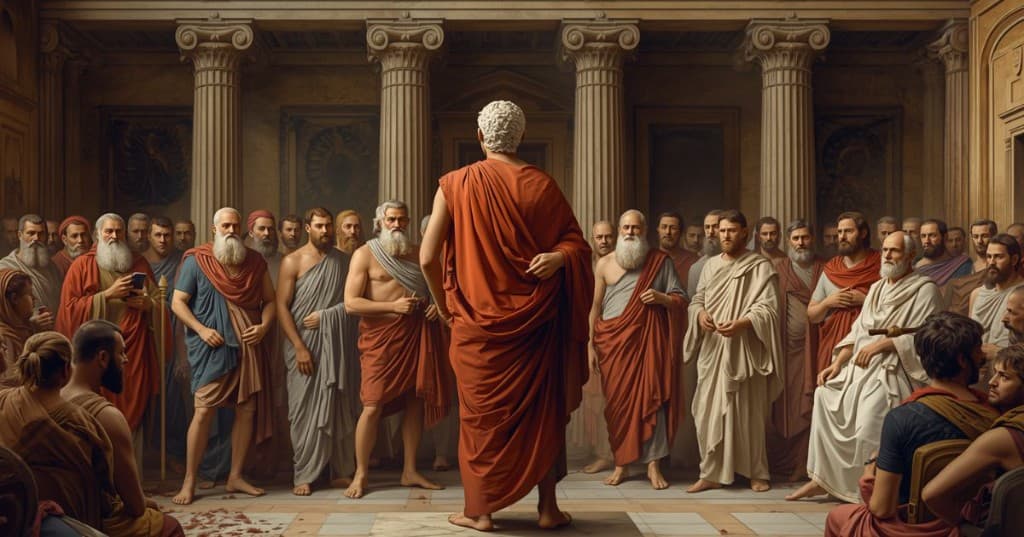
Socrates is seventy: poor, barefoot, and so sure that an unexamined life is not worth living that he will not polish a speech to save himself. Meletus brings the formal charge of impiety and corrupting the youth, with Anytus and Lycon behind him. The old accusers have no names. They are the childhood rumor, the Clouds of Aristophanes, and the city gossip that already decided who he is. Chaerephon is the friend who asked Delphi. Plato sits in the court and later writes himself into the sureties. The room also holds five hundred jurors, the Prytanes who once wanted an illegal mass trial of the generals, and the Thirty who ordered Socrates to fetch Leon of Salamis for execution. He refused both times.
Jowett opens by warning that this is Plato's portrait, true to the man and not a transcript. Socrates refuses ornamented rhetoric and asks only that the speaker speak truly and the judge decide justly. He fights shadows he cannot cross-examine, then tells the oracle story: he found that the men most in repute were all but the most foolish. The artisans knew their craft and thought they knew everything else. Meletus claims every Athenian improves the youth except Socrates alone, and a horse-trainer question breaks the charge in public. Socrates calls himself a gadfly on a sluggish steed. He will not parade his three sons. The jury convicts him. He proposes maintenance in the Prytaneum, then a small fine. They vote death. He tells them the unexamined life is not worth living, prophesies younger accusers, and walks out without pretending he knows what death is.
Plato wrote the speech after watching his teacher die, and he never treats the trial as a cute martyr story or the irony as a parlor trick. The title means defense, not regret. Rhetoric fails. Theatrical begging fails. A city that wants comfort more than questions will always find a charge that sounds like piety. Mercy, when it arrives, arrives as composure after the verdict, not as a pardon. What remains is not a sermon against Athens. It is a picture of what one man owes to a mission when the cost is everything he has left.
The old accusers are already in the room before Meletus speaks. Reputation vs. Truth is Jowett's warning, the Clouds of Aristophanes, and a city that already knew the verdict. Oracle Wisdom vs. Assumed Expertise is Delphi, then the politicians, poets, and artisans who thought a title was the same as a tested claim. Cross-Examining Weak Accusations is Meletus claiming every Athenian improves the youth except one man, then a horse-trainer question breaking the charge in public. The Gadfly Under Fire is the sluggish steed, the illegal trial of the generals, Leon of Salamis, and a mission he will not drop after they vote death. Dignity Over Desperation is the refused parade of three sons and the oath he will not ask the jury to break. Facing Death Without Fear is the unexamined life after the vote, the faster runner named unrighteousness, and the hour of departure he will not pretend to have mapped.
The Clouds already named him before Meletus filed a charge. A horse-trainer question is still standing in the open court. The three sons stay off the stage. Wide Reads sets summaries, quotes, and audio with all ten chapters, and Socrates still walks out without pretending he knows what death is.
Why this matters
People still open this speech the moment a room has decided who they are before the evidence arrives: the meeting where rumor set the verdict, the interview where a title stood in for a tested claim, the choice between a polished performance that buys safety and a plain account that will not. Socrates does not get a pardon or a rescue. This guide keeps that pressure tied to the oracle in chapter 1, the horse-trainer question in chapter 6, and the composure after the verdict in chapter 9.
Prestige deep dive
A Psychological Reading of The Apology
The Apology is the psychology of a man who must defend a life of questions inside a city that already has his verdict, and who refuses to buy survival with a performed self.
- The Story That Arrives Before You Speak
- Plain Speech as a Refusal to Play
- Fighting Accusers You Cannot Cross-Examine
Theme breakdowns
Explore the lessons
The Apology is Plato's account of Socrates' trial in 399 BC, where a Delphic oracle already called him the wisest man before Meletus ever filed a charge: Socrates spends years testing that verdict on politicians, poets, and craftsmen who become his enemies, breaks the formal charge in open court with a single question about horse-trainers, calls himself a gadfly on a sluggish city, refuses to parade his three sons for pity, and after five hundred jurors vote death, walks out still refusing to pretend he knows what comes next.
Each card traces a pattern through named chapters — summaries, quotes, and key insights tied to the scenes that prove it. Start with the featured lessons, then open the deep dives below.
Deep dives
Chapter-by-chapter breakdowns
Cross-Examining Weak Accusations
Watch Meletus claim every Athenian improves the youth except one man, then see a horse-trainer question break the charge in public.
The Gadfly Under Fire
Stay with Potidaea, the illegal trial of the generals, and Leon of Salamis, and treat the sting as a job the city needs more than it wants.
Continue Exploring
Guides, life skills, and the full library.More ways to read The Apology: guides, life skills, and the wider library.