
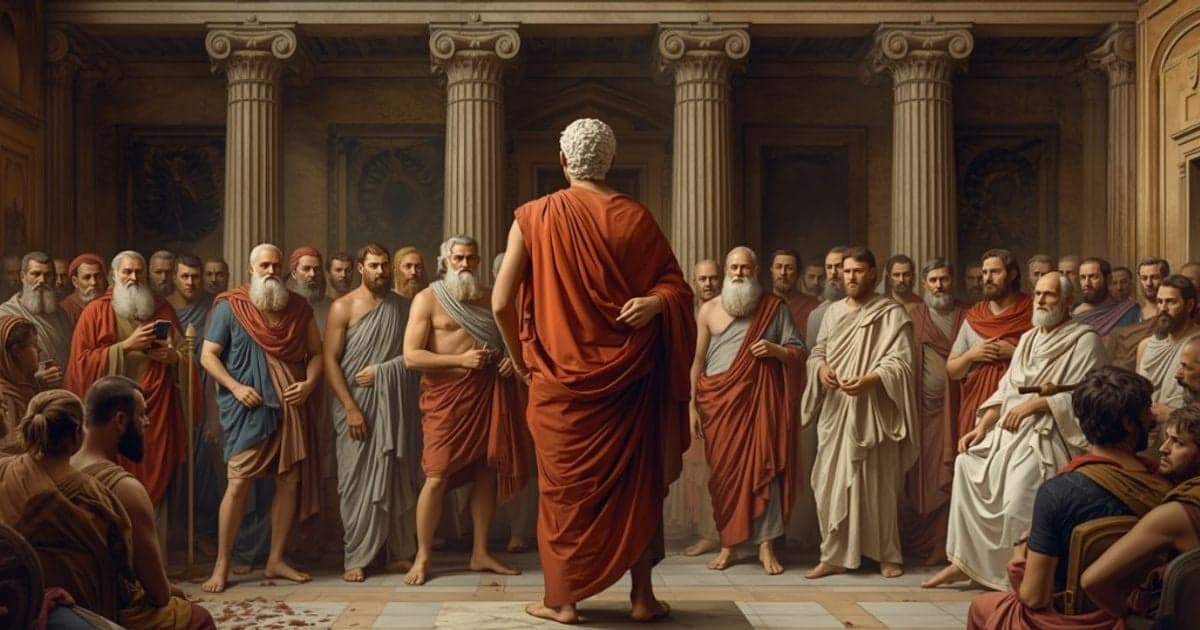
The Apology
Oracle Wisdom vs. Assumed Expertise
Follow Delphi through politicians, poets, and artisans, and watch the men most in repute prove they do not know what they claim.
The Wisest Know the Limit
The oracle does not say Socrates has the answers. It says no man is wiser, and Socrates spends a life trying to prove the god wrong. He fails in a useful way. The politicians talk as if they know. The poets cannot interpret their own lines. The artisans know a craft and then announce themselves on every other subject.
That pattern is the book's second skill. A title, a reputation, or a successful trade can become a costume for certainty. Socrates' only claimed advantage is negative: he does not think he knows what he does not know. Even death stays inside that rule.
The examined life is the method that survives the trial. You test the confident person, including yourself, until the conceit shows or the knowledge does.
The Central Lesson
The men most in repute were all but the most foolish because they never checked the edge of their knowledge. Oracle wisdom is not mysticism. It is the daily habit of testing a confident title, including your own, until the claim either stands or falls.
Chapter-by-Chapter Analysis
The Mission Begins as a Puzzle
Jowett recounts Chaerephon's trip to Delphi and Socrates' attempt to refute the oracle by finding a wiser man. Politicians, poets, and craftsmen fail the test in the same way: a little knowledge plus a large conceit.
Key Insight:
The oracle does not crown Socrates as a walking encyclopedia. It names a method: the person who knows the limit of his knowledge is already ahead of the person who does not.
“The enthusiastic Chaerephon had gone to Delphi and asked the oracle if there was any man wiser than Socrates; and the answer was, that there was no man wiser.”
Politicians, Poets, and the Gap
Socrates goes first to the politicians, then to the poets. The men of repute think they know. He neither knows nor thinks that he knows. The poets cannot explain their own work better than a bystander.
Key Insight:
A title can hide an empty room. Ask the person to explain the thing they are famous for. If they cannot, the reputation was doing the thinking for them.
“he knows nothing, and thinks that he knows; I neither know nor think that I know.”
Artisans Outside Their Lane
The good workmen know their craft and then assume they also know high matters. That overreach, Socrates says, overshadows the wisdom they actually have. God only is wise; human wisdom is worth little.
Key Insight:
Competence in one domain is not a license for every domain. The more useful someone is at a trade, the easier it is for them to mistake that usefulness for general authority.
“even the good artisans fell into the same error as the poets;—because they were good workmen they thought that they also knew all sorts of high matters, and this defect in them overshadowed their wisdom;”
Meletus as Expert on Youth
Meletus claims every Athenian improves the youth except Socrates. The charge treats the whole city as a faculty and one man as the sole corrupter. Socrates makes him own that absurdity in public.
Key Insight:
Assumed expertise loves total statements. If everyone is an improver except the accused, nobody has to demonstrate a method. The claim is a crowd, not a craft.
“Then every Athenian improves and elevates them; all with the exception of myself; and I alone am their corrupter?”
Knowing What You Do Not Know About Death
Socrates will not calculate living or dying as if he had a map of the next room. He is certain that deserting his duty is an evil. He is not certain that death is.
Key Insight:
The oracle lesson applies to the last question as well as the first. Refusing to fake knowledge is itself a form of expertise: you stop selling certainty you do not have.
“a man who is good for anything ought not to calculate the chance of living or dying; he ought only to consider whether in doing anything he is doing right or wrong”
The Unexamined Life
After the verdict Socrates tells the jury that the unexamined life is not worth living. The examined life is not a hobby. It is the only expertise he will claim: the work of testing what you think you know.
Key Insight:
Wisdom here is a practice, not a credential. The men of repute failed because they stopped examining. The condemned man keeps the method after the city has closed the case.
“the unexamined life is not worth living, you are still less likely to believe me.”
Applying This to Your Life
Ask Them to Explain the Thing
When a title is doing the talking, ask for the mechanism. Socrates asks poets to interpret their own lines. If the explanation cannot survive a follow-up, you have found conceit, not craft.
Keep Competence Inside Its Lane
The artisans fail by expanding. A good engineer is not automatically a good moralist, manager, or parent. Treat one proven skill as one proven skill.
Practice Negative Wisdom
Socrates' advantage is the sentence he will not say. Before you advise, diagnose, or predict, name what you do not know. That admission is the oracle's actual gift.