The Apology
Plato
0:000:00
0:00 / 0:00

Prestige · $2.99/month
Chapter audio, theme analysis, and downloads
Plato
0:00 / 0:00
Chaerephon asks the Delphic oracle if any man is wiser than Socrates, and the god says no. Socrates spends years trying to refute that answer by questioning politicians, poets, and craftsmen, and the men he exposes become his enemies. Plato wrote the speech after the trial of 399 BC, present in the court, later naming himself among the sureties. The old rumor had already done the work. The formal charge only had to finish it. The man Athens calls a corrupter is the only person in the courtroom who will not lie to stay alive.
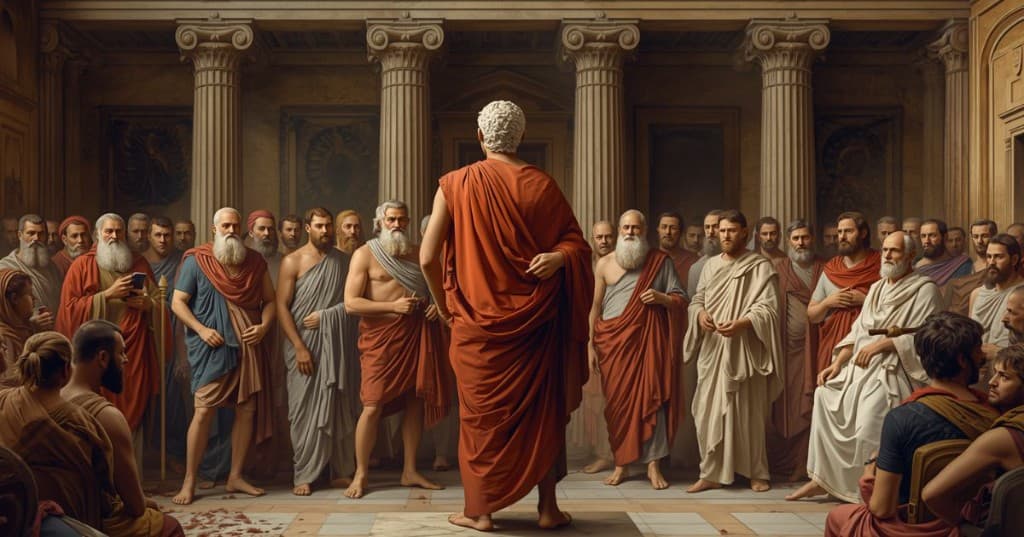
Socrates is seventy: poor, barefoot, and so sure that an unexamined life is not worth living that he will not polish a speech to save himself. Meletus brings the formal charge of impiety and corrupting the youth, with Anytus and Lycon behind him. The old accusers have no names. They are the childhood rumor, the Clouds of Aristophanes, and the city gossip that already decided who he is. Chaerephon is the friend who asked Delphi. Plato sits in the court and later writes himself into the sureties. The room also holds five hundred jurors, the Prytanes who once wanted an illegal mass trial of the generals, and the Thirty who ordered Socrates to fetch Leon of Salamis for execution. He refused both times.
Jowett opens by warning that this is Plato's portrait, true to the man and not a transcript. Socrates refuses ornamented rhetoric and asks only that the speaker speak truly and the judge decide justly. He fights shadows he cannot cross-examine, then tells the oracle story: he found that the men most in repute were all but the most foolish. The artisans knew their craft and thought they knew everything else. Meletus claims every Athenian improves the youth except Socrates alone, and a horse-trainer question breaks the charge in public. Socrates calls himself a gadfly on a sluggish steed. He will not parade his three sons. The jury convicts him. He proposes maintenance in the Prytaneum, then a small fine. They vote death. He tells them the unexamined life is not worth living, prophesies younger accusers, and walks out without pretending he knows what death is.
Plato wrote the speech after watching his teacher die, and he never treats the trial as a cute martyr story or the irony as a parlor trick. The title means defense, not regret. Rhetoric fails. Theatrical begging fails. A city that wants comfort more than questions will always find a charge that sounds like piety. Mercy, when it arrives, arrives as composure after the verdict, not as a pardon. What remains is not a sermon against Athens. It is a picture of what one man owes to a mission when the cost is everything he has left.
The old accusers are already in the room before Meletus speaks. Reputation vs. Truth is Jowett's warning, the Clouds of Aristophanes, and a city that already knew the verdict. Oracle Wisdom vs. Assumed Expertise is Delphi, then the politicians, poets, and artisans who thought a title was the same as a tested claim. Cross-Examining Weak Accusations is Meletus claiming every Athenian improves the youth except one man, then a horse-trainer question breaking the charge in public. The Gadfly Under Fire is the sluggish steed, the illegal trial of the generals, Leon of Salamis, and a mission he will not drop after they vote death. Dignity Over Desperation is the refused parade of three sons and the oath he will not ask the jury to break. Facing Death Without Fear is the unexamined life after the vote, the faster runner named unrighteousness, and the hour of departure he will not pretend to have mapped.
The Clouds already named him before Meletus filed a charge. A horse-trainer question is still standing in the open court. The three sons stay off the stage. Wide Reads sets summaries, quotes, and audio with all ten chapters, and Socrates still walks out without pretending he knows what death is.
Sit with Jowett's warning, the Clouds, and the nameless old accusers, and separate a city's story from what Socrates actually said.
On the whole we arrive at the conclusion that the “Apology” is true to the character of Socrates, but we cannot show…
Before Socrates speaks a word in the Apology, Victorian translator Benjamin Jowett stops you with a ...
Socrates opens his defense by admitting his accusers spoke so persuasively they almost made him forg...
Socrates opens by splitting his opponents in two: the recent accusers he can name, and a far older s...
Socrates imagines a juror asking a fair question: if the rumors are baseless, why do they keep follo...
Socrates turns last to the artisans. Unlike the politicians and poets, they truly know their trades,...
Socrates turns from the old accusers to the formal indictment led by Meletus, the self-described pat...
Socrates says he has answered Meletus and turns to the deeper danger: not the named prosecutors, but...
Socrates asks the jury to hear him out. If they kill a man like him, they will injure themselves mor...
Socrates adds one last word before resting his defense. Some juror, he imagines, may be angry that o...
Socrates is not grieved by the condemnation. The vote was closer than he expected; thirty ballots th...
Published -399
Plato (428-348 BC) was born into an Athenian family that expected him for politics, then watched the restored democracy put his teacher on trial. He was present at the defense, later named himself among the sureties for a fine Socrates never paid, and spent the rest of his life writing dialogues that keep that courtroom in view.
He founded the Academy just outside Athens, one of the first lasting schools in the West. The Apology is among his shortest works and his most personal: a reconstruction of the 399 BC trial that ended Socrates' life. It is not a transcript. Jowett said as much. It is a portrait meant to be true to the man.
His gift was making a question feel more dangerous than a charge. The speech still finds readers who recognize the moment a room decided who they were before they opened their mouths, and the moment they refused to beg for a verdict they would not respect.
Plato speaks to the moment a room has already decided who you are before you open your mouth: the meeting where the verdict was set by rumor before the evidence arrived, the interview where a title stood in for a tested claim, the choice between a polished performance that buys your safety and a plain account that will not. The Apology names that pressure inside an Athenian courtroom in 399 BC, with five hundred jurors and a sentence of death on the table.
What makes him indispensable here is that he was in the room. Plato watched the restored Athenian democracy try and execute his teacher, later named himself among the sureties for a fine Socrates never got the chance to pay, and spent the rest of his life writing dialogues that keep that courtroom in view. The Apology is not a transcript. It is a portrait, written by a student who needed to explain why the wisest man he knew died for asking questions.
Plot, characters, and themes — plus audio, source text, and patterns you can use after class
Two ways in
Chapter by chapter, with audio. The meaning arrives because you experienced it — not because someone listed bullet points.
Start with this.
The actual words the author wrote, alongside every summary. Use the guide, then step into the source.
Then step into the source.
Either way, the door opens inward.
— and most of all, Why does this matter?
Purchase the complete book to access all chapters and support classic literature
Available in paperback, hardcover, and e-book formats
Free to read • No account required

Weekly insights from the classics. Amplify Your Mind.
We focus on public domain classics because these timeless works belong to everyone. No paywalls, no restrictions—just wisdom that has stood the test of centuries, freely accessible to all readers.
Public domain books have shaped humanity's understanding of love, justice, ambition, and the human condition. By amplifying these works, we help preserve and share literature that truly belongs to the world.
© 2026 Wide Reads™. All Rights Reserved.
Intelligence Amplifier™ and Wide Reads™ are proprietary trademarks of Arvin Lioanag.
Copyright Protection: All original content, analyses, discussion questions, pedagogical frameworks, and methodology are protected by U.S. and international copyright law. Unauthorized reproduction, distribution, web scraping, or use for AI training is strictly prohibited. See our Copyright Notice for details.
Disclaimer: The information provided on this website is for general informational and educational purposes only and does not constitute professional, legal, financial, or technical advice. While we strive to ensure accuracy and relevance, we make no warranties regarding completeness, reliability, or suitability. Any reliance on such information is at your own risk. We are not liable for any losses or damages arising from use of this site. By using this site, you agree to these terms.
Follow Delphi through politicians, poets, and artisans, and watch the men most in repute prove they do not know what they claim.
The enthusiastic Chaerephon had gone to Delphi and asked the oracle if there was any man wiser than Socrates; and the answer…
Deep dives
Watch Meletus claim every Athenian improves the youth except one man, then see a horse-trainer question break the charge in public.
let the speaker speak truly and the judge decide justly.
Stay with Potidaea, the illegal trial of the generals, and Leon of Salamis, and treat the sting as a job the city needs more than it wants.
I found that the men most in repute were all but the most foolish; and that others less esteemed were really wiser…
Refuse the parade of three sons and the broken oath, and hold a defense that will not buy life with a spectacle.
but from me you shall hear the whole truth: not, however, delivered after their manner in a set oration duly ornamented with…
Hear the unexamined life, the faster runner named unrighteousness, and the hour of departure, without pretending the next room is mapped.
Socrates might have been acquitted if in any moderate degree he would have conciliated the favour of the dicasts;
Trending search questions mapped to the six lessons in this speech—what readers actually ask Google about why Socrates was put on trial, the Delphic oracle, the unexamined life, the gadfly metaphor, and the verdict.
Plato's account of Socrates' trial in Athens in 399 BC, where he faces charges of impiety and corrupting the youth after decades of testing a Delphic oracle's claim that no man was wiser than him. He questions politicians, poets, and craftsmen who become his enemies, breaks the formal charge in open court, and after five hundred jurors vote death, walks out refusing to pretend he knows what comes next.
Explore Reputation vs. TruthMeletus brings the formal charge of impiety and corrupting the youth, backed by Anytus and Lycon, but Socrates says the real accusers have no names: childhood rumor, the Clouds of Aristophanes, and years of city gossip that had already decided who he was. The old rumor did the work. The formal charge only had to finish it.
Explore Reputation vs. TruthSocrates' friend Chaerephon asks the oracle if any man is wiser than Socrates, and the god says no. Socrates spends years trying to refute that answer by questioning men in repute for wisdom, and finds that the artisans knew their craft and thought they knew everything else. The men most in repute turn out to be all but the most foolish.
Explore Oracle Wisdom vs. Assumed ExpertiseAfter the jury convicts him and votes death, Socrates tells them that day after day to discourse about virtue is the greatest good of man, and that the unexamined life is not worth living. It is not a slogan he adds for comfort. It is the reason he refuses to buy his life with a polished speech or a parade of his three sons.
Explore Facing Death Without FearHe compares Athens to a great and noble steed that is tardy in its motions and himself to the gadfly a god assigned to stir it into life. He points to two proofs he has already paid for the sting: he voted against an illegal mass trial of the generals, and he refused the Thirty's order to fetch Leon of Salamis for execution.
Explore The Gadfly Under FireSix lessons run through the speech: separate a city's story from what someone actually said and did; treat a title as a claim to test, not evidence of expertise; cross-examine weak accusations instead of accepting their premise; expect a system you keep honest to eventually call the honesty a crime; hold your dignity without staging desperation for pity; and face an uncertain ending without pretending you have already mapped it. Those skills, not a martyr story, are why the speech still answers modern searches.
The speech still finds readers who recognize the moment a city wants comfort more than questions and will always find a charge that sounds like piety. Plato gives Socrates no pardon and no last-minute rescue, only composure after the verdict. Anyone who has watched an old rumor do the work a formal charge only has to finish is reading the same trial Plato never stopped writing about.