Master this chapter. Complete your experience
Purchase the complete book to access all chapters and support classic literature
As an Amazon Associate, we earn a small commission from qualifying purchases at no additional cost to you.
Available in paperback, hardcover, and e-book formats
Why This Matters
Connect literature to life
This chapter teaches how to identify when authority figures resist questions not because the questions are wrong, but because they threaten comfortable arrangements.
Practice This Today
This week, notice when someone in authority deflects your legitimate concerns by attacking your character instead of addressing the issue itself.
Now let's explore the literary elements.
Key Quotes & Analysis
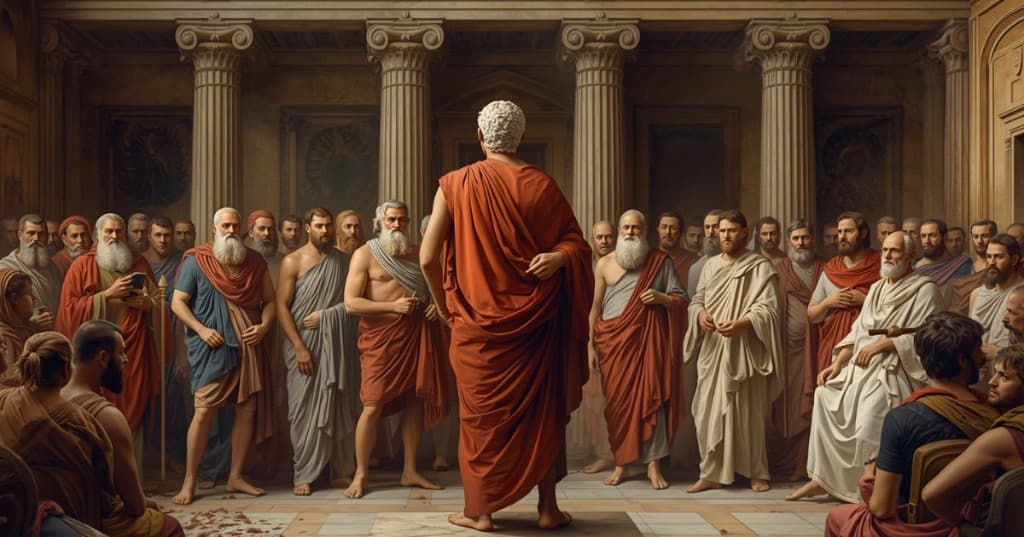
"If you kill me you will not easily find a successor to me, who, if I may use such a ludicrous figure of speech, am a sort of gadfly, given to the state by God; and the state is a great and noble steed who is tardy in his motions owing to his very size, and requires to be stirred into life."
Context: Explaining his role in Athens using the gadfly metaphor
He introduces this image with self-deprecating humor — 'if I may use such a ludicrous figure.' He knows it sounds absurd. He says it anyway. The gadfly is small, annoying, and entirely necessary for a horse that has grown sluggish with its own size and comfort.
In Today's Words:
I know this sounds ridiculous, but: Athens is a big sleepy horse, and I'm the fly keeping it awake.
"Nothing will injure me, not Meletus nor yet Anytus — they cannot, for a bad man is not permitted to injure a better than himself."
Context: Asserting that execution cannot constitute a genuine injury to a good man
This is not bravado. It is a philosophical claim: harm to a good person's body or reputation is not harm to the person. The real injury — corrupting the soul — is something Meletus and Anytus are incapable of inflicting on him.
In Today's Words:
They can kill me. They can't hurt me. Those are different things.
"I have a sufficient witness to the truth of what I say — my poverty."
Context: Proving he has never charged for his teaching by pointing to his own destitution
His poverty is the only evidence he needs. If he were being paid for corrupting youth, he would have money. He has none. The accusers cannot produce a single witness who paid him. His wallet makes his case.
In Today's Words:
If I'd been getting paid to corrupt people, I wouldn't be broke.
Thematic Threads
Class
In This Chapter
Socrates uses his poverty as proof of integrity, showing how economic status can signal moral character
Development
Builds on earlier themes of wealth versus wisdom, now explicitly connecting financial status to credibility
In Your Life:
You might notice how people judge your character based on your economic situation rather than your actions
Identity
In This Chapter
Socrates fully embraces his role as Athens' gadfly, defining himself through his function rather than status
Development
Evolution from defending his methods to claiming his essential purpose in society
In Your Life:
You might struggle between being who others want you to be versus embracing your true role in your community
Social Expectations
In This Chapter
Socrates explains why he avoided politics: the system punishes honesty and rewards corruption
Development
Deepens earlier exploration of why good people often avoid public roles
In Your Life:
You might find yourself choosing between advancing in broken systems or maintaining your principles
Personal Growth
In This Chapter
Socrates shows growth through concrete examples of choosing principle over safety
Development
Moves from abstract philosophy to specific moments of moral courage
In Your Life:
You might recognize moments when you had to choose between what's right and what's safe
Human Relationships
In This Chapter
Socrates points to the families of his supposed victims as character witnesses
Development
Introduced here as evidence of his true impact on those closest to his work
In Your Life:
You might realize that the people who know you best are your most credible character witnesses
You now have the context. Time to form your own thoughts.
Discussion Questions
- 1
Socrates compares himself to a gadfly stinging a lazy horse. What specific examples does he give to prove he's been doing this job his whole life?
analysis • surface - 2
Why does Socrates argue that his poverty actually proves his innocence? What does this reveal about how real corruption works?
analysis • medium - 3
Think about your workplace, family, or community. Who serves as the 'gadfly' asking uncomfortable but necessary questions? How do people typically respond to them?
application • medium - 4
Socrates chose to oppose illegal actions even when it put him in danger. When have you had to choose between safety and doing what's right? What factors influenced your decision?
application • deep - 5
What does this chapter suggest about why societies often silence their most valuable critics? How can we distinguish between destructive troublemakers and necessary gadflies?
reflection • deep
Critical Thinking Exercise
Map Your Gadfly Encounters
Think of three people who have made you uncomfortable by questioning something you believed or did. For each person, write down what they challenged, how you initially reacted, and whether you later realized they had a point. Then identify one area in your own life where you might need to be the gadfly for someone else.
Consider:
- •Consider both personal relationships and professional situations
- •Look for patterns in how you respond to uncomfortable feedback
- •Think about the difference between criticism meant to help versus criticism meant to harm
Journaling Prompt
Write about a time when you had to choose between speaking up about something wrong and staying quiet to avoid conflict. What factors influenced your decision, and how do you feel about that choice now?
Coming Up Next...
Chapter 9: Dignity Over Desperation
Having made his case, Socrates must now address a different kind of challenge: why he won't resort to the emotional appeals and theatrical displays that other defendants use to win sympathy from the jury.