
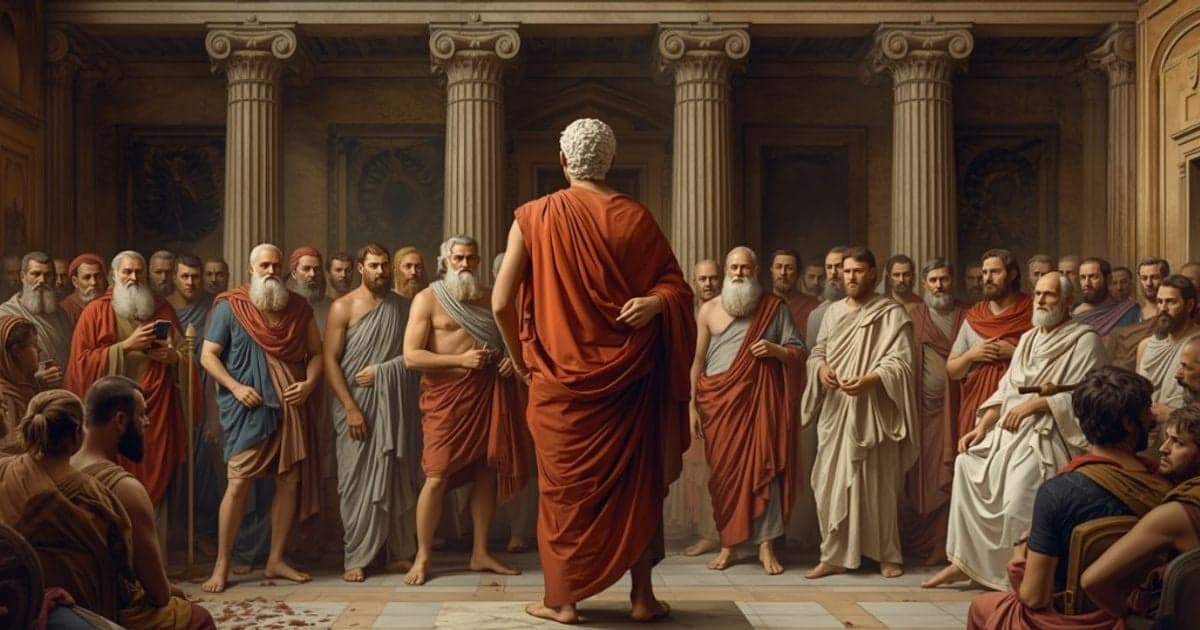
The Apology
Facing Death Without Fear
Hear the unexamined life, the faster runner named unrighteousness, and the hour of departure, without pretending the next room is mapped.
The Slower Runner
Socrates is seventy and slow. Death has caught him. Unrighteousness, he says, is faster, and it has already caught the men who voted. That sentence is the book's last argument about fear. The thing you should outrun is not the end of the body. It is the life that would make the ending a disgrace.
He will not pretend he knows what comes next. Sleep or a journey to just judges: both remain possible. The divine sign did not interrupt the defense, so he guesses the death is not an evil. He still will not sell a finished picture. The unexamined life is not worth living even if the jury will not believe him.
Courage in this speech is not a roar. It is the same method used on politicians, now used on the last rumor: the rumor that death is the worst thing, and that any bargain is therefore wise.
The Central Lesson
Death is the slower runner. Unrighteousness is faster. The Apology trains you to fear the life that would make the ending cheap, not the ending itself, and to walk toward an unknown room without selling a map you do not have.
Chapter-by-Chapter Analysis
A Life Already Aimed at the Hour
Jowett notes Xenophon's report that Socrates had no wish to live at any cost and that the divine sign would not let him prepare a conciliatory defense. The speech is written as if the hour had been in view for years.
Key Insight:
Fear shrinks when the ending has already been included in the job. Socrates does not discover courage in chapter 10. He arrives with a life that treated this day as possible.
“Socrates might have been acquitted if in any moderate degree he would have conciliated the favour of the dicasts;”
Do Not Pretend You Know the Next Room
He will not calculate living and dying as if he had a map. Deserting the post is a known evil. Death is not known to be one. That ignorance is the opposite of bravado. It is a refusal to sell certainty.
Key Insight:
Fear often dresses as knowledge: death is the worst thing, therefore any bargain is wise. Socrates strips that sentence. You may not know what death is. You do know when you are doing wrong.
“a man who is good for anything ought not to calculate the chance of living or dying; he ought only to consider whether in doing anything he is doing right or wrong”
Two Rehearsals
The illegal trial of the generals and the order to fetch Leon were earlier chances to prefer safety. He voted no. He went home. Death had already been priced in those rooms and found cheaper than complicity.
Key Insight:
Facing death without fear is rarely a first performance. It is a sequence of smaller refusals that make the last one recognizable to the person who has to live it.
“I made up my mind that I would run the risk, having law and justice with me, rather than take part in your injustice because I feared imprisonment and death.”
Acquittal Is Not the Highest Good
He will not buy a few more years with a broken oath and a parade of sons. The judge's duty is to give judgment, not to make a present of justice. A life purchased that way would be a different life.
Key Insight:
Fear of death makes almost any continuation look like a win. Dignity asks whether the continuation would still be yours. If not, the longer life is the loss.
“his duty is, not to make a present of justice, but to give judgment;”
The Slower Runner and the Hour
Unrighteousness runs faster than death. The accusers have already been caught by the faster runner. He is old and slow; death has overtaken him. The unexamined life is not worth living. Either death is a long sleep or a journey to just judges. He will not pretend to know which. The hour of departure has arrived.
Key Insight:
The last chapter refuses both panic and a sales pitch for the afterlife. Courage here is composure plus honesty: name the two possibilities, keep the mission, walk out.
“The hour of departure has arrived, and we go our ways—I to die, and you to live.”
God Only Is Wise
Before the verdict, the oracle lesson already limits human claims. If human wisdom is worth little, then confident terror about death is another pretension. The man who knows he does not know cannot be bullied by a story he will not authorize.
Key Insight:
Fear needs a finished picture. Socratic ignorance leaves the picture unfinished on purpose. That unfinishedness is what keeps the last hour from becoming a performance of certainty.
“God only is wise; and by his answer he intends to show that the wisdom of men is worth little or nothing;”
Applying This to Your Life
Separate the Known Evil from the Unknown End
Socrates knows desertion is wrong and will not claim the same knowledge about death. When fear is running a decision, write down what you actually know. Do not let a rumor about the worst case authorize a sure wrong.
Rehearse on Smaller Days
The generals and Leon come before the hemlock. Practice the refusal when the cost is a vote, a job, or a friendship, so the large hour is not your first attempt at the same sentence.
Keep the Picture Unfinished
He allows sleep or a journey and will not decorate either. You do not need a finished metaphysics to refuse panic. You need a mission that still makes sense if the next room is blank.