Wide Reads
Literature MattersLife IndexEducators
Sign in
Where to Begin
The Apology - Dignity Over Desperation

Plato

The Apology

Dignity Over Desperation

Home›Books›The Apology›Chapter 9
Previous
9 of 10
Next

Summary

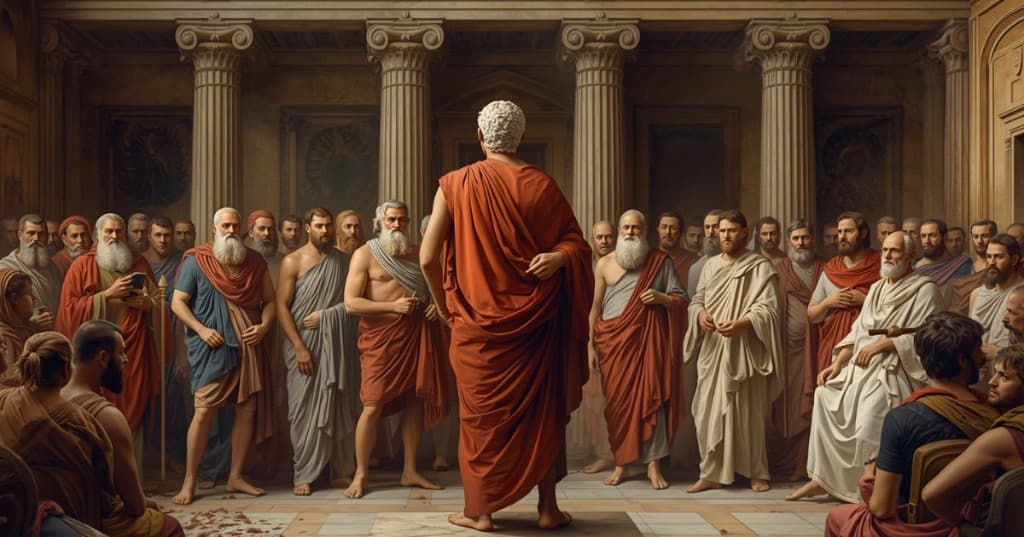
Before resting his defense, Socrates anticipates a particular kind of juror: one who has himself, on some lesser occasion, wept before the judges and produced his children and friends as a moving spectacle — and who now sits displeased that Socrates, facing death, refuses to do the same. He addresses this person directly, and with characteristic care. He is not, he says, made of wood or stone, as Homer says. He has a family. He has three sons — one nearly grown, two still young. He could bring them here. He will not. But not from pride, or indifference to the jury's feelings. He gives two separate reasons, each distinct. The first is public opinion — and he handles it with the sharp irony of a man who knows his reputation and has decided to use it. The world has concluded that Socrates is in some way superior to other men. If men who are held to be superior in wisdom and courage demean themselves with desperate weeping, what does that make them? He has watched men of reputation, condemned in court, behave as though death were something dreadful and unendurable, as though they could be immortal if only the jury let them live. Any stranger arriving in Athens and witnessing this, he says, would conclude that the most eminent men of Athens are no better than women. He will not add to that dishonour. And the jury, he suggests, ought to share that standard: they should be more inclined to condemn a man who stages a pitiful scene than one who holds his peace. The second reason goes deeper. There is something simply wrong, he argues, in asking a judge for a favour rather than informing and convincing him. A judge's oath is to rule according to the law — not according to his own good pleasure, and certainly not according to pity. To ask a judge to set aside that oath for the sake of sentiment is to ask him to commit perjury. And to get an acquittal by overpowering the jury's oaths through entreaty would be, Socrates says, to teach them there are no gods — since only someone who believed that oaths mean nothing would encourage their violation. This would convict him of the very impiety he stands accused of. He will not defend himself by proving the charge true. He closes with a profession of genuine belief: he does believe in the gods, and in a sense higher than any of his accusers do. He commits his cause to the jury and to God alike, to be determined as is best for everyone.

Coming Up in Chapter 10

The jury has spoken, and Socrates faces their verdict. His reaction to the decision reveals surprising insights about fear, expectations, and what it truly means to accept consequences with grace.

Share it with friends

Previous ChapterNext Chapter
GO ADS FREE — JOIN US
Original text
complete·692 words
H

ave to offer. Yet a word more. Perhaps there may be some one who is offended at me, when he calls to mind how he himself on a similar, or even a less serious occasion, prayed and entreated the judges with many tears, and how he produced his children in court, which was a moving spectacle, together with a host of relations and friends; whereas I, who am probably in danger of my life, will do none of these things. The contrast may occur to his mind, and he may be set against me, and vote in anger because he is displeased at me on this account. Now if there be such a person among you,—mind, I do not say that there is,—to him I may fairly reply: My friend, I am a man, and like other men, a creature of flesh and blood, and not “of wood or stone,” as Homer says; and I have a family, yes, and sons, O Athenians, three in number, one almost a man, and two others who are still young; and yet I will not bring any of them hither in order to petition you for an acquittal. And why not? Not from any self-assertion or want of respect for you. Whether I am or am not afraid of death is another question, of which I will not now speak. But, having regard to public opinion, I feel that such conduct would be discreditable to myself, and to you, and to the whole state. One who has reached my years, and who has a name for wisdom, ought not to demean himself. Whether this opinion of me be deserved or not, at any rate the world has decided that Socrates is in some way superior to other men. And if those among you who are said to be superior in wisdom and courage, and any other virtue, demean themselves in this way, how shameful is their conduct! I have seen men of reputation, when they have been condemned, behaving in the strangest manner: they seemed to fancy that they were going to suffer something dreadful if they died, and that they could be immortal if you only allowed them to live; and I think that such are a dishonour to the state, and that any stranger coming in would have said of them that the most eminent men of Athens, to whom the Athenians themselves give honour and command, are no better than women. And I say that these things ought not to be done by those of us who have a reputation; and if they are done, you ought not to permit them; you ought rather to show that you are far more disposed to condemn the man who gets up a doleful scene and makes the city ridiculous, than him who holds his peace.

1 / 2

Master this chapter. Complete your experience

Purchase the complete book to access all chapters and support classic literature

Read Free on GutenbergBuy at Powell'sBuy on Amazon

As an Amazon Associate, we earn a small commission from qualifying purchases at no additional cost to you.

Available in paperback, hardcover, and e-book formats

GO ADS FREE — JOIN US

Why This Matters

Connect literature to life

Skill: Detecting Manipulation Tactics

This chapter teaches how to recognize when people use emotional theater and desperate tactics to avoid accountability.

Practice This Today

This week, notice when someone shifts from addressing facts to making emotional appeals, and ask yourself what they're trying to avoid discussing.

GO ADS FREE — JOIN US

Now let's explore the literary elements.

Key Quotes & Analysis

"I am a man, and like other men, a creature of flesh and blood, and not of wood or stone, as Homer says; and I have a family, yes, and sons, O Athenians, three in number."

— Socrates

Context: Acknowledging he has a family before explaining why he will not produce them in court

He establishes his humanity before the refusal — he is not indifferent to his children or his life. He has everything to lose. The refusal to beg is not because he has nothing at stake but because he will not compromise what he is to protect what he has.

In Today's Words:

I'm not made of stone. I have kids. I have everything to lose. I'm still not going to beg.

"Having regard to public opinion, I feel that such conduct would be discreditable to myself, and to you, and to the whole state. One who has reached my years, and who has a name for wisdom, ought not to demean himself."

— Socrates

Context: His first reason for refusing to produce his children and beg — dignity and reputation

His first argument is pragmatic and social: men of his standing who weep and grovel make everyone look bad. The most eminent men of Athens, seen by a stranger behaving this way, would be judged 'no better than women.' He will not contribute to that spectacle.

In Today's Words:

Men in my position who fall apart in court don't just embarrass themselves — they embarrass everyone who respected them.

"For if, O men of Athens, by force of persuasion and entreaty I could overpower your oaths, then I should be teaching you to believe that there are no gods, and in defending should simply convict myself of the charge of not believing in them."

— Socrates

Context: His second and deeper reason — begging would itself constitute impiety

His second argument is philosophical and devastating: asking the jury to override their sworn oaths through emotional manipulation is to treat those oaths as meaningless — which is to treat the gods as meaningless. He would prove the charge against him true by the very act of trying to escape it.

In Today's Words:

If I manipulate you into ignoring your oaths, I've just proved I don't believe oaths mean anything — which is exactly what I'm on trial for.

Thematic Threads

Class

In This Chapter

Socrates refuses to perform the expected role of a desperate defendant, maintaining dignity despite social pressure to conform

Development

Builds on earlier themes of how class expectations shape behavior and social performance

In Your Life:

You might feel pressure to act a certain way in professional or family situations that contradict your actual values

Identity

In This Chapter

Socrates defines himself by his principles rather than by what others expect or what might save him

Development

Deepens the exploration of authentic self versus performed self from previous chapters

In Your Life:

You face moments where being true to yourself conflicts with what others want or expect from you

Social Expectations

In This Chapter

The court expects emotional theater and manipulation, but Socrates deliberately violates these unspoken rules

Development

Continues the theme of challenging social norms and expectations established throughout the trial

In Your Life:

You encounter situations where 'everyone does it this way' but that way feels wrong to you personally

Personal Growth

In This Chapter

Socrates demonstrates that growth means staying consistent with your values even when it's costly

Development

Builds on the idea that wisdom involves understanding what truly matters versus what appears urgent

In Your Life:

You realize that real maturity sometimes means accepting negative consequences rather than compromising your principles

Human Relationships

In This Chapter

Socrates shows respect for the judges by refusing to manipulate them, treating them as rational beings capable of justice

Development

Extends the theme of honest communication and mutual respect from earlier interactions

In Your Life:

You build stronger relationships by being direct and honest rather than trying to manipulate outcomes through emotional tactics

You now have the context. Time to form your own thoughts.

Discussion Questions

  1. 1

    What tactics does Socrates refuse to use in his defense, and what does he say others typically do in court?

    analysis • surface
  2. 2

    Why does Socrates believe that emotional manipulation in court would be especially hypocritical given his charges?

    analysis • medium
  3. 3

    Think about workplace conflicts or family arguments you've witnessed. How do people typically behave when they feel desperate to win or avoid consequences?

    application • medium
  4. 4

    Describe a situation where you had to choose between getting what you wanted and maintaining your principles. What factors influenced your decision?

    application • deep
  5. 5

    What does Socrates' approach reveal about the relationship between short-term tactics and long-term reputation?

    reflection • deep

Critical Thinking Exercise

10 minutes

Map Your Pressure Points

Think of three different areas where you face regular pressure: work, family, finances, or health. For each area, write down what tactics you've seen people use when they get desperate, and what you've observed happens to their relationships and reputation afterward. Then identify what your own 'non-negotiable' principles are in each area.

Consider:

  • •Notice the difference between temporary relief and long-term consequences
  • •Consider how others remember your behavior under pressure
  • •Think about what you want to be known for when things get difficult

Journaling Prompt

Write about a time when you maintained your principles despite pressure to compromise. What did it cost you in the short term, and what did you gain in the long term?

Coming Up Next...

Chapter 10: Facing Death with Dignity

The jury has spoken, and Socrates faces their verdict. His reaction to the decision reveals surprising insights about fear, expectations, and what it truly means to accept consequences with grace.

Continue to Chapter 10
Previous
The Gadfly's Final Stand
Contents
Next
Facing Death with Dignity

Continue Exploring

The Apology Study GuideTeaching ResourcesEssential Life IndexBrowse by ThemeAll Books

You Might Also Like

The Republic cover

The Republic

Plato

Also by Plato

Jane Eyre cover

Jane Eyre

Charlotte Brontë

Explores personal growth

Great Expectations cover

Great Expectations

Charles Dickens

Explores personal growth

The Strange Case of Dr Jekyll and Mr Hyde cover

The Strange Case of Dr Jekyll and Mr Hyde

Robert Louis Stevenson

Explores personal growth

Browse all 47+ books

Share This Chapter

Know someone who'd enjoy this? Spread the wisdom!

TwitterFacebookLinkedInEmail

Read ad-free with Prestige

Get rid of ads, unlock study guides and downloads, and support free access for everyone.

Subscribe to PrestigeCreate free account
Intelligence Amplifier
Intelligence Amplifier™Powering Wide Reads

Exploring human-AI collaboration through books, essays, and philosophical dialogues. Classic literature transformed into navigational maps for modern life.

2025 Books

→ The Amplified Human Spirit→ The Alarming Rise of Stupidity Amplified→ San Francisco: The AI Capital of the World
Visit intelligenceamplifier.org
hello@widereads.com

WideReads Originals

→ You Are Not Lost→ The Last Chapter First→ The Lit of Love→ Wealth and Poverty→ 10 Paradoxes in the Classics · coming soon
Arvintech
arvintechAmplify your Mind
Visit at arvintech.com

Navigate

  • Home
  • Library
  • Essential Life Index
  • How It Works
  • Subscribe
  • Account
  • About
  • Contact
  • Authors
  • Suggest a Book
  • Landings

Made For You

  • Students
  • Educators
  • Families
  • Readers
  • Literary Analysis
  • Finding Purpose
  • Letting Go
  • Recovering from a Breakup
  • Corruption
  • Gaslighting in the Classics

Newsletter

Weekly insights from the classics. Amplify Your Mind.

Legal

  • Privacy Policy
  • Terms of Service
  • Cookie Policy
  • Accessibility

Why Public Domain?

We focus on public domain classics because these timeless works belong to everyone. No paywalls, no restrictions—just wisdom that has stood the test of centuries, freely accessible to all readers.

Public domain books have shaped humanity's understanding of love, justice, ambition, and the human condition. By amplifying these works, we help preserve and share literature that truly belongs to the world.

A Pilgrimage

Powell's City of Books

Portland, Oregon

If you ever find yourself in Portland, walk to the corner of Burnside and 10th. The building takes up an entire city block. Inside is over a million books, new and used on the same shelf, organized by color-coded rooms with names like the Rose Room and the Pearl Room. You can lose an afternoon. You can lose a weekend. You will find a book you have been looking for your whole life, and three you did not know existed.

It is a pilgrimage. We cannot find a bookstore like it anywhere on earth. If you read the classics, and you ever get the chance, go. It belongs on every reader's bucket list.

Visit powells.com

We are not in any way affiliated with Powell's. We are just a very big fan.

© 2026 Wide Reads™. All Rights Reserved.

Intelligence Amplifier™ and Wide Reads™ are proprietary trademarks of Arvin Lioanag.

Copyright Protection: All original content, analyses, discussion questions, pedagogical frameworks, and methodology are protected by U.S. and international copyright law. Unauthorized reproduction, distribution, web scraping, or use for AI training is strictly prohibited. See our Copyright Notice for details.

Disclaimer: The information provided on this website is for general informational and educational purposes only and does not constitute professional, legal, financial, or technical advice. While we strive to ensure accuracy and relevance, we make no warranties regarding completeness, reliability, or suitability. Any reliance on such information is at your own risk. We are not liable for any losses or damages arising from use of this site. By using this site, you agree to these terms.