Wide Reads
Literature MattersLife IndexEducators
Sign in
Where to Begin
The Apology - Standing Your Ground Under Fire

Plato

The Apology

Standing Your Ground Under Fire

Home›Books›The Apology›Chapter 7
Previous
7 of 10
Next

Summary

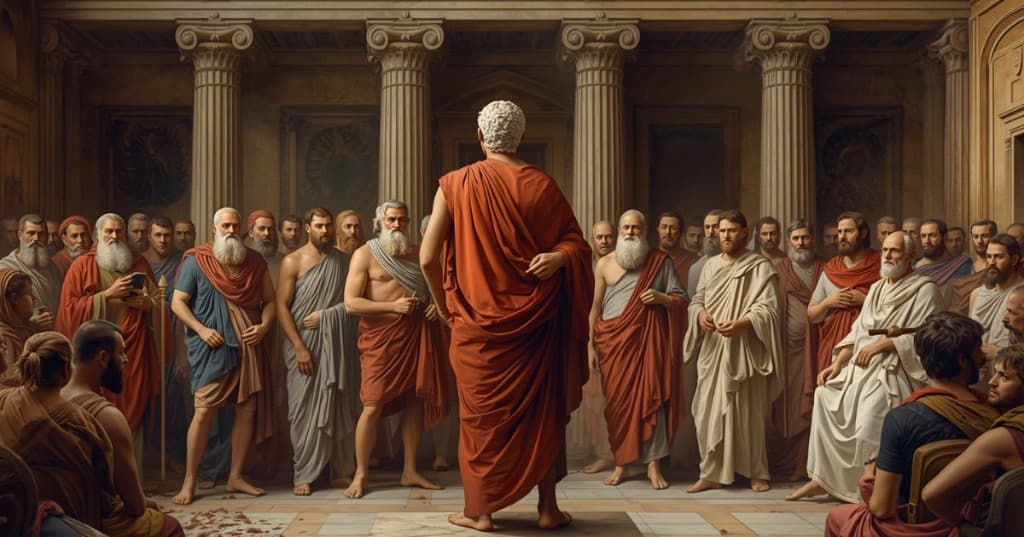
Socrates closes his answer to Meletus and turns to what he considers the real threat: not the men who brought formal charges, but the envy and detraction of the world. This, he tells the jury, is what has destroyed many good men before him and will likely destroy many more. The named accusers are almost beside the point. Someone, he imagines, will ask whether he is not ashamed of pursuing a course of life that is bringing him to an early death. His answer is uncompromising: a man worth anything does not calculate the odds of living or dying. He considers only whether what he is doing is right or wrong. To illustrate, he reaches for Achilles — who was warned by his goddess mother that killing Hector would mean his own death, and who responded with contempt for the warning. "Let me die forthwith and be avenged of my enemy," Achilles said, "rather than abide here by the beaked ships, a laughing-stock and a burden of the earth." A man's only business, wherever he is placed, is to stay at his post. Everything else is disgrace. Socrates then draws the parallel to his own situation. At Potidaea, Amphipolis, and Delium, he stood where his commanders placed him and faced death like any other soldier. It would be strange indeed — and genuinely impious, he suggests — if he now abandoned the post God has assigned him out of fear. The fear of death, he argues, is itself a form of false wisdom: a pretense of knowing something that no one actually knows. No one can say with certainty whether death is a great evil. It may, for all anyone knows, be a great good. To treat it as the worst thing that can happen to a person is the disgraceful ignorance of a man who believes he knows what he does not know. In this alone, Socrates says, he may claim to be wiser than others: he does not suppose he knows what lies beyond. He then puts the matter in the starkest terms possible. Suppose the jury offered him a deal — go free, but stop philosophising. His answer is immediate: he would refuse. He will obey God rather than the jury. While he has life and strength, he will never stop questioning, never stop exhorting everyone he meets — young and old, citizen and foreigner — to care less for money and reputation and more for wisdom, truth, and the improvement of the soul. Virtue, he insists, is not given by money. Money and every other good flow from virtue. That is his teaching. If this is what corrupting the youth means, then he is guilty of it. He will never alter his ways, he says — not even if he has to die many times.

Coming Up in Chapter 8

Socrates warns the jury that killing him will hurt them more than it hurts him. He's about to explain why removing a gadfly like himself damages the very people who think they're protecting themselves.

Share it with friends

Previous ChapterNext Chapter
GO ADS FREE — JOIN US
Original text
complete·1,110 words
H

ave said enough in answer to the charge of Meletus: any elaborate defence is unnecessary, but I know only too well how many are the enmities which I have incurred, and this is what will be my destruction if I am destroyed;—not Meletus, nor yet Anytus, but the envy and detraction of the world, which has been the death of many good men, and will probably be the death of many more; there is no danger of my being the last of them.

1 / 4

Master this chapter. Complete your experience

Purchase the complete book to access all chapters and support classic literature

Read Free on GutenbergBuy at Powell'sBuy on Amazon

As an Amazon Associate, we earn a small commission from qualifying purchases at no additional cost to you.

Available in paperback, hardcover, and e-book formats

GO ADS FREE — JOIN US

Why This Matters

Connect literature to life

Skill: Distinguishing Between Safety and Purpose

This chapter teaches how to separate what feels safe from what feels meaningful when facing difficult choices.

Practice This Today

This week, notice when you feel pressure to compromise something important to you, and ask yourself Socrates' question: is this action right or wrong, not is it safe or risky.

GO ADS FREE — JOIN US

Now let's explore the literary elements.

Key Quotes & Analysis

"A man who is good for anything ought not to calculate the chance of living or dying; he ought only to consider whether in doing anything he is doing right or wrong — acting the part of a good man or of a bad."

— Socrates

Context: Responding to anyone who thinks he should have chosen a safer way of life

This is the ethical core of the chapter: moral calculation and risk calculation are different operations. A person of genuine character does not run the first one through the second. Right and wrong are not adjusted for survival odds.

In Today's Words:

Good people don't ask 'is this safe?' They ask 'is this right?' Those are completely different questions.

"I shall obey God rather than you, and while I have life and strength I shall never cease from the practice and teaching of philosophy."

— Socrates

Context: Rejecting a hypothetical offer of acquittal in exchange for silence

He is offered what most people in danger would take: freedom, on a condition. He refuses. Not because he doesn't value his life, but because the condition would require him to stop being who he is. He will not trade his identity for his survival.

In Today's Words:

Freedom with conditions isn't freedom if the condition is to stop being yourself.

"The fear of death is indeed the pretence of wisdom, and not real wisdom, being a pretence of knowing the unknown; and no one knows whether death, which men in their fear apprehend to be the greatest evil, may not be the greatest good."

— Socrates

Context: Explaining why he refuses to treat death as a threat worth fearing

Fear of death assumes death is bad. But no one knows this. To fear it as the worst possible outcome is to claim certain knowledge of something entirely beyond human knowledge — and that, Socrates says, is the disgraceful kind of ignorance.

In Today's Words:

Fearing death as the worst thing that can happen to you requires knowing that it's bad. Nobody knows that.

Thematic Threads

Purpose

In This Chapter

Socrates reveals his divine mission as Athens' philosophical challenger, a calling he refuses to abandon despite death threats

Development

Evolution from earlier defensive arguments to clear declaration of life purpose

In Your Life:

You might recognize this when a job, relationship, or situation demands you compromise something fundamental to who you are

Courage

In This Chapter

Socrates draws parallels between his military service and philosophical mission, showing consistent bravery across contexts

Development

Building on earlier themes of intellectual honesty to reveal moral courage

In Your Life:

You might need this when standing up to authority figures who demand you violate your principles

Social Expectations

In This Chapter

Socrates rejects the expected response of begging for mercy or promising to change his ways

Development

Deepening from earlier challenges to social norms into outright refusal to conform

In Your Life:

You might face this when family or community expects you to stay quiet about problems you feel compelled to address

Wisdom

In This Chapter

Socrates admits ignorance about death while claiming certainty about the evil of injustice and disobedience to higher authority

Development

Continuation of his theme of knowing what he doesn't know, now applied to ultimate questions

In Your Life:

You might apply this by focusing on what you can control and know rather than worrying about unknowable outcomes

Identity

In This Chapter

Socrates defines himself completely through his philosophical mission, making it inseparable from his existence

Development

Culmination of earlier identity themes into complete integration of role and self

In Your Life:

You might experience this when discovering work or activities that feel like calling rather than just jobs

GO ADS FREE — JOIN US

You now have the context. Time to form your own thoughts.

Discussion Questions

  1. 1

    What does Socrates mean when he says he will 'obey God rather than men' and refuse to stop questioning people?

    analysis • surface
  2. 2

    Why does Socrates compare his philosophical mission to military service at battles like Potidaea and Delium?

    analysis • medium
  3. 3

    Where do you see people today choosing their principles over their safety or comfort, like Socrates does here?

    application • medium
  4. 4

    When have you had to decide between doing what's right and doing what's safe? How did you navigate that choice?

    application • deep
  5. 5

    What does Socrates teach us about the relationship between finding your life's purpose and becoming willing to face consequences?

    reflection • deep

Critical Thinking Exercise

10 minutes

Map Your Non-Negotiables

List three principles you absolutely will not compromise, even if it costs you something important. For each principle, write down a specific situation where you might be pressured to abandon it. Then describe what 'holding your position' would look like in that scenario, using Socrates' military analogy.

Consider:

  • •Think about areas where you've already shown courage in smaller situations
  • •Consider what consequences you could actually live with versus what would destroy your self-respect
  • •Remember that principled stands often protect or serve others, even when they don't thank you for it

Journaling Prompt

Write about a time when you compromised a principle for safety or convenience. What did that cost you internally? How would you handle the same situation now?

Coming Up Next...

Chapter 8: The Gadfly's Final Stand

Socrates warns the jury that killing him will hurt them more than it hurts him. He's about to explain why removing a gadfly like himself damages the very people who think they're protecting themselves.

Continue to Chapter 8
Previous
Exposing a Weak Prosecutor
Contents
Next
The Gadfly's Final Stand

Continue Exploring

The Apology Study GuideTeaching ResourcesEssential Life IndexBrowse by ThemeAll Books

You Might Also Like

The Republic cover

The Republic

Plato

Also by Plato

Jane Eyre cover

Jane Eyre

Charlotte Brontë

Explores personal growth

Great Expectations cover

Great Expectations

Charles Dickens

Explores personal growth

The Strange Case of Dr Jekyll and Mr Hyde cover

The Strange Case of Dr Jekyll and Mr Hyde

Robert Louis Stevenson

Explores personal growth

Browse all 47+ books

Share This Chapter

Know someone who'd enjoy this? Spread the wisdom!

TwitterFacebookLinkedInEmail

Read ad-free with Prestige

Get rid of ads, unlock study guides and downloads, and support free access for everyone.

Subscribe to PrestigeCreate free account
Intelligence Amplifier
Intelligence Amplifier™Powering Wide Reads

Exploring human-AI collaboration through books, essays, and philosophical dialogues. Classic literature transformed into navigational maps for modern life.

2025 Books

→ The Amplified Human Spirit→ The Alarming Rise of Stupidity Amplified→ San Francisco: The AI Capital of the World
Visit intelligenceamplifier.org
hello@widereads.com

WideReads Originals

→ You Are Not Lost→ The Last Chapter First→ The Lit of Love→ Wealth and Poverty→ 10 Paradoxes in the Classics · coming soon
Arvintech
arvintechAmplify your Mind
Visit at arvintech.com

Navigate

  • Home
  • Library
  • Essential Life Index
  • How It Works
  • Subscribe
  • Account
  • About
  • Contact
  • Authors
  • Suggest a Book
  • Landings

Made For You

  • Students
  • Educators
  • Families
  • Readers
  • Literary Analysis
  • Finding Purpose
  • Letting Go
  • Recovering from a Breakup
  • Corruption
  • Gaslighting in the Classics

Newsletter

Weekly insights from the classics. Amplify Your Mind.

Legal

  • Privacy Policy
  • Terms of Service
  • Cookie Policy
  • Accessibility

Why Public Domain?

We focus on public domain classics because these timeless works belong to everyone. No paywalls, no restrictions—just wisdom that has stood the test of centuries, freely accessible to all readers.

Public domain books have shaped humanity's understanding of love, justice, ambition, and the human condition. By amplifying these works, we help preserve and share literature that truly belongs to the world.

A Pilgrimage

Powell's City of Books

Portland, Oregon

If you ever find yourself in Portland, walk to the corner of Burnside and 10th. The building takes up an entire city block. Inside is over a million books, new and used on the same shelf, organized by color-coded rooms with names like the Rose Room and the Pearl Room. You can lose an afternoon. You can lose a weekend. You will find a book you have been looking for your whole life, and three you did not know existed.

It is a pilgrimage. We cannot find a bookstore like it anywhere on earth. If you read the classics, and you ever get the chance, go. It belongs on every reader's bucket list.

Visit powells.com

We are not in any way affiliated with Powell's. We are just a very big fan.

© 2026 Wide Reads™. All Rights Reserved.

Intelligence Amplifier™ and Wide Reads™ are proprietary trademarks of Arvin Lioanag.

Copyright Protection: All original content, analyses, discussion questions, pedagogical frameworks, and methodology are protected by U.S. and international copyright law. Unauthorized reproduction, distribution, web scraping, or use for AI training is strictly prohibited. See our Copyright Notice for details.

Disclaimer: The information provided on this website is for general informational and educational purposes only and does not constitute professional, legal, financial, or technical advice. While we strive to ensure accuracy and relevance, we make no warranties regarding completeness, reliability, or suitability. Any reliance on such information is at your own risk. We are not liable for any losses or damages arising from use of this site. By using this site, you agree to these terms.