
The Apology
Cross-Examining Weak Accusations
Watch Meletus claim every Athenian improves the youth except one man, then see a horse-trainer question break the charge in public.
Ask the Question the Charge Cannot Survive
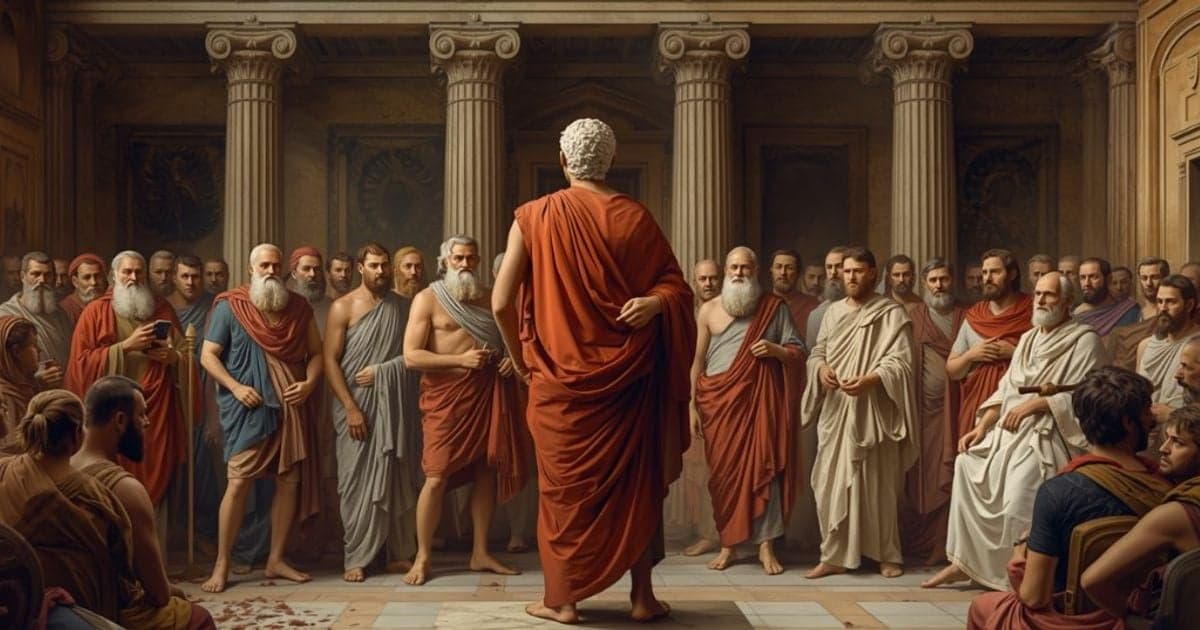
Meletus sounds serious until he has to answer. Every Athenian improves the youth. Socrates alone corrupts them. Socrates asks about horses. One trainer helps; the crowd does not. The courtroom hears the charge become a joke without anyone raising their voice.
The method is older than the trial and still ordinary. Separate the rumor from the indictment. Make the accuser name the act. Use an analogy from a craft everyone understands. Call the nearest witnesses. Even after you lose the vote, keep naming what was never proved.
A weak accusation lives on momentum. Cross-examination is the interruption that forces a specific sentence into a room that preferred a mood.
The Central Lesson
A charge can sound like piety and still be a riddle nobody has to solve. Socrates shows that one precise question, asked in public, can do more than a matching speech. The skill is interrupting momentum until the accuser has to live with a specific sentence.
Chapter-by-Chapter Analysis
Refuse the Ornamented Charge
Socrates will not answer a set oration with a set oration. He asks for truth from the speaker and justice from the judge. The first move of a cross-examination is refusing the frame that makes the accusation sound finished.
Key Insight:
A weak charge often arrives dressed as a complete speech. If you accept the costume, you spend the rest of the hour defending tone instead of testing content.
“let the speaker speak truly and the judge decide justly.”
Separate the Shadows from the Man
The old accusers cannot be questioned. Socrates still names what they confuse: physical speculation, sophistry, paid teaching. He denies each in turn so the formal charge cannot hide inside the rumor.
Key Insight:
Before you fight the indictment, list the extra claims riding on it. A prosecutor who cannot keep those extras will often fail to keep the core.
“But the simple truth is, O Athenians, that I have nothing to do with physical speculations.”
Make Them Name the Evil
People call Socrates a villainous misleader, then cannot tell what evil he practices. The hatred is loud. The specification is missing. That gap is already a cross-examination, even before Meletus stands up.
Key Insight:
Ask for the act. If the accuser can only offer a type, a mood, or a stock phrase about philosophers, the charge is not ready for a verdict.
“if somebody asks them, Why, what evil does he practise or teach? they do not know, and cannot tell;”
The Horse-Trainer Question
Meletus says every Athenian improves the youth except Socrates. Socrates asks who improves horses: one trainer, or everyone who meets a horse. The analogy forces Meletus to own an impossibility in front of five hundred men.
Key Insight:
The simplest public question is often enough. Find the claim that cannot be true of any other craft, and ask the accuser to apply it there. Serious-sounding charges die on ordinary comparisons.
“One man is able to do them good, or at least not many;—the trainer of horses, that is to say, does them good, and others who have to do with them rather injure them?”
Call the Missing Witnesses
If the young men were corrupted, their fathers and brothers could say so. They appear for Socrates instead. Meletus has a charge and no household that will carry it.
Key Insight:
A complaint that cannot produce the nearest witnesses is a theory. Invite the people who would have to live with the harm. Their silence, or their support, is part of the examination.
“they know that I am speaking the truth, and that Meletus is a liar.”
The Faster Runner
After death is voted, Socrates says the difficulty is not avoiding death but avoiding unrighteousness, which runs faster. The accusers won a count and lost the argument about what they actually proved.
Key Insight:
A verdict can close a case without answering the questions that mattered. Cross-examination is still useful after you lose, because it names what the win did not establish.
“The difficulty, my friends, is not to avoid death, but to avoid unrighteousness; for that runs faster than death.”
Applying This to Your Life
Ask for the Act, Not the Type
When someone is called toxic, disloyal, or a bad fit, ask what they did, when, and who saw it. If the answer is only a category, you are still in chapter 5: hatred without a named evil.
Use One Ordinary Comparison
Socrates uses horses. You can use hiring, medicine, or teaching. If the rule would be ridiculous in a craft everyone respects, it is ridiculous here. Say that out loud once.
Keep the Question After You Lose
A committee can still vote. That does not mean the charge survived. Name what was never established so the record in your own mind stays cleaner than the count.