
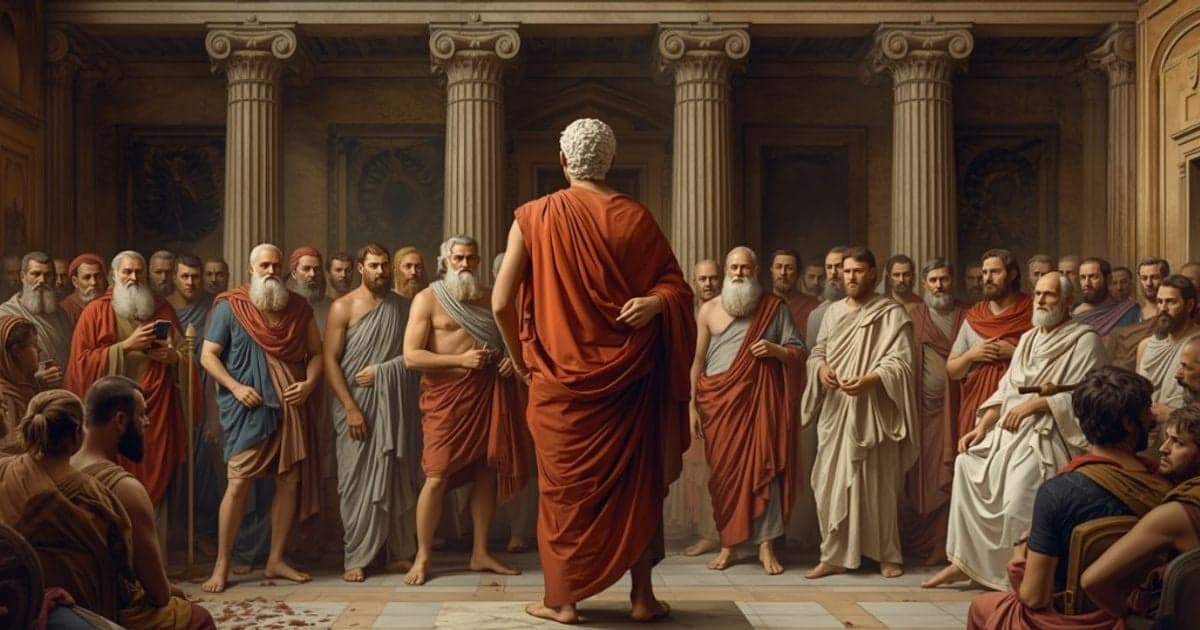
The Apology
Dignity Over Desperation
Refuse the parade of three sons and the broken oath, and hold a defense that will not buy life with a spectacle.
The Tool He Will Not Use
Athenian defendants brought children into court. It worked often enough to become a habit. Socrates has three sons and will not use them. He is not made of rock or oak, he says. He simply will not teach the jury that justice is a gift you extract with tears.
That refusal sits on top of quieter ones: no ornamented speech, no panic in front of Meletus, no bargain that trades the post for years, two earlier moments when shouting or a junta wanted his fear. The last chapter is the same man after the count.
Dignity is not stiffness. It is the decision that some rescues cost the name you were trying to keep.
The Central Lesson
The Apology is a defense speech that refuses the most effective defenses. Socrates keeps the name he came in with, even when a rewritten self would have bought years. Dignity is that refusal practiced early enough that, on the last day, it no longer looks like a stunt.
Chapter-by-Chapter Analysis
No Ornamented Defense
Socrates will not deliver a set oration duly ornamented with words and phrases. Dignity here is stylistic before it is theatrical: he will not become a different man in order to be believed.
Key Insight:
Desperation starts as a costume. The first refusal is remaining recognizable. If the room only rewards a rewritten self, the acquittal already costs the thing you were defending.
“but from me you shall hear the whole truth: not, however, delivered after their manner in a set oration duly ornamented with words and phrases.”
Do Not Play Meletus's Game
He treats the prosecutor as a man in jest who pretends zeal. The cross-examination is sharp, not groveling. He will not flatter the charge by meeting it with panic.
Key Insight:
A weak accuser often wants your fear as confirmation. Answering with clarity instead of apology keeps the dignity on the side that still has a method.
“Meletus is a doer of evil, in that he pretends to be in earnest when he is only in jest”
Life Is Not the Highest Bid
He will not calculate living against dying as if survival were the only score. Right and wrong stay the measure. The offer to go quiet is refused because it would purchase years with a deserted post.
Key Insight:
Desperation always has a price list. Dignity is the decision that some prices are not payable, even when the alternative is a shorter life.
“a man who is good for anything ought not to calculate the chance of living or dying; he ought only to consider whether in doing anything he is doing right or wrong”
The Body Already Spent
At the trial of the generals he voted against the illegal procedure while the crowd shouted. Under the Thirty he refused to fetch Leon. Those scenes are dignity practiced when no speech was being written.
Key Insight:
Public composure at the end is believable only if private refusals came first. The jury is watching a habit, not a performance invented for sentencing day.
“I made up my mind that I would run the risk, having law and justice with me, rather than take part in your injustice because I feared imprisonment and death.”
Three Sons Stay Home
He has a family, yes, and sons, one almost a man and two still young. He will not bring them to petition. The judge has sworn to judge according to the laws, not according to weeping. Asking for perjury would convict him of the impiety he denies.
Key Insight:
The spectacle of children is the standard desperate move because it works. Socrates names why it is discreditable: it teaches the city that justice is a present you can beg. Dignity is refusing a tool that would save you by ruining the oath.
“I have a family, yes, and sons, O Athenians, three in number, one almost a man, and two others who are still young; and yet I will not bring any of them hither in order to petition you for an acquittal.”
Die in His Fashion
He does not repent of the defense. He would rather die in his own fashion than live in theirs. The last request is that they trouble his sons if the boys prefer riches to virtue.
Key Insight:
Dignity after the vote is consistency. He will not rewrite the speech to match the count, and he will not ask for a softer ending than the life he just described.
“he would rather die in his own fashion than live in theirs.”
Applying This to Your Life
Name the Tool You Will Not Use
Socrates will not use the children. Your version may be a public smear, a tearful scene, or a lie that would work. Decide the tool in advance, because desperation chooses fast.
Stay Recognizable
He will not become a rhetorician for an hour. If the only way to win is to become someone you will have to live inside afterward, the win is a costume. Check whether you will still respect the voice that got you out.
Do Not Ask Anyone to Break an Oath for You
He will not invite the jury into perjury. In modern rooms that looks like asking a friend to lie, a manager to bury a file, or a partner to pretend. Dignity includes the people you refuse to compromise on your behalf.