Free study guide · no paywall
Fathers and SonsStudy Guide
by Ivan Turgenev (1862)
A father rehearsing a welcome, a nihilist who trusts only a scalpel, and a duel neither man wanted: mapped across 28 chapters and six lessons.
Start here
Plot, characters & chapter jump
28 chapter summaries · 5 key figures · discussion questions · quotes · free
Plot summary
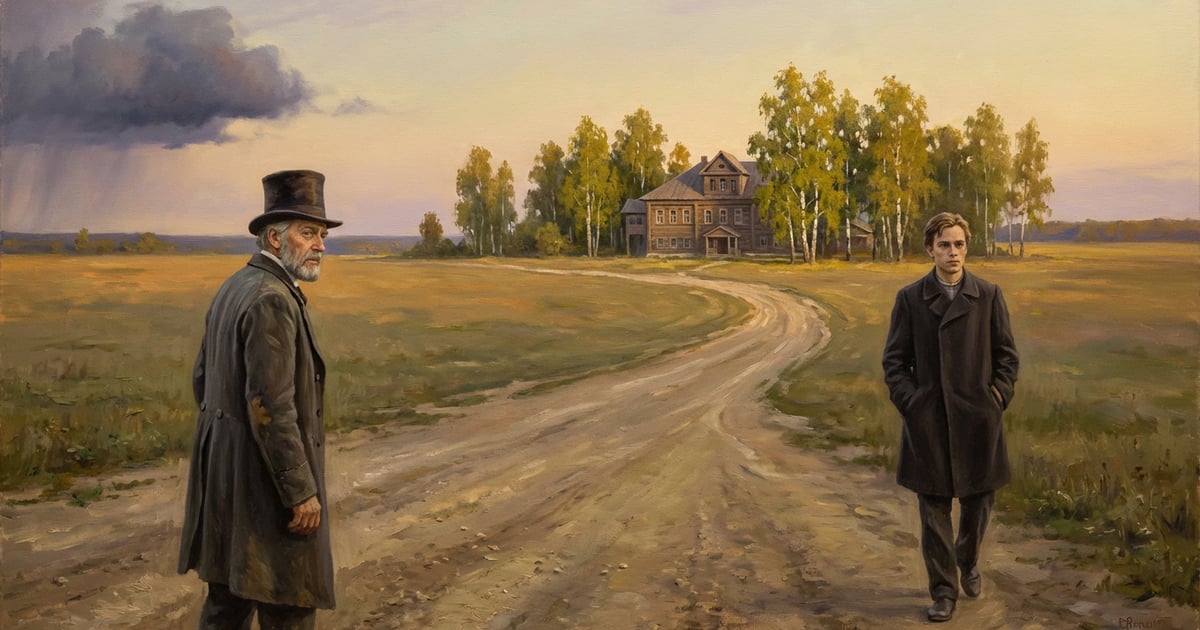
Nikolai Kirsanov waits at a posting-house for his son Arkady to come home from university, only to meet Evgeny Bazarov, a nihilist medical student who treats feeling as a costume not worth the time it takes to remove. Bazarov's certainty survives a breakfast-table war with Nikolai's brother Pavel, a peasant autopsy, and frog dissections with village boys, then meets its match in Anna Odintsova, a widow who will not have him on his terms. Pavel challenges Bazarov to a duel over a kiss in the garden; Bazarov cuts himself performing an autopsy soon after and dies of the resulting infection with his parents at his side. Six months later, Arkady has married Katya and become a landowner, and Bazarov's parents are still visiting his grave.
Key characters
Jump to chapter
What readers search for
Common questions about Fathers and Sons
What is Fathers and Sons about?
Nikolai Kirsanov waits at a posting-house for his son Arkady to come home from university in 1859, only to watch him arrive with Evgeny Bazarov, a nihilist medical student who treats feeling as a costume. Bazarov's certainty survives frog dissections and a breakfast-table war with Nikolai's brother Pavel, then breaks against a woman who will not have him and a typhus infection no theory can argue with. Turgenev refuses to hand either generation a win: the novel closes on two old people who never stop visiting a grave.
Why is Bazarov called a nihilist in Fathers and Sons?
Bazarov defines nihilism himself in the breakfast argument with Pavel: a nihilist is someone who "does not bow down before any authority" and takes nothing "on trust, whatever reverence may surround it." He dismisses art, Schubert, and romantic love as sentiment dressed up as principle, and trusts only what a scalpel or a microscope can confirm. The novel spends the rest of its chapters testing that posture against a face he cannot dissect and a fever he cannot out-argue.
When Your Certainties Aren't EnoughWhy do Bazarov and Pavel fight a duel in Fathers and Sons?
Pavel sees Bazarov kiss Fenichka, Nikolai's common-law wife, in the garden and treats it as an unforgivable violation of a household he has already organised his whole life around defending. The duel that follows is, by Bazarov's own admission, "a sheer absurdity from the theoretical standpoint," and both men know it, yet they proceed anyway. Turgenev stages it as two men who cannot find another form for a conflict that was never really about Fenichka.
Disagreeing Without ContemptWhy does Nikolai feel like a stranger in his own house in Fathers and Sons?
Bazarov calls Nikolai a man whose "song has been sung," and Arkady lets the line stand without defending his father. Nikolai overhears it, does not confront anyone, and walks into the garden alone to grieve. The novel treats this as crueller than open disagreement: a person can answer being called wrong, but being filed as finished leaves no argument to make.
Navigating the Generation GapWhy does Anna Odintsova refuse Bazarov in Fathers and Sons?
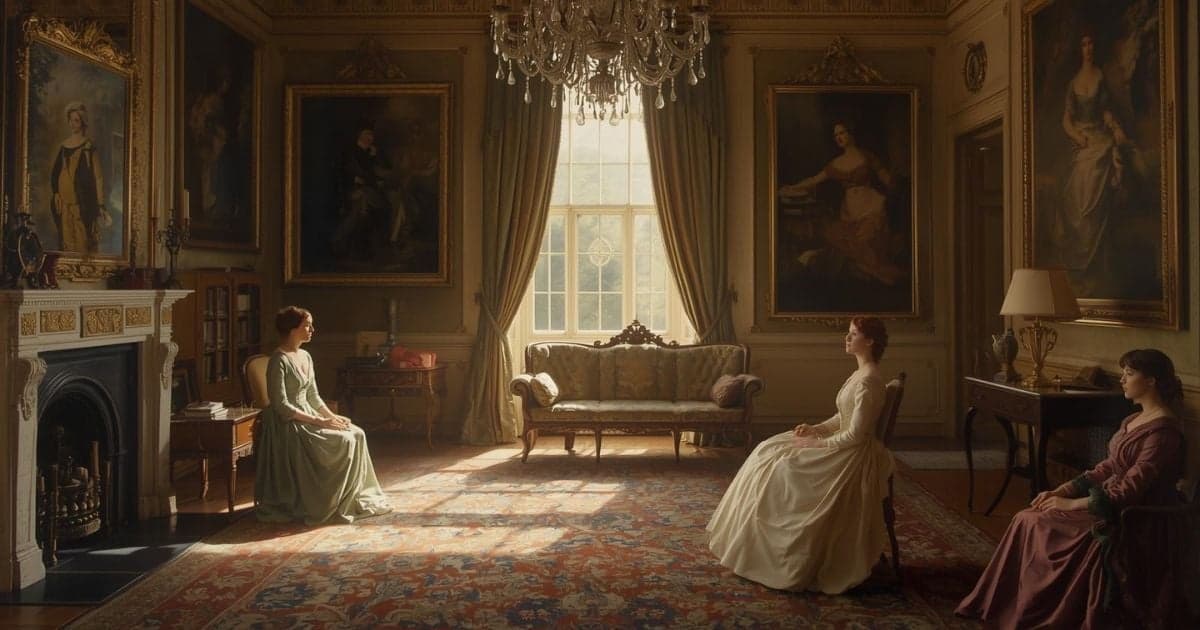
Bazarov confesses love to Anna in her boudoir almost as if it were an accusation against himself, offering her everything or nothing. Anna keeps her carefully run estate and her own timetable instead, because a man who has spent the whole novel mocking feeling cannot suddenly demand she treat his feeling as the exception. She still comes when he is dying, but she will not rearrange her life around a conversion that arrived only under pressure.
When Love Refuses Your TermsFast track
Short on time? Start here
You do not have to read all 28 chapters in one sprint. These 5 beats hold the book's argument together.
Full coverage
Everything in this study guide
The same surfaces readers expect from a traditional study guide — plot, characters, themes, quotes, and homework help — plus audio and the source text on every chapter. Free, no paywall.
Plot overview
Summary, context, and why the book still matters
28 chapter summaries
Every chapter with audio narration
5 key figures
Who drives the plot and what each one does
6 lessons
Themes traced to scenes, not generic labels
15+ important quotes
Verified lines with chapter links and analysis
Discussion questions
Five per chapter, with suggested answers for class and essays
Original text
Author's words beside every summary
This is not a plot cheat sheet. Wide Reads walks Fathers and Sons the way the novel actually builds: a father's rehearsed welcome, a friendship tested by a house that cannot hold two philosophies, a woman who will not be won on ultimatums, and a death that argues with nothing. Use the reading path below to keep your bearings, follow the six lesson deep dives when a scene hooks you, and open individual chapters for summaries, quotes, and audio.
For plot and theme questions about Fathers and Sons, see Common Questions on the book page.
How to use this guide
How to Read This Book with Wide Reads
Start with the arrival
Read chapters 1 through 6 for Nikolai's posting-house wait, Bazarov's introduction as Arkady's nihilist friend, and the first breakfast-table war with Pavel over Germans, art, and whether any principle deserves faith.
Follow the certainty crack
Chapters 10 through 19 send Bazarov and Arkady to town, into Anna Odintsova's orbit, and back to Bazarov's parents. Watch the boudoir confession, Anna's refusal, and the ash tree where Arkady starts becoming someone Bazarov did not invent.
Let the ending settle the argument
Chapters 23 through 28 stage the duel over Fenichka, Bazarov's fatal autopsy cut, and the double wedding six months on. When a chapter raises a question you cannot shake, jump to the matching lesson page, then return to the chapter list.
Plot & context
Book Overview
A posting-house on a dusty May afternoon in 1859, and a father cannot stand still. Nikolai Petrovitch Kirsanov waits for his son Arkady to come home from university, rehearsing the welcome, already afraid the boy will not be the boy who left. The coach arrives with a second passenger: Evgeny Bazarov, medical student, frog-dissector, and a man who has decided that most of what Nikolai loves is not worth the time it takes to say so. Turgenev published the book in 1862. The new man who believes in nothing but science will be undone by a woman who will not take him, a father who cannot stop loving him, and a death no theory can argue with.
Bazarov is a privileged destroyer: brilliant, abrasive, and so sure that feeling is a costume that he will treat Pavel's elegance, Nikolai's Schubert, and his own parents' tears as specimens. Arkady is the loyal pupil who has borrowed a worldview and does not yet know it is a loan. Pavel Petrovitch, the uncle in English clothes, has organised his whole life around a lost princess and will not forgive a young man who shrugs at that kind of ruin. Anna Odintsova keeps a house that runs on rails and a heart that will not leave its timetable for anyone, including herself. Fenichka lives in the half-light of a love Nikolai is still ashamed to name. Katya waits until Arkady can see her. Vasili and Arina worship a son who cannot stay. Sitnikov and Kukshina are cheap copies of a rebellion they do not understand.
Bazarov dissects frogs with peasant boys while Pavel buttons his cuffs for breakfast and asks what a nihilist is. The first fight is about Germans and art and whether any principle deserves faith. Arkady tells the story of Princess R. and the uncle who never recovered. At the governor's ball Anna appears, and Bazarov's certainty slips. In her boudoir he confesses love as if it were an insult; she refuses him because everything-or-nothing is a rule she cannot live. He goes home to parents who cannot stop touching him. Pavel sees a kiss in the garden and demands a duel that both men know is absurd. Arkady sits under an ash tree with Katya and becomes someone Bazarov did not invent. Bazarov cuts himself doing a peasant autopsy, lasts a few days of fever, asks Anna to come, and dies. Six months later the fathers are still visiting a grave.
Turgenev wrote the book after watching Russia split into sons who wanted to tear the house down and fathers who could not imagine another one, and he refused to pick a winner. The novel never treats nihilism as a costume you should skip, or tradition as a joke you should outgrow. Ideology fails. Armor fails. Even love, when it arrives as a demand that the other person become convenient, fails. What remains is not a verdict on 1862. It is a picture of what happens when two generations share a table and cannot share a language, and when a mind that was built to deny feeling has to live inside a body that will not cooperate.
Read the full summary on the book page →
Why this book now
People still arrive at this novel the moment a family shares a table and cannot share a language: the adult child fluent in a vocabulary the parents never learned, the parent rehearsing a welcome the visit has already outgrown, the argument about ideas that is really an argument about who still gets to matter in the house. Turgenev never lets nihilism win as a philosophy or lose as a punchline. This guide keeps that argument tied to the posting-house wait, the breakfast table, the boudoir refusal, and the grave two old people will not stop visiting.
About Ivan Turgenev
Ivan Turgenev (1818-1883) was the first Russian novelist Europe took seriously, the one Flaubert and James read for the way a feeling can arrive without a speech. He was born on a country estate to a mother who ruled serfs with a hard hand, and he never forgot the rooms where people were property. He left Russia for long stretches, lived near the singer Pauline Viardot, and wrote as a man who could love a country and still not live inside its arguments. Fathers and Sons, published in 1862, came out of that distance. Radicals called Bazarov a smear. Conservatives called him a warning. Turgenev had written a person, not a pamphlet, and he spent years explaining a sympathy neither camp wanted. He had watched sons arrive home with new vocabularies and fathers try to keep up without surrendering the only language they had. His gift was refusing the consolation of a winner. Tolstoy will tell you how to live. Dostoevsky will tell you what the soul owes God. Turgenev will sit you at a breakfast table where two intelligent men destroy a morning, then follow both of them home and make you feel the loneliness each one is protecting. The novel is still useful because that table has never been cleared.
Themes with proof
Lessons from Fathers and Sons
Six pressures the novel tests from the posting-house wait to the grave two old people will not stop visiting: a generation gap that dismissal makes crueller than disagreement, certainties that hold up in a lab and fail in a boudoir, the armour of manners and sneers people build so no one has to see them, a duel fought over a principle neither man can name out loud, a love offered as an ultimatum and refused on those exact terms, and a pupil who finally outgrows a borrowed voice without needing to prove his teacher wrong. Each spoke ties named chapters to the proof.
Deep dives
Chapter-by-chapter breakdowns
The Armor We Build Against Feeling
See Pavel's cuffs, Anna's rails, and Bazarov's sneer as the same closed door.
Women went nearly mad over him, while men called him Fate, and secretly detested him.
Disagreeing Without Contempt
Follow the breakfast fight to the duel, and notice the one talk that is not a score.
You think highly of the Germans?
Character guide
Key Figures
Who drives the plot, what each one wants, and why they matter to the argument of the book.
Evgeny Bazarov
Medical student and self-declared nihilist who trusts only what a scalpel or microscope can confirm, until a woman's face and a fever prove otherwise.
Arkady Kirsanov
Bazarov's loyal friend and pupil, who has borrowed a worldview and does not yet know it is a loan, until an ash tree and Katya give him one of his own.
Nikolai Petrovitch Kirsanov
Arkady's father, a gentle, modernising landowner who keeps trying to stay relevant to a son who has already filed him as finished.
Pavel Petrovitch Kirsanov
Nikolai's brother, an aristocrat in English clothes whose whole composure depends on a lost love and a code Bazarov will not respect.
Anna Odintsova
A wealthy, self-possessed widow who runs her estate like a ledger and refuses Bazarov because his everything-or-nothing love arrives as a demand, not an offer.
Memorable lines
Key Quotes
Verified passages with chapter links — the lines teachers and essays keep returning to.
“His father, one of the generals of 1812, had spent his life exclusively in military service”
“Cannot you see them yet?" asked a _barin_[1] of about forty who, hatless, and clad in a dusty jacket over a pair of tweed breeches, stepped on to the verandah of a posting-house on the 20th day of May”
“Oh, but that will not matter”
“Yes, but first give me a rub down, dearest Papa," said Arkady in a voice which, though a little hoarsened with travelling, was yet clear and youthful”
“im in every way you can. I could not express to you how much I value his friendship”
“he truth, he knows practically _everything”
“So here we are at home again!”
“And here comes Prokofitch”
“ith asperity). "You see, I like to open them, and then to observe what their insides are doing”
“Next morning Bazarov was the first to awake and go out of doors.”
“At least the savants of that part of the world have some energy in them”
“You think highly of the Germans?”
“women went nearly mad over him, while men called him 'Fate,' and secretly detested him”
“everything suddenly underwent a change”
“Mais je puis vous donner de l'argent”
Class & essay prep
Discussion Questions
Sample prompts drawn from the chapter guides — each with suggested answers for seminars and written work.
Why does Nikolai keep asking Peter whether he can see the carriage yet, and what does his dusty, hatless appearance at the posting-house suggest about his state of mind?
From Chapter 1When Nikolai's thoughts keep returning to his dead wife during the wait, how does that grief complicate his pride in Arkady's graduation?
From Chapter 1How does the warmth of Nikolai's greeting to Arkady change once Bazarov is introduced at the inn?
From Chapter 2What do Bazarov's greenish eyes, careless dress, and sharp speech communicate before he states a single political opinion?
From Chapter 2Why does conversation in the carriage keep slipping into pauses even though Nikolai and Arkady clearly care for each other?
From Chapter 3How does Nikolai's embarrassed, roundabout way of mentioning Fenichka make the domestic situation harder rather than easier for Arkady to receive?
From Chapter 3Why does Arkady address his father more formally upon arriving at Marino, and how do Nikolai and Pavel respond to that shift?
From Chapter 4At supper, what contrast between Pavel's elegance and Bazarov's silence establishes the household's central tension?
From Chapter 4What does Bazarov's choice to dissect frogs with local peasant children reveal about how he relates to people below his social rank?
From Chapter 5During Arkady's morning talk with Nikolai about Fenichka, why is the conversation careful on both sides despite their stated goodwill?
From Chapter 5How does Paul Petrovitch turn a breakfast question about woodcock shooting into an examination of Bazarov's beliefs?
From Chapter 6When Bazarov says he believes in nothing and treats even 'science in the mass' as meaningless, what is he rejecting beyond religion or art?
From Chapter 6Why does Arkady insist that Bazarov hear his uncle's history before continuing to treat Paul as merely ridiculous?
From Chapter 7What makes Princess R. both socially dazzling and emotionally destructive in Pavel's account of their affair?
From Chapter 7What financial pressures on Nikolai sit beneath the chapter's domestic scenes at Marino?
From Chapter 8Chapter by chapter
All Chapters
Chapter-by-chapter summaries, quotes, and audio.
Ch. 1 · A Father's Anxious WaitNikolai waits at the posting-house
On a dusty May afternoon in 1859, Nikolai Petrovitch Kirsanov waits nervously at a rural posting-house for his son Arkady to return home from universi...
Ch. 2 · First Impressions and Social Masks
Arkady finally reunites with his father Nikolai at a roadside inn, and the joy between them is palpable, so much so that the older man stammers with e...
Ch. 3 · The Awkward Homecoming Conversation
Arkady returns home after university to his father Nikolai's estate, and their carriage ride reveals the delicate dance of family relationships after ...
Ch. 4 · First Impressions and Hidden Tensions
The travelers finally arrive at the Kirsanov family estate, where the real drama begins to unfold. Arkady returns home to his father Nikolai, but he's...
Ch. 5 · Morning Revelations and Uncomfortable Truths
The morning after brings clarity and complications. Bazarov starts his day dissecting frogs with local peasant children, treating them as equals while...
Ch. 6 · When Old Meets NewThe breakfast-table war over nihilism
The morning after Bazarov's arrival, tension explodes over breakfast as the young nihilist clashes with Arkady's refined uncle, Paul Petrovitch. What ...
Ch. 7 · The Princess Who Broke a Man
This chapter reveals the tragic backstory behind Pavel's bitter personality through Arkady's explanation to Bazarov. Pavel was once a dazzling militar...
Ch. 8 · Behind Closed Doors
This chapter reveals the complex web of relationships beneath the surface at Marino estate. Nikolai struggles with financial problems as his estate ma...
Ch. 9 · First Impressions and Social Boundaries
Bazarov meets Fenichka, Nikolai's young partner and mother of his child, in a scene that reveals volumes about social class, family dynamics, and pers...
Ch. 10 · The Battle Lines Are Drawn
Two weeks into Bazarov's stay at Marino, the household dynamics crystallize around him. The servants embrace him as one of their own, while Pavel desp...
Ch. 11 · The Weight of Memory
Nikolai retreats to his favorite garden spot, wrestling with the growing distance between himself and his son Arkady. He questions whether the younger...
Ch. 12 · Meeting the Local Power Players
Arkady and Bazarov arrive in the provincial town and immediately encounter the local political drama. The town is ruled by a young, progressive govern...
Ch. 13 · The Emancipated Woman's Salon
Bazarov and Arkady visit Evdoksia Kukshin, a self-proclaimed 'emancipated' woman who embodies everything shallow about progressive pretensions. Her sa...
Ch. 14 · The Governor's Ball and an Enchanting Stranger
At the Governor's ball, we witness the theatre of provincial high society in full swing. Matvei Ilyitch holds court as guest of honour, dispensing cal...
Ch. 15 · The Art of Social Performance
Bazarov and Arkady visit Anna Odintsova at her hotel, where Bazarov's usual confidence crumbles in her presence. Despite his cynical views about her m...
Ch. 16 · First Impressions at the Estate
Bazarov and Arkady arrive at Anna Sergievna's grand estate, where the opulent surroundings make both men feel out of place despite their attempts at b...
Ch. 17 · The Confession of DesireBazarov's confession in Anna's boudoir
The structured routine at Anna's estate creates a deceptive calm that masks growing tensions beneath the surface. Bazarov chafes against the formality...
Ch. 18 · The Confession That Changes Everything
The morning after their intense conversation, Anna and Bazarov are both clearly affected by what passed between them. When Anna calls Bazarov to her p...
Ch. 19 · The Awkward Exit
The morning after his emotional confession, Bazarov apologises to Anna but announces he's leaving immediately. His pride won't let him stay after bein...
Ch. 20 · A Son Returns Home
Bazarov brings Arkady home to meet his parents, revealing a completely different side of the cynical nihilist. His mother Arina bursts into tears of j...
Ch. 21 · A Father's Love and Letting Go
Vasili Ivanitch's morning garden work reveals a man desperate to connect with his son through shared purpose and meaningful conversation. His enthusia...
Ch. 22 · The Weight of Unspoken Feelings
Arkady and Bazarov make an impulsive, uncomfortable visit to Anna Sergievna's estate on their way home. The awkwardness is palpable, no one expected t...
Ch. 23 · The Garden Encounter
Bazarov throws himself into his scientific work while tensions with Paul Petrovitch reach a cold standoff. The two men can barely speak without confli...
Ch. 24 · The Duel and Its AftermathThe duel with Pavel
Paul Petrovitch formally challenges Bazarov to a duel, claiming his presence offends him while hiding his true motives about the kiss he witnessed. Bo...
Ch. 25 · Declarations Under the Ash Tree
In a pivotal garden scene, Arkady and Katia sit beneath an ash tree in comfortable silence, their relationship deepening beyond words. Their conversat...
Ch. 26 · The Art of Letting Go
In the temple ruins on Anna's estate, two conversations unfold that will reshape everyone's future. Arkady finally confesses his love to Katia, stamme...
Ch. 27 · The Final ReckoningBazarov's death
Bazarov returns to his parents' home, initially throwing himself into work to avoid confronting his inner turmoil. But restlessness and depression soo...
Ch. 28 · Six Months Later: Where Everyone Ends Up
Six months after the dramatic events at Nikolskoe, winter has settled over the Russian countryside, and everyone has found their place in the new orde...
Using this guide
Study Guide FAQ
How to use Wide Reads for class, essays, and revision — and how this guide compares to traditional study sites.
Why Wide ReadsWhat makes this different from SparkNotes or CliffsNotes?
Traditional study guides summarise what happens in Fathers and Sons chapter by chapter. This guide gives you that coverage: all 28 chapters, five key figures, and a three-part path from the posting-house wait to the grave visited six months later. Wide Reads adds Navigating the Generation Gap and When Your Certainties Aren't Enough traced through named scenes like the breakfast-table war and the boudoir confession. Summaries include audio; the original text sits beside every chapter. Free, no paywall.
Is Fathers and Sons hard to read?
Fathers and Sons is rated intermediate difficulty. Our chapter-by-chapter analysis breaks down complex passages, explains historical context, and highlights key themes to make the text more accessible. Each chapter includes summaries, character analysis, and discussion questions to deepen your understanding.
Can I use this study guide for essays and homework?
Yes — use this reading guide alongside Fathers and Sons, not instead of it. Wide Reads exists to show you why the book still matters: lessons, chapter summaries with audio, and life skills you can carry into real life. That context can sharpen essays on themes, characters, and quotes. Always read Ivan Turgenev's original text, though. We are the guide at the trailhead; the classic is still the point.
Begin with the posting-house wait
Chapter 1 opens with a father who cannot stand still and a coach that brings home a son he no longer recognises. Each chapter adds summaries, quotes, audio, and the Lesson thread that turns a 28-chapter argument between generations into a case file on what outlasts the fight.
Wide Reads is different.
Plot, characters, and themes — plus audio, source text, and patterns you can use after class
Two ways in
Read & listen to the summary
Chapter by chapter, with audio. The meaning arrives because you experienced it — not because someone listed bullet points.
Start with this.
Read the original text
The actual words the author wrote, alongside every summary. Use the guide, then step into the source.
Then step into the source.
Either way, the door opens inward.
— and most of all, Why does this matter?
Continue Exploring
Guides, life skills, and the full library.More ways to read Fathers and Sons: guides, life skills, and the wider library.