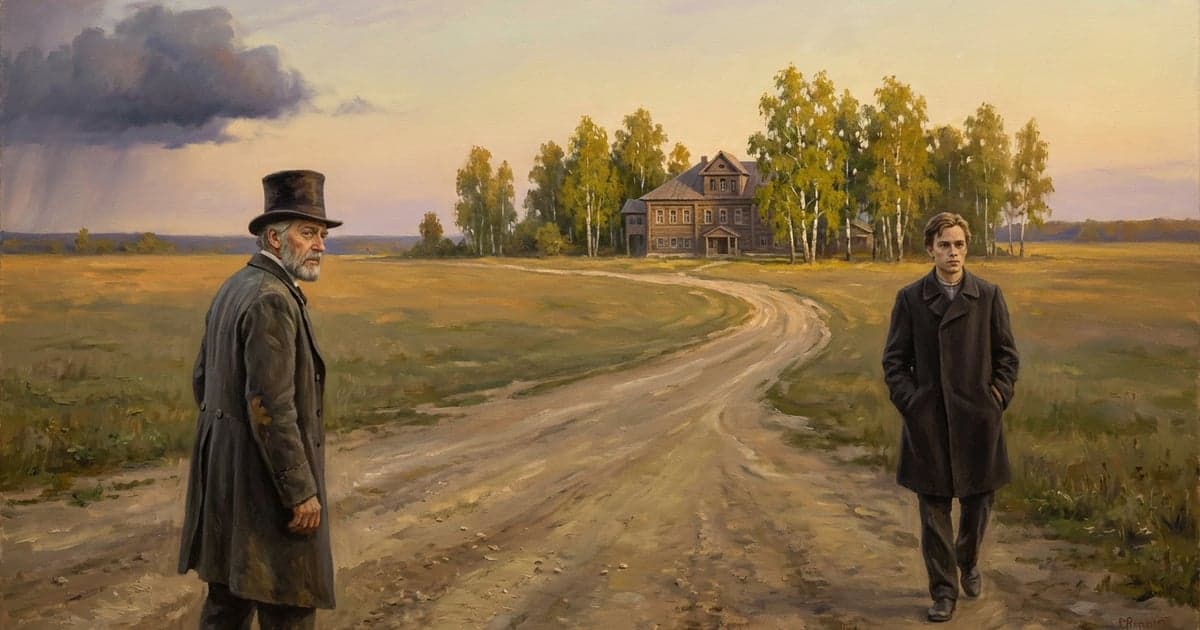
Paul Petrovitch formally challenges Bazarov to a duel, claiming his presence offends him while hiding his true motives about the kiss he witnessed. Both men recognize the absurdity of their situation yet proceed anyway, Paul driven by wounded pride and jealousy, Bazarov by his refusal to back down. The duel itself is almost farcical, with the terrified servant Peter as their only witness. Paul is wounded in the leg but not seriously, and both men maintain their dignity while privately acknowledging the foolishness of it all.
The morning at the copse plays out with grim politeness: Paul supplies the pistols, Bazarov measures the distance, and Peter trembles as the improvised second. Paul fires first and grazes Bazarov's ear; Bazarov returns fire without aiming carefully and hits Paul's thigh. Bazarov immediately drops the role of nihilist duelist and becomes a doctor, bandaging the wound and mocking Paul's faint when the pain hits. They agree to tell Nikolai they quarreled over Sir Robert Peel, and Nikolai arrives in panic before Peter can fetch the drozhki cleanly.
Back at Marino the house erupts. Thenichka hides, Nikolai wrings his hands, and Paul performs bravado from his sickbed while fever and delirium loosen his tongue. He compares Thenichka's face to Princess R., mutters about loving idle life, and swears he will not let any rascal touch him. A town doctor confirms Bazarov's prognosis after Nikolai disobeys Paul's wish to keep the duel secret, pockets twenty-five roubles, and shrugs that such accidents happen. Old Prokofitch grumbles that in his day only gentlemen dueled while upstarts like Bazarov would have been ducked in the gutter, but the servants weep as the nihilist drives away. Bazarov packs his specimens, says a cold goodbye, and leaves the estate knowing he has unsettled everyone he touched.
That night no one undresses; Nikolai steals in and out of Paul's room while the wounded man mutters in half-sleep, asks for lemonade through Thenichka's hands, and startles his brother with old memories. As Paul recovers on the sofa, he interrogates Thenichka about the lilac arbour, watches her defend her love for Nikolai, and breaks down in tears instead of punishing her. When Nikolai enters with baby Mitia, Paul urges him at last to marry Thenichka and end the scandal of an unacknowledged family. Nikolai embraces him in astonishment, and the brothers reconcile as Paul accepts that happiness matters more than caste. Paul jokes that Arkady will approve on principle even if marriage is not in his nihilist vocabulary. His wound does not kill anyone, but it finally forces the entire household to stop performing the old aristocratic script.
Coming Up in Chapter 25
As the dust settles at Marino, we shift to a very different scene at Nikolsköe, where Arkady and Katia sit quietly together in the garden. Their peaceful moment suggests important conversations are about to unfold, conversations that will determine the direction of both their futures..