Master this chapter. Complete your experience
Purchase the complete book to access all chapters and support classic literature
As an Amazon Associate, we earn a small commission from qualifying purchases at no additional cost to you.
Available in paperback, hardcover, and e-book formats
Why This Matters
Connect literature to life
This chapter teaches how to identify when someone uses intelligence or education to establish dominance rather than solve problems.
Practice This Today
This week, notice when someone dismisses others' experience or expertise—watch how they treat service workers, older colleagues, or people without degrees.
Now let's explore the literary elements.
Key Quotes & Analysis
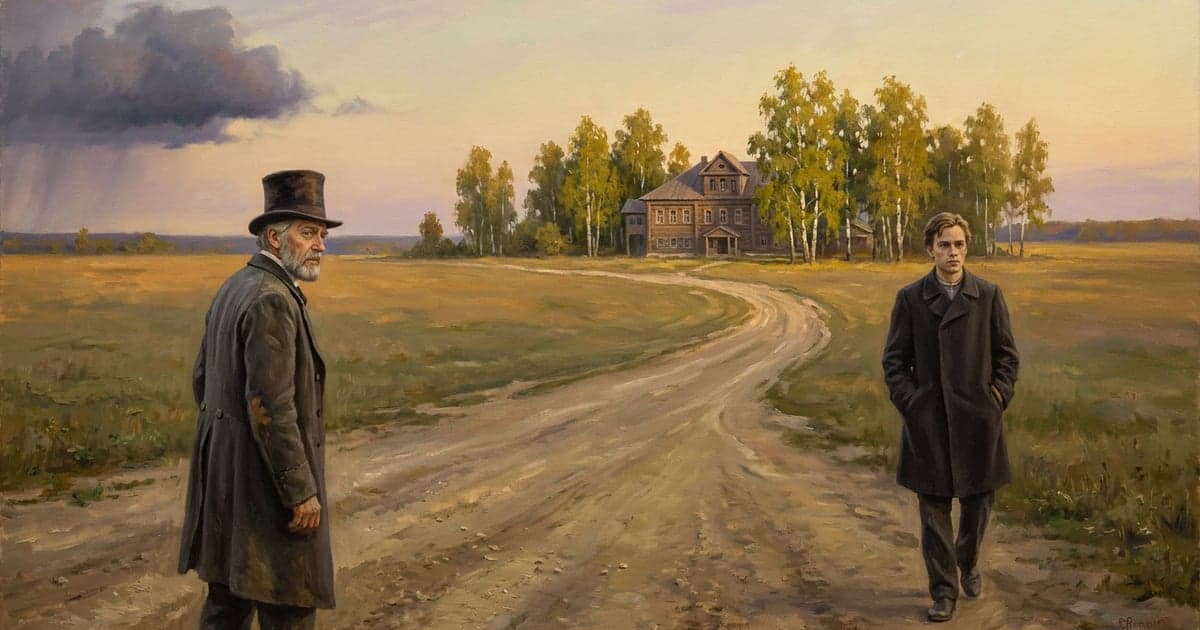
"I am indeed glad to see you! I am indeed grateful to you for your kindness in paying us this visit!"
Context: Nikolai greeting Bazarov for the first time, trying to make him feel welcome
This shows Nikolai's genuine Russian hospitality and his eagerness to please his son's friend. The repetition of 'indeed' reveals his nervousness and desire to make a good impression. It's the old generation trying to bridge the gap with the new.
In Today's Words:
I'm so happy to meet you! Thank you so much for coming to visit us!
"Oh, but that will not matter"
Context: When Arkady worries about getting dust on his father during their embrace
This simple phrase reveals Nikolai's priorities - physical comfort matters less than emotional connection. It shows the warmth and unconditional love of the older generation, contrasting sharply with Bazarov's emotional distance.
In Today's Words:
Don't worry about that - I don't care if I get dirty
"He is wonderful but simple"
Context: Arkady describing Bazarov to smooth over any awkwardness
This reveals Arkady's position as mediator between his father and friend. The word 'simple' is patronizing - Arkady is already adopting Bazarov's condescending attitude toward traditional values, even about his own father.
In Today's Words:
He's great, but you know, kind of old-fashioned
Thematic Threads
Class
In This Chapter
Bazarov casually insults the working-class ostler while treating the landowner with barely concealed condescension
Development
Introduced here as active social tension
In Your Life:
You see this when someone uses education or position to justify treating service workers or 'lower-status' people as less worthy of basic respect
Identity
In This Chapter
Arkady tries to manage impressions by calling Bazarov 'wonderful but simple' - already defending his friend's behavior
Development
Introduced here as internal conflict
In Your Life:
You recognize this when you find yourself making excuses for someone's bad behavior because you want others to like them
Social Expectations
In This Chapter
The contrast between Nikolai's warm courtesy and Bazarov's cool politeness reveals competing social codes
Development
Introduced here as generational conflict
In Your Life:
You experience this tension when your values about how to treat people clash with someone else's idea of what's 'modern' or 'progressive'
Power
In This Chapter
Small power dynamics play out through who gets approached familiarly, who promises rewards, who insults whom
Development
Introduced here through social positioning
In Your Life:
You notice this in how people use whatever small authority they have - knowledge, position, connections - to establish hierarchy
Recognition
In This Chapter
Nikolai's joy at seeing his son contrasts sharply with Bazarov's need to establish intellectual superiority immediately
Development
Introduced here as competing needs
In Your Life:
You see this when someone can't just enjoy a moment without proving they're the smartest person in the room
You now have the context. Time to form your own thoughts.
Discussion Questions
- 1
What are the first signs that Bazarov and Nikolai are going to clash, even before they really talk?
analysis • surface - 2
Why does Bazarov treat the ostler with such casual contempt, and what does this reveal about his character?
analysis • medium - 3
Where have you seen someone use their education or expertise to justify looking down on others?
application • medium - 4
How would you handle being in Arkady's position - caught between a friend who's being dismissive and a family member who's trying to be welcoming?
application • deep - 5
What's the difference between genuine confidence and intellectual arrogance, and how can you tell them apart?
reflection • deep
Critical Thinking Exercise
Spot the Arrogance Warning Signs
Think of someone you know who's genuinely smart and knowledgeable. Now think of someone who acts superior because of their education or position. Write down three specific behaviors that distinguish the humble expert from the intellectual snob. Then reflect: which category do you fall into when you're in your area of expertise?
Consider:
- •How do they treat people who know less about their specialty?
- •Do they show curiosity about what others know, or only interest in showing what they know?
- •When they disagree with someone, do they attack the idea or the person?
Journaling Prompt
Write about a time when you caught yourself using your knowledge or position to make someone else feel small. What was really driving that behavior, and how would you handle it differently now?
Coming Up Next...
Chapter 3: The Awkward Homecoming Conversation
As the carriages roll toward home, Nikolai's excitement about his son's return bubbles over into conversation. But what will happen when traditional father-son bonds meet the influence of Arkady's mysterious friend?