Wide Reads
Literature MattersLife IndexEducators
Sign in
Where to Begin
Fathers and Sons - First Impressions at the Estate

Ivan Turgenev

Fathers and Sons

First Impressions at the Estate

Home›Books›Fathers and Sons›Chapter 16
Previous
16 of 28
Next

Summary

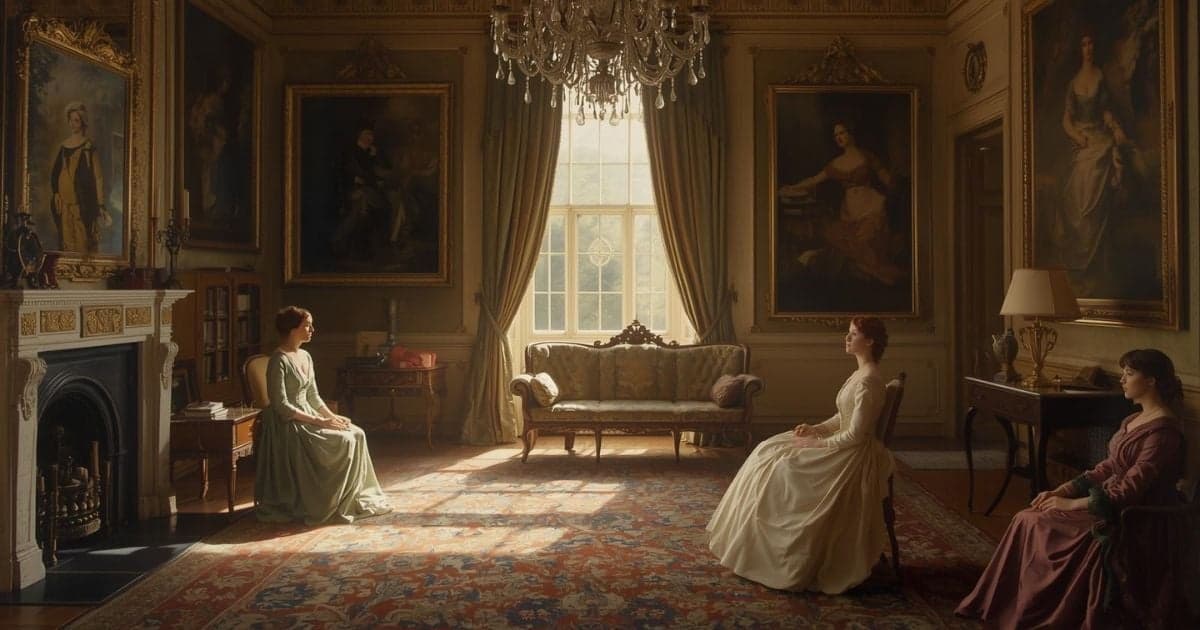
Bazarov and Arkady arrive at Anna Sergievna's grand estate, where the opulent surroundings make both men feel out of place despite their attempts at bravado. Anna proves to be an intelligent, composed woman who engages Bazarov in philosophical debate about human nature and art. Bazarov argues that all people are essentially identical, like trees in a forest, dismissing individual differences as mere social conditioning. Meanwhile, Arkady finds himself awkwardly paired with Anna's shy younger sister Katia, who plays piano for him with quiet competence but little warmth. The household includes Anna's disagreeable elderly aunt, a princess who treats everyone with disdain. During an evening of cards and conversation, Anna reveals her curiosity about Bazarov's unconventional ideas, while he remains characteristically blunt and dismissive of social niceties. That night, both Anna and Bazarov reflect on their encounter - she intrigued by his directness and lack of pretension, he surprisingly noting Katia's freshness compared to her more sophisticated sister. The chapter establishes the complex dynamics that will drive the relationships forward, showing how genuine intellectual curiosity can create unexpected attractions across social boundaries, while also revealing the loneliness that wealth and status can create.

Coming Up in Chapter 17

As the days pass at the estate, routines develop that will either deepen these new relationships or expose their fundamental incompatibilities. The structured life Anna has created begins to work its influence on her guests.

Share it with friends

Previous ChapterNext Chapter
GO ADS FREE — JOIN US
Original text
complete·3,824 words
T

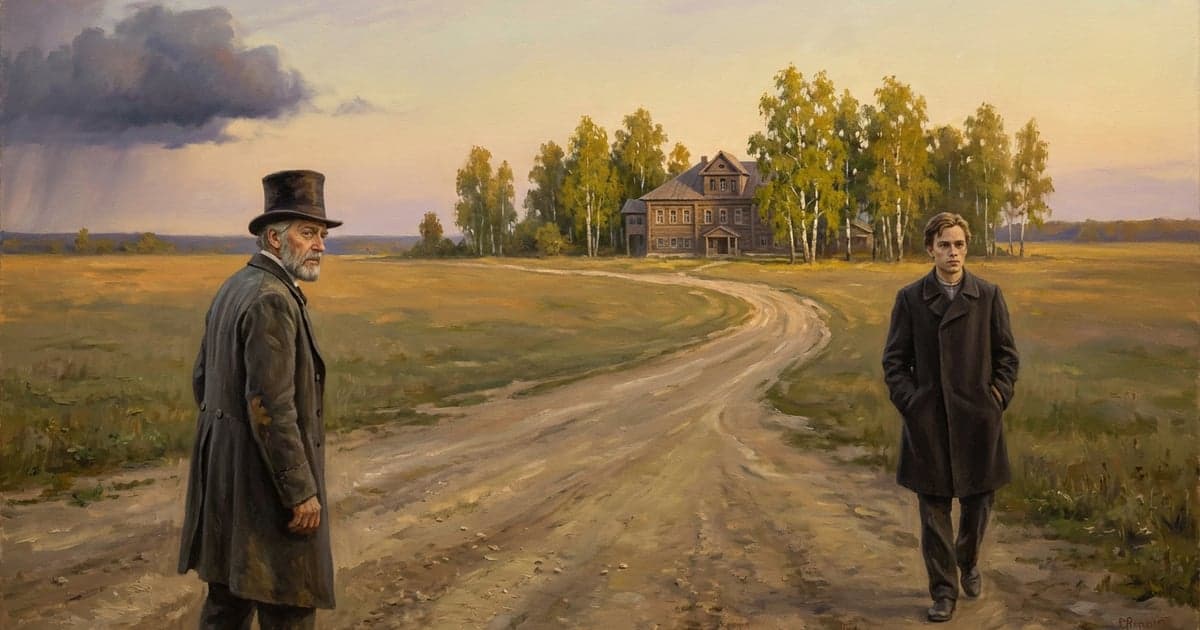
he manor-house in which Anna Sergievna resided stood on an open hillock, and close to a yellow stone church with a green roof, white columns, and an entrance surmounted by a fresco representative of Our Lord's Resurrection--the latter executed in the "Italian" style, and having as its most noticeable feature the figure of a swarthy warrior whose rounded contours filled the entire foreground. Behind the church, the village extended into two long wings, and had thatched roofs surmounted by a medley of chimneys; while the manor-house itself was built in a style homogeneous with the design of the church--that is to say, in the style commonly known as "Alexandrine," and embracing yellow-painted walls, a green roof, white columns, and a front adorned with a coat-of-arms. In fact, both buildings had been erected by a provincial architect to the order of the late Odintsov, a man impatient (so he himself always expressed it) of "vain and arbitrary innovations." Lastly, to right and left of the house there showed the trees of an antique garden, while an avenue of clipped firs led the way to the principal entrance.

1 / 23

Master this chapter. Complete your experience

Purchase the complete book to access all chapters and support classic literature

Read Free on GutenbergBuy at Powell'sBuy on Amazon

As an Amazon Associate, we earn a small commission from qualifying purchases at no additional cost to you.

Available in paperback, hardcover, and e-book formats

GO ADS FREE — JOIN US

Why This Matters

Connect literature to life

Skill: Detecting Intellectual Posturing

This chapter teaches how to spot when someone (including yourself) uses intelligence as a shield rather than a tool for understanding.

Practice This Today

This week, notice when conversations turn into competitions - ask yourself whether you're trying to learn something or prove something.

GO ADS FREE — JOIN US

Now let's explore the literary elements.

Key Quotes & Analysis

"All people are identical; each of us has brain, spleen, heart, lungs, all made alike; and the so-called moral qualities are the same in all of us - slight variations don't matter. A single human specimen is sufficient to judge all others by. People are like trees in a forest; no botanist would think of studying each individual birch."

— Bazarov

Context: During philosophical debate with Anna about human nature and individuality

This reveals Bazarov's materialist worldview that reduces humans to their biological components while dismissing individual differences as superficial. It shows both his scientific training and his defensive rejection of the class distinctions that exclude him.

In Today's Words:

People are basically all the same - we all have the same body parts and emotions. The differences we think matter are just surface stuff that society teaches us to care about.

"She was struck by the strange combination of humility and arrogance in his manner."

— Narrator

Context: Anna's observation of Bazarov during their first extended conversation

This captures the internal conflict of someone who intellectually rejects social hierarchies but still feels their emotional impact. Bazarov's contradictory manner reflects the difficulty of maintaining revolutionary principles while navigating actual social situations.

In Today's Words:

She noticed how he acted both insecure and cocky at the same time.

"There was something fresh and innocent about her which made one think of the morning, of the sound of church bells, and of the dew on spring flowers."

— Narrator

Context: Bazarov's surprising thoughts about Katia as he reflects on the evening

This poetic description contrasts sharply with Bazarov's usual materialist language, suggesting that genuine attraction can break through even the most rigid philosophical positions. It shows how personal feelings can contradict intellectual theories.

In Today's Words:

There was something pure and natural about her that reminded him of peaceful, simple things.

Thematic Threads

Class

In This Chapter

Bazarov's discomfort in Anna's wealthy estate drives him to assert intellectual superiority over material privilege

Development

Building from earlier chapters where class differences created tension with Pavel

In Your Life:

You might feel the need to prove your worth through what you know when you're in spaces where others have more money or status

Identity

In This Chapter

Bazarov maintains his nihilist identity by dismissing individual differences, even when evidence contradicts his position

Development

His rigid self-concept is becoming more defensive as he encounters challenges to his worldview

In Your Life:

You might cling to old versions of yourself even when growth requires letting go of familiar but limiting beliefs

Attraction

In This Chapter

Both Anna and Bazarov are intrigued by each other despite their different social positions and philosophies

Development

Introduced here as a new dynamic that will challenge both characters' assumptions

In Your Life:

You might find yourself drawn to people who challenge your thinking, even when it makes you uncomfortable

Loneliness

In This Chapter

Anna's wealth and status create isolation, while Bazarov's intellectual superiority serves the same function

Development

Emerging theme showing how different forms of armor create similar isolation

In Your Life:

You might discover that the very things you use to protect yourself also keep others at a distance

Performance

In This Chapter

Everyone is playing roles—Bazarov the nihilist, Anna the sophisticated hostess, Arkady the loyal friend

Development

Continuing pattern of characters struggling between authentic selves and social expectations

In Your Life:

You might exhaust yourself maintaining different versions of who you think you should be in different settings

GO ADS FREE — JOIN US

You now have the context. Time to form your own thoughts.

Discussion Questions

  1. 1

    How does Bazarov use his intelligence as a weapon when he feels out of place at Anna's estate?

    analysis • surface
  2. 2

    Why does Bazarov claim all people are identical like trees in a forest - does he really believe this or is something else happening?

    analysis • medium
  3. 3

    Where have you seen people use their expertise or knowledge to shut down conversations instead of helping others understand?

    application • medium
  4. 4

    When someone consistently makes you feel stupid during discussions, how can you tell if it's about your intelligence or their insecurity?

    application • deep
  5. 5

    What's the difference between someone who uses intelligence to solve problems versus someone who uses it to win arguments?

    reflection • deep

Critical Thinking Exercise

10 minutes

Decode the Intellectual Power Play

Think of a recent conversation where someone used their knowledge or expertise in a way that made you feel small or shut down. Write down what they said, then rewrite how they could have shared the same information in a way that invited discussion rather than ended it. Notice the difference between building bridges and building walls with intelligence.

Consider:

  • •Pay attention to tone and word choice - how did they package their knowledge?
  • •Consider their body language and timing - were they teaching or performing?
  • •Think about the outcome - did the conversation move forward or shut down?

Journaling Prompt

Write about a time when you caught yourself using your knowledge or skills to make someone else feel inferior. What were you actually feeling in that moment, and how might you handle it differently now?

GO ADS FREE — JOIN US

Coming Up Next...

Chapter 17: The Confession of Desire

As the days pass at the estate, routines develop that will either deepen these new relationships or expose their fundamental incompatibilities. The structured life Anna has created begins to work its influence on her guests.

Continue to Chapter 17
Previous
The Art of Social Performance
Contents
Next
The Confession of Desire

Continue Exploring

Fathers and Sons Study GuideTeaching ResourcesEssential Life IndexBrowse by ThemeAll Books

You Might Also Like

Jane Eyre cover

Jane Eyre

Charlotte Brontë

Explores personal growth

Great Expectations cover

Great Expectations

Charles Dickens

Explores personal growth

The Strange Case of Dr Jekyll and Mr Hyde cover

The Strange Case of Dr Jekyll and Mr Hyde

Robert Louis Stevenson

Explores personal growth

Don Quixote cover

Don Quixote

Miguel de Cervantes Saavedra

Explores personal growth

Browse all 47+ books
GO ADS FREE — JOIN US

Share This Chapter

Know someone who'd enjoy this? Spread the wisdom!

TwitterFacebookLinkedInEmail

Read ad-free with Prestige

Get rid of ads, unlock study guides and downloads, and support free access for everyone.

Subscribe to PrestigeCreate free account
Intelligence Amplifier
Intelligence Amplifier™Powering Wide Reads

Exploring human-AI collaboration through books, essays, and philosophical dialogues. Classic literature transformed into navigational maps for modern life.

2025 Books

→ The Amplified Human Spirit→ The Alarming Rise of Stupidity Amplified→ San Francisco: The AI Capital of the World
Visit intelligenceamplifier.org
hello@widereads.com

WideReads Originals

→ You Are Not Lost→ The Last Chapter First→ The Lit of Love→ Wealth and Poverty→ 10 Paradoxes in the Classics · coming soon
Arvintech
arvintechAmplify your Mind
Visit at arvintech.com

Navigate

  • Home
  • Library
  • Essential Life Index
  • How It Works
  • Subscribe
  • Account
  • About
  • Contact
  • Authors
  • Suggest a Book
  • Landings

Made For You

  • Students
  • Educators
  • Families
  • Readers
  • Literary Analysis
  • Finding Purpose
  • Letting Go
  • Recovering from a Breakup
  • Corruption
  • Gaslighting in the Classics

Newsletter

Weekly insights from the classics. Amplify Your Mind.

Legal

  • Privacy Policy
  • Terms of Service
  • Cookie Policy
  • Accessibility

Why Public Domain?

We focus on public domain classics because these timeless works belong to everyone. No paywalls, no restrictions—just wisdom that has stood the test of centuries, freely accessible to all readers.

Public domain books have shaped humanity's understanding of love, justice, ambition, and the human condition. By amplifying these works, we help preserve and share literature that truly belongs to the world.

A Pilgrimage

Powell's City of Books

Portland, Oregon

If you ever find yourself in Portland, walk to the corner of Burnside and 10th. The building takes up an entire city block. Inside is over a million books, new and used on the same shelf, organized by color-coded rooms with names like the Rose Room and the Pearl Room. You can lose an afternoon. You can lose a weekend. You will find a book you have been looking for your whole life, and three you did not know existed.

It is a pilgrimage. We cannot find a bookstore like it anywhere on earth. If you read the classics, and you ever get the chance, go. It belongs on every reader's bucket list.

Visit powells.com

We are not in any way affiliated with Powell's. We are just a very big fan.

© 2026 Wide Reads™. All Rights Reserved.

Intelligence Amplifier™ and Wide Reads™ are proprietary trademarks of Arvin Lioanag.

Copyright Protection: All original content, analyses, discussion questions, pedagogical frameworks, and methodology are protected by U.S. and international copyright law. Unauthorized reproduction, distribution, web scraping, or use for AI training is strictly prohibited. See our Copyright Notice for details.

Disclaimer: The information provided on this website is for general informational and educational purposes only and does not constitute professional, legal, financial, or technical advice. While we strive to ensure accuracy and relevance, we make no warranties regarding completeness, reliability, or suitability. Any reliance on such information is at your own risk. We are not liable for any losses or damages arising from use of this site. By using this site, you agree to these terms.