Wide Reads
Literature MattersLife IndexEducators
Sign in
Where to Begin
Fathers and Sons - Six Months Later: Where Everyone Ends Up

Ivan Turgenev

Fathers and Sons

Six Months Later: Where Everyone Ends Up

Home›Books›Fathers and Sons›Chapter 28
Previous
28 of 28

Summary

Six months after the dramatic events at Nikolskoe, winter has settled over the Russian countryside, and everyone has found their place in the new order. At Marino, there's a farewell dinner as Pavel prepares to leave for Moscow—but first, we learn about two quiet weddings that took place: Arkady married Katya, and Nikolai married Fenechka. The dinner is formal but awkward, everyone trying to be proper in their new roles. Pavel, thinner but still elegant, toasts the company and departs for a life of cultured exile in Dresden, where he'll spend his days among English tourists and fellow expatriate Russians. The narrator then reveals what became of everyone else: Anna Sergievna married a practical politician in a union of convenience rather than passion. The Kirsanovs are successfully managing their estate, with Arkady proving surprisingly capable as a landowner. Fenechka has adapted beautifully to her new status, while little Mitya thrives. Even the servants have found their paths—Peter married a market gardener's daughter who chose him for his watch and patent leather shoes. But the novel's most powerful ending focuses on a small country cemetery where Bazarov lies buried. His elderly parents visit regularly, weeping over their son's grave, tending it with heartbroken devotion. The narrator asks whether their tears and prayers are meaningless, then answers with a resounding no—even passionate, erring hearts like Bazarov's are part of nature's eternal calm and the promise of life without end. This epilogue shows how life moves forward after revolutionary moments, how people adapt and find new equilibriums, while suggesting that even the most disruptive forces become part of something larger and more enduring.

Share it with friends

Previous Chapter
GO ADS FREE — JOIN US
Original text
complete·5,043 words
S

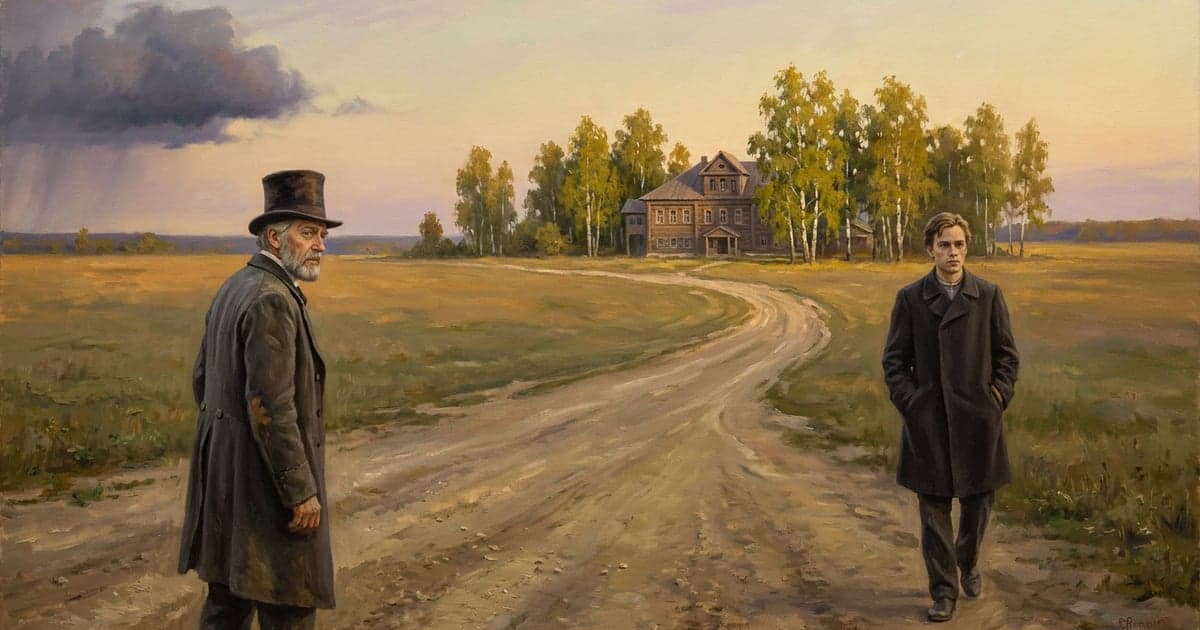
ince that time six months have passed, and there has fallen upon the country a "white" winter--a winter of clear, keen, motionless frosts, of deep, crackling snow, of pink-rimed trees, of pale-emerald heavens, of smoke-capped chimneys, of puffs of vapour from momentarily opened doors, of faces fresh and hard-bitten, of horses galloping headlong to thaw their frozen limbs. It is now the close of a January day, and the increasing chill of evening is nipping the still air in an ever-tightening vice as the sun sinks downward into a sea of red.

1 / 28

Master this chapter. Complete your experience

Purchase the complete book to access all chapters and support classic literature

Read Free on GutenbergBuy at Powell'sBuy on Amazon

As an Amazon Associate, we earn a small commission from qualifying purchases at no additional cost to you.

Available in paperback, hardcover, and e-book formats

GO ADS FREE — JOIN US

Why This Matters

Connect literature to life

Skill: Recognizing Long-Term Change Patterns

This chapter teaches how to identify when slow, undramatic adaptation is actually creating lasting transformation.

Practice This Today

This week, notice when changes in your workplace or family happen gradually rather than dramatically—look for the small shifts in how people interact six months after a major event.

GO ADS FREE — JOIN US

Now let's explore the literary elements.

Key Quotes & Analysis

"At three o'clock precisely the company gathers around the board."

— Narrator

Context: Describing the formal farewell dinner at Marino

The precision of timing shows how everyone is trying to maintain proper social forms in their new arrangements. It's awkward but necessary as they navigate their changed relationships.

In Today's Words:

Everyone showed up exactly on time because nobody wanted to make this any more awkward than it already was.

"Paul Petrovitch is seated between Katya and Thenichka, and the bridegrooms are ranged one on either side of their newly-wedded spouses."

— Narrator

Context: Describing the seating arrangement at the farewell dinner

The formal seating reflects the new social order - Pavel between the two ladies, the men beside their wives. Everyone has found their proper place in the hierarchy.

In Today's Words:

They arranged the seating like a wedding reception, making sure everyone knew their new roles in the family.

"Can it be that their prayers and their tears are fruitless? Can it be that love, sacred, devoted love, is not all-powerful?"

— Narrator

Context: Reflecting on Bazarov's parents visiting his grave

The narrator questions whether the grief and love of parents has any meaning when their child is gone. It's the book's deepest question about whether human emotion matters in the face of death.

In Today's Words:

Does it even matter that his parents still love him and cry for him when he's gone forever?

Thematic Threads

Adaptation

In This Chapter

Everyone finds their new place after the upheaval—Arkady as landowner, Fenechka as wife, Pavel in exile

Development

Culmination of the adaptation struggles shown throughout the novel

In Your Life:

You might see this in how you gradually adjust to new roles after major life changes, finding your footing through daily practice rather than sudden transformation.

Class

In This Chapter

The marriages between classes (Nikolai-Fenechka, Arkady-Katya) have been absorbed into new social arrangements

Development

Resolution of the class tensions that drove much of the novel's conflict

In Your Life:

You might see this in how workplace hierarchies shift and people find new ways to relate across different backgrounds and positions.

Legacy

In This Chapter

Bazarov's parents tending his grave, his memory becoming part of something larger than his revolutionary ideals

Development

Final transformation of Bazarov from disruptor to part of eternal human story

In Your Life:

You might see this in how the impact of difficult people in your life becomes clearer with time and distance.

Practical Love

In This Chapter

Anna's marriage of convenience, the servants' practical matches, love finding realistic expression

Development

Evolution from the novel's earlier romantic idealism to mature understanding of how relationships actually work

In Your Life:

You might see this in how your own relationships succeed through daily consideration and practical support rather than grand romantic gestures.

Continuity

In This Chapter

Life continuing its patterns despite all the disruption, nature's eternal calm encompassing human passion

Development

Final answer to the novel's questions about change and permanence

In Your Life:

You might see this in how life keeps moving forward even after your most intense personal crises, requiring you to find your place in ongoing routines.

GO ADS FREE — JOIN US

You now have the context. Time to form your own thoughts.

Discussion Questions

  1. 1

    Six months after all the drama, what has actually changed in everyone's lives? Who adapted well and who struggled?

    analysis • surface
  2. 2

    Why do you think the real transformations happened quietly after the confrontations, rather than during the big dramatic moments?

    analysis • medium
  3. 3

    Think about a major change in your workplace, family, or community. Where did you see this pattern of quiet adaptation happening after the initial disruption?

    application • medium
  4. 4

    When you're facing a major life change, how can you focus on the small daily choices that matter rather than waiting for everything to feel clear and resolved?

    application • deep
  5. 5

    The novel ends at Bazarov's grave, suggesting that even disruptive people become part of something eternal. What does this teach us about how to view difficult people in our own lives?

    reflection • deep

Critical Thinking Exercise

10 minutes

Map Your Own Quiet Revolution

Think of a major disruption you've experienced in the last few years - a job change, relationship shift, family crisis, or health challenge. Create two lists: the dramatic moments everyone noticed, and the small daily changes that actually transformed your life. Notice which list feels more important to your actual growth.

Consider:

  • •Focus on actions you took repeatedly, not one-time decisions
  • •Include changes in routine, relationships, and daily habits
  • •Notice what you stopped doing as much as what you started

Journaling Prompt

Write about a time when you had to adapt to something you didn't choose. What small daily choices helped you find your footing? How did you maintain your dignity while everything changed around you?

GO ADS FREE — JOIN US
Previous
The Final Reckoning
Contents

Continue Exploring

Fathers and Sons Study GuideTeaching ResourcesEssential Life IndexBrowse by ThemeAll Books

You Might Also Like

Jane Eyre cover

Jane Eyre

Charlotte Brontë

Explores personal growth

Great Expectations cover

Great Expectations

Charles Dickens

Explores personal growth

The Strange Case of Dr Jekyll and Mr Hyde cover

The Strange Case of Dr Jekyll and Mr Hyde

Robert Louis Stevenson

Explores personal growth

Don Quixote cover

Don Quixote

Miguel de Cervantes Saavedra

Explores personal growth

Browse all 47+ books
GO ADS FREE — JOIN US

Share This Chapter

Know someone who'd enjoy this? Spread the wisdom!

TwitterFacebookLinkedInEmail

Read ad-free with Prestige

Get rid of ads, unlock study guides and downloads, and support free access for everyone.

Subscribe to PrestigeCreate free account
Intelligence Amplifier
Intelligence Amplifier™Powering Wide Reads

Exploring human-AI collaboration through books, essays, and philosophical dialogues. Classic literature transformed into navigational maps for modern life.

2025 Books

→ The Amplified Human Spirit→ The Alarming Rise of Stupidity Amplified→ San Francisco: The AI Capital of the World
Visit intelligenceamplifier.org
hello@widereads.com

WideReads Originals

→ You Are Not Lost→ The Last Chapter First→ The Lit of Love→ Wealth and Poverty→ 10 Paradoxes in the Classics · coming soon
Arvintech
arvintechAmplify your Mind
Visit at arvintech.com

Navigate

  • Home
  • Library
  • Essential Life Index
  • How It Works
  • Subscribe
  • Account
  • About
  • Contact
  • Authors
  • Suggest a Book
  • Landings

Made For You

  • Students
  • Educators
  • Families
  • Readers
  • Literary Analysis
  • Finding Purpose
  • Letting Go
  • Recovering from a Breakup
  • Corruption
  • Gaslighting in the Classics

Newsletter

Weekly insights from the classics. Amplify Your Mind.

Legal

  • Privacy Policy
  • Terms of Service
  • Cookie Policy
  • Accessibility

Why Public Domain?

We focus on public domain classics because these timeless works belong to everyone. No paywalls, no restrictions—just wisdom that has stood the test of centuries, freely accessible to all readers.

Public domain books have shaped humanity's understanding of love, justice, ambition, and the human condition. By amplifying these works, we help preserve and share literature that truly belongs to the world.

A Pilgrimage

Powell's City of Books

Portland, Oregon

If you ever find yourself in Portland, walk to the corner of Burnside and 10th. The building takes up an entire city block. Inside is over a million books, new and used on the same shelf, organized by color-coded rooms with names like the Rose Room and the Pearl Room. You can lose an afternoon. You can lose a weekend. You will find a book you have been looking for your whole life, and three you did not know existed.

It is a pilgrimage. We cannot find a bookstore like it anywhere on earth. If you read the classics, and you ever get the chance, go. It belongs on every reader's bucket list.

Visit powells.com

We are not in any way affiliated with Powell's. We are just a very big fan.

© 2026 Wide Reads™. All Rights Reserved.

Intelligence Amplifier™ and Wide Reads™ are proprietary trademarks of Arvin Lioanag.

Copyright Protection: All original content, analyses, discussion questions, pedagogical frameworks, and methodology are protected by U.S. and international copyright law. Unauthorized reproduction, distribution, web scraping, or use for AI training is strictly prohibited. See our Copyright Notice for details.

Disclaimer: The information provided on this website is for general informational and educational purposes only and does not constitute professional, legal, financial, or technical advice. While we strive to ensure accuracy and relevance, we make no warranties regarding completeness, reliability, or suitability. Any reliance on such information is at your own risk. We are not liable for any losses or damages arising from use of this site. By using this site, you agree to these terms.