Wide Reads
Literature MattersLife IndexEducators
Sign in
Where to Begin

A Father's Love and Letting Go — Fathers and Sons

Fathers and Sons - A Father's Love and Letting Go

Ivan Turgenev

Fathers and Sons

A Father's Love and Letting Go

Home›Books›Fathers and Sons›Chapter 21: A Father's Love and Letting Go
Previous
21 of 28
Next

Analysis by the Wide Reads editorial team·Reviewed against the source text·Updated July 31, 2026

Summary

A Father's Love and Letting Go

Fathers and Sons by Ivan Turgenev

0:000:00
Listen to Next Chapter

Vasili Ivanitch's morning garden work reveals a man desperate to connect with his son through shared purpose and meaningful conversation. His enthusiastic praise of Bazarov to Arkady shows how parents often seek validation of their children's worth from outsiders, needing others to confirm what they already know in their hearts. The philosophical debate between Arkady and Bazarov under the haystack exposes deeper tensions, Bazarov's nihilistic worldview clashing with his friend's romantic idealism, their friendship straining under the weight of different values. When Bazarov announces his departure, Vasili's careful preparations and hopeful plans crumble. The father's quiet acceptance masks profound heartbreak, while Arina's simple wisdom about being 'like lichen in a hollow tree' offers a different model of enduring love. This chapter captures the universal tension between a parent's desire to hold onto their child and the necessity of letting them go. Bazarov's inability to appreciate his parents' devotion reflects his broader struggle with emotion and connection, while his parents' graceful acceptance of his departure demonstrates mature love that prioritizes the beloved's needs over one's own desires. The morning departure scene becomes a masterclass in dignified grief, how people can maintain their composure while their hearts break, and how true love sometimes means watching someone walk away.

Turgenev understood something about love that modern culture often misses: sometimes the most loving thing you can do is watch someone walk away without making them feel guilty about it.

Vasili's morning garden work reveals a father desperate for connection, but when Bazarov announces his departure, Vasili doesn't guilt-trip or manipulate.

This restraint comes from painful wisdom, he knows his son's respect matters more than his own comfort.

In our age of helicopter parenting and emotional manipulation disguised as care, this feels almost revolutionary.

We're taught that love means fighting for what we want, but Turgenev shows us love that prioritizes the beloved's needs over our own desires.

Arina's wisdom about being 'like lichen in a hollow tree' captures this perfectly: enduring love adapts to circumstances rather than demanding circumstances adapt to it.

The parent who doesn't guilt their adult child for moving away for better opportunities.

The friend who gives space during difficult times without taking it personally.

Each situation requires the same painful calculation: short-term emotional satisfaction versus long-term relationship health.

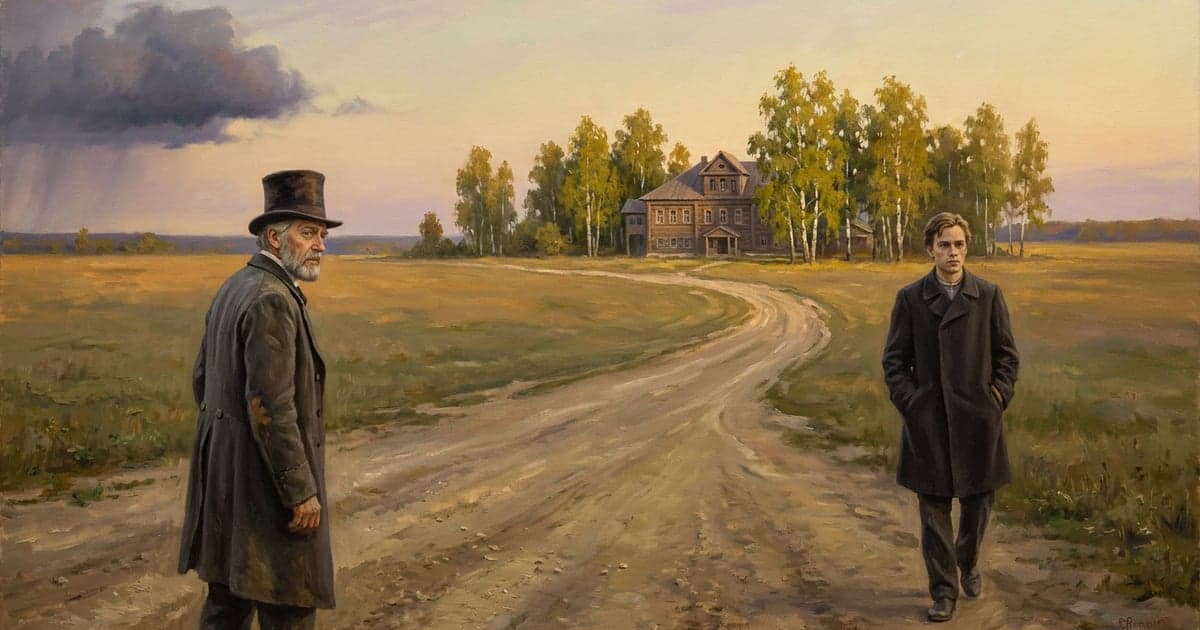
This chapter reveals a fundamental pattern: true love often requires releasing what we most want to hold onto.

This is the graceful release, the painful wisdom that sometimes loving someone means watching them leave.

Arina's wisdom about being 'like lichen in a hollow tree' captures this perfectly: enduring love adapts to circumstances rather than demanding circumstances adapt to it.

Each situation requires the same painful calculation: short-term emotional satisfaction versus long-term relationship health.

In this chapter: Terms Characters Key Quotes Themes Modern Story

Why This Matters

Connect literature to life

Skill: Reading Emotional Restraint

A father's love shows most clearly when he learns to let go without disappearing. Old Bazarov and his wife watch their son with a love he keeps treating as inconvenience. Tell a parent or elder one specific thing you appreciate before assuming they already know.

Coming Up in Chapter 22

The journey to Thedot's posting-house becomes a silent reckoning between the two friends. Arkady's disappointment with Bazarov's treatment of his parents creates new tension, while Bazarov grapples with his own conflicted feelings about family and belonging..

Share it with friends

PreviousPrevious ChapterNextNext Chapter
Original text
6,144 wordscomplete

Chapter 21

A Father's Love and Letting Go

When, in the morning, Arkady rose and opened the window, the first object to greet his eyes was Vasili Ivanitch. Clad in a smock-frock, and belted with a handkerchief, the old man was busily digging in his vegetable garden. As soon as he noticed his young guest, he leaned upon his spade, and cried: "Good morning! How have you slept?" "Splendidly," replied Arkady. "And I, as you see, am imitating Cincinnatus, and preparing a bed of late turnips. By the mercy of God do the times compel every man to win his bread with his own hands. At all times,…

Public-domain chapter text, formatted for reading.

Master this chapter. Complete your experience

Purchase the complete book to access all chapters and support classic literature

Buy at Powell'sBuy on Amazon

Available in paperback, hardcover, and e-book formats

Now let's explore the literary elements.

Key Quotes & Analysis

"By the mercy of God do the times compel every man to win his bread with his own hands. At all times, indeed, is it useless to rely upon others: it is best to work oneself"

— Vasili Ivanitch

Context: While working in his garden and explaining his morning routine to Arkady

Vasili finds dignity in manual labor and self-reliance, trying to connect with his son's generation through shared values of independence. His reference to God shows how he blends traditional faith with modern self-sufficiency. This reveals his attempt to bridge old and new worldviews.

In Today's Words:

At work or at the dinner table, when a younger voice treats your experience as obsolete, Vasili finds dignity in manual labor and self-reliance, trying to connect with his son's generation through shared values of independence. His reference to God shows how he blends traditional faith with modern self-sufficiency. This reveals his attempt to bridge.

"When, in the morning, Arkady rose and opened the window, the first object to greet his eyes was Vasili Ivanitch"

— Narrator

Context: From A Father's Love and Letting Go

In A Father's Love and Letting Go, Turgenev uses this line to anchor the chapter's argument: "When, in the morning, Arkady rose and opened the window, the first object to..."

In Today's Words:

When you believe you are right and still cannot reach the person across from you, In A Father's Love and Letting Go, Turgenev uses this line to anchor the chapter's argument: "When, in the morning, Arkady rose and opened the window, the first object to...". Borrowed certainty travels fast; you can refuse to let it.

"Clad in a smock-frock, and belted with a handkerchief, the old man was busily digging in his vegetable garden"

— Narrator

Context: From A Father's Love and Letting Go

In A Father's Love and Letting Go, Turgenev uses this line to anchor the chapter's argument: "Clad in a smock-frock, and belted with a handkerchief, the old man was busily..."

In Today's Words:

After a fight about principles that was really about pride, In A Father's Love and Letting Go, Turgenev uses this line to anchor the chapter's argument: "Clad in a smock-frock, and belted with a handkerchief, the old man was busily...". That is the pressure Turgenev tracks in Fathers and Sons.

"as busily digging in his vegetable garden. As soon as he noticed his young guest, he leaned upon his spade, and cried: "Good morning"

— Narrator

Context: From A Father's Love and Letting Go

In A Father's Love and Letting Go, Turgenev uses this line to anchor the chapter's argument: "As soon as he noticed his young guest, he leaned upon his spade, and..."

In Today's Words:

When love makes you perform instead of connect, In A Father's Love and Letting Go, Turgenev uses this line to anchor the chapter's argument: "As soon as he noticed his young guest, he leaned upon his spade, and...". Notice whether you are defending an idea or protecting your place in the relationship.

Thematic Threads

Parental Love

In This Chapter

Vasili's desperate desire for connection with Bazarov, balanced against his wisdom to let his son leave without guilt

Development

Deepened from earlier glimpses of his devotion to show the full complexity of parental sacrifice

In Your Life:

You might see this when your grown children make choices you disagree with but you bite your tongue to preserve the relationship

Generational Divide

In This Chapter

Bazarov's inability to appreciate his parents' simple devotion, seeing it as weakness rather than strength

Development

Evolved from intellectual disagreements to emotional disconnection showing the full cost of nihilistic worldview

In Your Life:

You might see this in conflicts between your values and those of younger family members or coworkers

Dignity in Loss

In This Chapter

How Vasili and Arina maintain composure while their hearts break, refusing to burden Bazarov with their pain

Development

Introduced here as a masterclass in emotional maturity under devastating circumstances

In Your Life:

You might see this when you have to stay professional during layoffs or family crises

Friendship Under Strain

In This Chapter

Arkady and Bazarov's philosophical debate revealing how different values can fracture even close relationships

Development

Continued from earlier tensions, now showing the friendship may not survive their diverging paths

In Your Life:

You might see this when political differences or life changes create distance with old friends

Recognition and Validation

In This Chapter

Vasili seeking confirmation from Arkady that his son is truly remarkable, needing external validation of what he already knows

Development

Introduced here as a universal parental need to have others see their child's worth

In Your Life:

You might see this when you fish for compliments about your work or family from colleagues or friends

You now have the context. Time to form your own thoughts.

Discussion Questions

This is not a test. Five prompts guide you through the chapter, from how it opens to how it closes, so you notice context and rhythm rather than facts to memorize. Sit with each question in your own words. When you see "One way to read it," treat it as a starting point, not the only answer.

  1. 1

    What does Vasili hope to achieve by praising Bazarov to Arkady while working in the garden?

    ▶One way to read it

    He wants an outsider to confirm the worth of the son he already adores. Parental love here needs witness and validation, not because he doubts Bazarov, but because he cannot say enough himself.

    analysis • surface
  2. 2

    How does the philosophical argument under the haystack strain the friendship between Bazarov and Arkady?

    ▶One way to read it

    Bazarov's nihilism clashes with Arkady's growing romantic idealism, and Bazarov's plan to leave sharpens the divide. The debate is less about abstractions than about two futures no longer aligned.

    analysis • medium
  3. 3

    How do Vasili's preparations for Bazarov's departure show love that helps without clinging?

    ▶One way to read it

    He packs, plans, and hopes, yet accepts the leave-taking with composed grief. His dignity models a love that serves the child's path rather than demanding that he stay to ease parental fear.

    application • medium
  4. 4

    When is letting someone go the most generous act a parent or mentor can perform?

    ▶One way to read it

    Answers should contrast control masked as care with support that accepts departure. Vasili breaks inside while behaving graciously, showing that true release often costs the giver more than the one who leaves.

    application • deep
  5. 5

    What does Arina's image of clinging like lichen in a hollow tree offer that Bazarov's philosophy cannot?

    ▶One way to read it

    She names enduring attachment without argument or reform. Her simplicity exposes the limit of a worldview that treats need as weakness yet depends on parents who never stop waiting.

    reflection • deep

Critical Thinking Exercise

10 minutes

Practice the Graceful Release

Think of someone in your life who seems to be pulling away or creating distance. Write two responses: first, what your emotional impulse wants you to say or do. Then, rewrite it using Vasili's approach - expressing your feelings without making them responsible for managing those feelings, and showing support for their choices even when they hurt you.

Consider:

  • •Notice the difference in tone between demanding connection and offering it freely
  • •Consider how each approach might affect the other person's willingness to stay close
  • •Pay attention to which response feels more mature, even if it's harder to execute

Journaling Prompt

Write about a time when someone gave you space when you needed it, even though it probably hurt them. How did their graceful release affect your feelings toward them and your relationship long-term?

Coming Up Next...

Chapter 22: The Weight of Unspoken Feelings

The journey to Thedot's posting-house becomes a silent reckoning between the two friends. Arkady's disappointment with Bazarov's treatment of his parents creates new tension, while Bazarov grapples with his own conflicted feelings about family and belonging..

Continue to Chapter 22
Previous
A Son Returns Home
Contents
Next
The Weight of Unspoken Feelings
Keep exploring

Continue Exploring

Study guides, teaching tools, themes, and the full library.More ways to read Fathers and Sons: study guides, teaching tools, and the wider library.

  • Fathers and Sons Study Guide
  • Teaching Resources
  • Essential Life Index
  • Browse by Theme
  • All Books

What this chapter teaches

Theme analyses that draw on this chapter and apply it to modern life.

  • Navigating the Generation GapExplore navigating the generation gap through Fathers and Sons by Turgenev. Life lessons from classic literature applied to modern challenges.

You Might Also Like

Washington Square cover

Washington Square

Henry James

Explores love & romance

Wuthering Heights cover

Wuthering Heights

Emily Brontë

Explores love & romance

Anna Karenina cover

Anna Karenina

Leo Tolstoy

Explores love & romance

Sense and Sensibility cover

Sense and Sensibility

Jane Austen

Explores love & romance

Browse all 107+ books

Share This Chapter

Know someone who'd enjoy this? Spread the wisdom!

TwitterFacebookLinkedInEmail

Go further with Prestige

Unlock study guides and downloads, early access, and exclusive content — and support free access for everyone.

Subscribe to PrestigeCreate free account
Intelligence Amplifier
Intelligence Amplifier™Powering Wide Reads

Exploring human-AI collaboration through books, essays, and philosophical dialogues. Classic literature transformed into navigational maps for modern life.

2025 Books

→ The Amplified Human Spirit→ The Alarming Rise of Stupidity Amplified→ San Francisco: The AI Capital of the World
Visit intelligenceamplifier.org
hello@widereads.com

WideReads Originals

→ You Are Not Lost→ The Last Chapter First→ The Lit of Love→ Wealth and Poverty→ Wisdom for the Wounded
Arvintech
arvintechAmplify your Mind
Visit at arvintech.com

Navigate

  • Home
  • Library
  • Essential Life Index
  • How It Works
  • Subscribe
  • Account
  • About
  • Contact
  • Authors
  • Suggest a Book
  • Landings

Made For You

  • Trending
  • Students
  • Educators
  • Families
  • Readers
  • Literary Analysis
  • Finding Purpose
  • Letting Go
  • Recovering from a Breakup
  • Corruption
  • Gaslighting in the Classics

Newsletter

Weekly insights from the classics. Amplify Your Mind.

Legal

  • Privacy Policy
  • Terms of Service
  • Editorial Standards
  • Cookie Policy
  • Accessibility

Why Public Domain?

We focus on public domain classics because these timeless works belong to everyone. No paywalls, no restrictions—just wisdom that has stood the test of centuries, freely accessible to all readers.

Public domain books have shaped humanity's understanding of love, justice, ambition, and the human condition. By amplifying these works, we help preserve and share literature that truly belongs to the world.

A Pilgrimage

Powell's City of Books

Portland, Oregon

If you ever find yourself in Portland, walk to the corner of Burnside and 10th. The building takes up an entire city block. Inside is over a million books, new and used on the same shelf, organized by color-coded rooms with names like the Rose Room and the Pearl Room. You can lose an afternoon. You can lose a weekend. You will find a book you have been looking for your whole life, and three you did not know existed.

It is a pilgrimage. We cannot find a bookstore like it anywhere on earth. If you read the classics, and you ever get the chance, go. It belongs on every reader's bucket list.

Visit powells.com

We are not in any way affiliated with Powell's. We are just a very big fan.

© 2026 Wide Reads™. All Rights Reserved.

Intelligence Amplifier™ and Wide Reads™ are proprietary trademarks of Arvin Lioanag.

Copyright Protection: All original content, analyses, discussion questions, pedagogical frameworks, and methodology are protected by U.S. and international copyright law. Unauthorized reproduction, distribution, web scraping, or use for AI training is strictly prohibited. See our Copyright Notice for details.

Disclaimer: The information provided on this website is for general informational and educational purposes only and does not constitute professional, legal, financial, or technical advice. While we strive to ensure accuracy and relevance, we make no warranties regarding completeness, reliability, or suitability. Any reliance on such information is at your own risk. We are not liable for any losses or damages arising from use of this site. By using this site, you agree to these terms.