Free study guide · no paywall

Prestige · $2.99/month
Chapter audio, theme analysis, and downloads
Free study guide · no paywall
by Upton Sinclair (1906)
Packingtown, a wedding debt, and an election that does not bring anyone back, mapped across 31 chapters and six lessons.
Start here
31 chapter summaries · 8 key figures · discussion questions · quotes · free
Jurgis Rudkus dances at his own wedding in a hall above a saloon and tells Ona he will work harder when the guests cannot pay their share. The killing floor uses the strongest man in the yards, the house contract hides interest he cannot read, Ona dies upstairs while Madame Haupt wipes grease from her hands, Little Antanas drowns in a puddle the city will not pave, and Jurgis ends in a socialist hall on an election night that does not bring anyone back.
What readers search for
Sinclair's 1906 novel follows Jurgis Rudkus, a Lithuanian immigrant who arrives in Chicago's Packingtown believing hard work will buy a home. The wedding feast cannot pay for itself, the house contract hides interest he cannot read, the killing floor uses him up, and Ona dies upstairs while Madame Haupt wipes grease from her hands. Sinclair aimed at the public's heart. The country converted its dinner instead.
Seeing Systemic ExploitationNot a documentary, but Sinclair spent seven weeks in Chicago's packinghouses, sleeping in the district and interviewing workers in Lithuanian, Polish, and English. The condemned meat, silenced inspectors, and wage that cannot cover winter are fiction built from what he saw. Roosevelt sent investigators after publication. Congress passed the Pure Food and Drug Act and the Meat Inspection Act the same year.
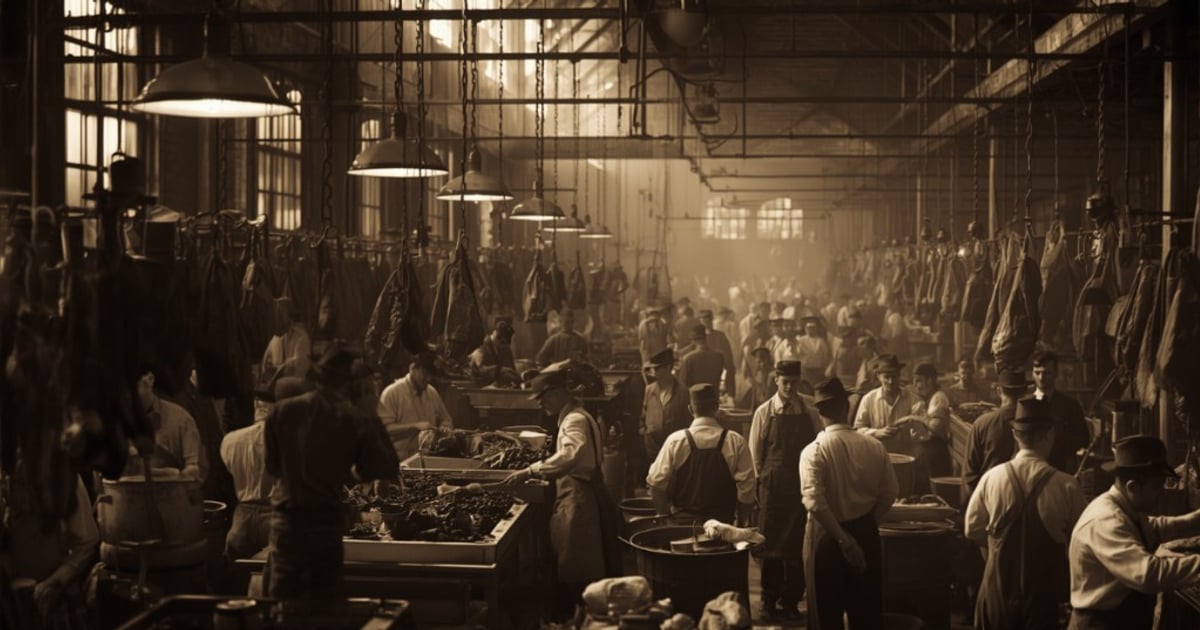
Understanding Reform MovementsThe Chicago stockyards district where cattle become meat and immigrants become inventory. Jokubas tours Jurgis through Brown's on his first day: they do not waste anything here, hide, bone, hair, and gut all find a bin. The pride is real. So is the speed-up, the unread contract, and the blacklist that travels without him after one beating of a boss.
Seeing Systemic ExploitationOna works the night shift, then confesses that Phil Connor priced her job as a body. Jurgis beats Connor and goes to jail. When he returns, Ona is dying in childbirth upstairs while Madame Haupt, the midwife, wipes sausage grease from her hands before climbing the stairs. Sinclair refuses the rescue. The strongest man on the killing floor cannot outrun a trap the same owners wrote into the lease and the shift.
Holding a Family Together Under ScarcityHe wanted to convert the country to the workers. He said later he hit it in the stomach instead. The novel shows graft as everyday government in chapter 25: votes, inspectors, and a hundred-dollar bill Jurgis cannot change without being robbed. The last chapters move Jurgis into a socialist hall where Ostrinski finally names the machine. Chapter 31 is an election night that does not bring anyone back.
Understanding Reform MovementsFast track
You do not have to read all 31 chapters in one sprint. These 9 beats hold the book's argument together.
Chapter 1
The wedding that cannot pay for itself
Chapter 6
The house with hidden interest
Chapter 13
The fertilizer mill starving men avoid
Chapter 15
Ona's confession and jail
Chapter 19
Madame Haupt wipes grease from her hands
Chapter 22
Little Antanas in the puddle
Chapter 25
Graft as everyday government
Chapter 28
The socialist hall
Chapter 31
Election night without a rescue
Full coverage
The same surfaces readers expect from a traditional study guide — plot, characters, themes, quotes, and homework help — plus audio and the source text on every chapter. Free, no paywall.
Plot overview
Summary, context, and why the book still matters
31 chapter summaries
Every chapter with audio narration
8 key figures
Who drives the plot and what each one does
6 lessons
Themes traced to scenes, not generic labels
15+ important quotes
Verified lines with chapter links and analysis
Discussion questions
Five per chapter, with suggested answers for class and essays
Original text
Author's words beside every summary
This is not a plot cheat sheet. Wide Reads walks The Jungle as Sinclair's test of what happens when harder work is priced as inventory. Use the part-by-part path below to keep your bearings, follow the six lesson deep dives when a theme hooks you, and open individual chapters for summaries, quotes, and audio.
For plot and theme questions about The Jungle, see Common Questions on the book page.
How to use this guide
Read chapters 1–8 for the veselija that mortgages the future, Jurgis's pride on the killing beds, and the house with hidden interest. You need the immigrant promise before the contract starts eating it.
Chapters 9–22 hold the sprain that will not heal, the fertilizer mill, Ona's confession, jail, Madame Haupt, and Little Antanas in the puddle. Each scene asks what a wage can buy when the same owners wrote the job and the lease.
Chapters 23–31 move through Marija in the brothel, Jack Duane's cell, chapter 25's graft city, Ostrinski naming the machine, and the election night that does not rescue the dead. When a chapter raises a question you cannot shake, jump to the matching lesson page, then return to the chapter list.
Plot & context
Jurgis Rudkus dances at his own wedding in a hall above a saloon in Packingtown, and when the guests cannot pay their share of the veselija he tells Ona he will work harder. Sinclair published the novel in 1906. The strongest man on the killing floor will still be priced like the cattle, and America will pass a food law before it saves his family.
Jurgis is the Lithuanian who arrives with a back the bosses want and a faith that wages can buy a home. Ona Lukoszaite is the girl he married, slight enough that the winter and the night shift both take her. Teta Elzbieta keeps the household standing after the men fail. Marija Berczynskas is the cousin with a laugh and a job in the canning rooms who will end in a brothel with a needle in her arm. Dede Antanas is the old man who dies coughing fertilizer dust for a job he was too proud to refuse. Stanislovas is the child sent to work before he can keep warm. Phil Connor is the boss who prices Ona's job as a body. Jack Duane is the thief in the cell who teaches Jurgis that the law is a business. Jonas vanishes. Little Antanas drowns in a puddle the city will not pave. Ostrinski finally names the machine. The packers never need to appear as one man. The only opponent who never leaves the page is the claim that harder work can outrun a system built to harvest it.
Chapter 1 opens on the wedding that mortgages the future before the first paycheck. Chapters 3 and 4 put Jurgis on the killing beds, proud of a job that will use him up. Chapter 6 is the house: a down payment, hidden interest, and a contract they cannot read. Chapter 7 sends even Stanislovas out into the cold. Chapter 12 is the sprain that will not heal and the walk back to the line. Chapter 13 is the fertilizer mill. Chapter 15 is Ona's confession and the beating that sends Jurgis to jail. Chapter 19 is Madame Haupt wiping grease from her hands while Ona dies upstairs. Chapter 22 is the child who falls off a sidewalk into water the city left for him. Chapter 25 is the city as a second packing house: votes, inspectors, and a hundred-dollar bill Jurgis cannot change without being robbed. Chapter 27 finds Marija sold. Chapter 28 is the hall where a socialist speech finally gives Jurgis a sentence that can hold what happened. Chapter 31 is an election night that does not bring anyone back.
Sinclair spent seven weeks in the yards and never treats Packingtown as local color, or Jurgis as a mascot for grit, or the sausage as the real subject. He wrote to convert the country to the workers. The country converted its dinner. He refuses the cheap ending. Jurgis does not get the house. Ona does not survive the doctor who had no time to eat. The last chapter is a meeting, not a rescue. What remains is not a sermon that capitalism is rude. It is a picture of how a wage can look like a ladder while every rung is greased, and how a man who believed in effort learns that the effort was the product.
Read the full summary on the book page →
People still watch a wage look like a ladder while every rung is greased: the contract written in language you cannot read, the inspection stamp that sells poisoned meat, the blacklist that travels without you. Sinclair wrote from seven weeks in the yards, not from a safe reform genre. This guide keeps the wedding, Ona's death, and the hall tied to choices you can still name.
Upton Beall Sinclair Jr. (1878-1968) was born in Baltimore to a family that knew both the pawnshop and the rich relatives across town. He put himself through City College and Columbia by writing jokes and dime novels, then turned that speed into muckraking fiction. He was twenty-eight when The Jungle appeared. He spent seven weeks in Chicago's packinghouses, sleeping in the district and interviewing workers in Lithuanian, Polish, and English. He aimed the book at the public's heart. He said later that he hit it in the stomach. Roosevelt sent investigators. Congress passed the Pure Food and Drug Act and the Meat Inspection Act the same year. The labor program he wanted did not ride in on that wave. He wrote nearly a hundred books, ran for governor of California in 1934, and never stopped treating fiction as a tool. The gift in this one is refusing to let grit be the moral. He lets the strongest man in the yards break, lets the wedding become a debt, and still leaves a meeting at the end instead of a rescue. The book still finds readers who recognize the night a contract, a shift, or a promise quietly changed owners.
Themes with proof
Six pressures Sinclair tests from the veselija to the hall: systemic exploitation when the trap looks like bad luck, a family held together under scarcity, survival after the system breaks you, graft read as everyday government, reform movements that change dinner before wages, and the immigrant perspective in contracts written in English they cannot read. Each spoke ties named chapters to the proof.
Character guide
Who drives the plot, what each one wants, and why they matter to the argument of the book.
The Lithuanian who arrives with a back the bosses want and learns that harder work is priced as inventory.
The girl Jurgis married, slight enough that winter and the night shift both take her.
The elder who keeps the household standing after the men fail and sends Stanislovas into the cold.
The cousin with a laugh and a job in the canning rooms who ends in a brothel with a needle in her arm.
The old man who dies coughing fertilizer dust for a job he was too proud to refuse.
The boss who prices Ona's job as a body and sends Jurgis to jail when he fights back.
The thief in the cell who teaches Jurgis that the law is a business.
The socialist who finally gives Jurgis a sentence that can hold what happened.
Memorable lines
Verified passages with chapter links — the lines teachers and essays keep returning to.
“I will work harder.”
“When that personage had developed a will of his own in the matter, Marija had flung up the window of the carriage, and, leaning out, proceeded to tell him her opinion of him, first in Lithuanian, which he did not understand, and then in Polish, which he did.”
“He was the sort of man the bosses like to get hold of, the sort they make it a grievance they cannot get hold of.”
“When he was told to go to a certain place, he would go there on the run.”
“He had a job! He had a job!”
“They don't waste anything here”
“He gave him a good cursing, but as Jurgis did not understand a word of it he did not object.”
“He came to the door that had been pointed out to him, and there he waited for nearly two hours.”
“It was quite touching, the zeal of people to see that his health and happiness were provided for.”
“They spent all their time thinking about it, and what they were going to put into it.”
“All his thoughts were there; he accepted the family because it was a part of Ona.”
“And he was interested in the house because it was to be Ona’s home.”
“Over them, relentless and savage, there cracked the lash of want”
“They wondered if ever any love that had blossomed in the world had been so crushed and trampled”
“Everybody laughed at them, for Tamoszius was petite and frail, and Marija could have picked him up and carried him off under one arm.”
Class & essay prep
Sample prompts drawn from the chapter guides — each with suggested answers for seminars and written work.
In the opening of Chapter 1, how does the scene where Ona and Jurgis celebrate their wedding in the back room of a Chicago saloon, surrounded by their Lithuanian immigrant community. What should be pure joy becomes shado
From Chapter 1What does the middle sequence where The celebration pulses with life: Tamoszius the inspired violinist plays with demonic energy, guests dance until dawn, and the acziavimas ceremony collects money for the newlyweds. But
From Chapter 1In the opening of Chapter 2, how does the scene where Jurgis embodies the dangerous optimism of youth and inexperience as he dismisses warnings from older workers about the brutal realities of industrial labor. His physi
From Chapter 2What does the middle sequence where Their journey from the old country involves multiple scams and financial losses, foreshadowing the systematic exploitation awaiting them. Upon arriving in Chicago's Packingtown distric
From Chapter 2In the opening of Chapter 3, how does the scene where Jurgis lands his first job at Brown's packinghouse through a brief, broken-English exchange with a boss who notices his strong build. His joy is infectious, he runs h
From Chapter 3What does the middle sequence where They witness the industrial slaughter process, hogs and cattle transformed into meat products with ruthless efficiency. The tour reveals both the marvel and horror of mass production:
From Chapter 3In the opening of Chapter 4, how does the scene where Jurgis starts his first day at the meatpacking plant, earning seventeen and a half cents an hour sweeping entrails from cattle carcasses. Despite the horrific conditi
From Chapter 4What does the middle sequence where With three incomes secured, the family considers buying a house advertised in a colorful flyer promising homeownership for less than rent. The advertisement shows a beautiful home avai
From Chapter 4In the opening of Chapter 5, how does the scene where Jurgis and his family finally move into their new house, buying furniture on credit from predatory advertisers who target Packingtown's immigrant population. The joy
From Chapter 5What does the middle sequence where His father Antanas, desperate for work, pays a third of his wages for a job cleaning pickle room floors and discovers he's expected to mix floor scraps back into the food supply. Marij
From Chapter 5In the opening of Chapter 6, how does the scene where Jurgis and Ona's wedding plans collide with a crushing financial reality when their elderly neighbor, Grandmother Majauszkiene, reveals the dark history of their hous
From Chapter 6What does the middle sequence where But the real bombshell comes when the old woman discovers hidden interest charges in their contract, seven percent annually that no one explained to them. This adds seven dollars to th
From Chapter 6In the opening of Chapter 7, how does the scene where Jurgis and Ona's wedding becomes their first major financial disaster when guests fail to cover costs through traditional gifts, leaving them over $100 in debt. Despi
From Chapter 7What does the middle sequence where Old Antanas develops a fatal cough and chemical burns on his feet from his job, eventually dying after months of suffering while the family struggles to afford even basic funeral servi
From Chapter 7In the opening of Chapter 8, how does the scene where Marija finds love with Tamoszius, the gentle violinist whose music transforms their cramped kitchen into a place of beauty. Their romance brings unexpected benefits,
From Chapter 8Chapter by chapter
Chapter-by-chapter summaries, quotes, and audio.
Ona and Jurgis celebrate their wedding in the back room of a Chicago saloon, surrounded by their Lithuanian immigrant community. Marija Berczynskas ha...
Jurgis talks lightly about work because he is young and a giant besides. Older workers tell him horror stories about men broken in the stockyards, but...
Jurgis secures work at Brown's through a pantomime the boss understands before he does: shovel guts, see door, tomorrow at seven. He runs home yelling...
Jurgis reports at seven and waits nearly two hours at the wrong side of the door because no one told him to enter. The boss curses him in English he c...
Settlement begins with predatory commerce. Feather-your-nest advertisements furnish four rooms for seventy-five dollars down and monthly payments; ano...
Jurgis and Ona are deep in love, measuring every decision by whether it brings their marriage closer. Elzbieta insists on a proper veselija, not a roa...
All summer the family toils until Jurgis and Ona can marry with decency, then November's feast leaves them more than a hundred dollars in debt. Love h...
Marija finds love with Tamoszius, the gentle violinist whose music transforms their cramped kitchen into a place of beauty. Their romance brings unexp...
Jurgis begins learning English because the union is the first place he has seen democracy work: every voice counts, and decisions touch everyone in th...
Spring mud, summer heat, and swarms of flies announce that surviving winter was only the first lie. Jurgis's wages fall from nine or ten dollars a wee...
Summer returns and Jurgis earns again, but less than before because the packers hire surplus hands to break strikes and keep everyone hungry for hours...
Jurgis's ankle injury becomes a nightmare that won't end. What should have been a simple sprain turns into months of agony because they can't afford p...
Little Kristoforas dies, Elzbieta's disabled three-year-old, possibly poisoned by contaminated sausage. The family must choose between a pauper burial...
Sinclair exposes the grotesque practices behind America's meat industry: spoiled meat masked with chemicals, rat droppings mixed into sausage, poisone...
Winter demands sixteen-hour shifts simply to keep the house. Overtime is not opportunity; it is the price of staying one month ahead of eviction. Jurg...
Jurgis sits in his cell satisfied for an hour after beating Connor, then arithmetic arrives: no wages, no home, eleven mouths while he rots behind bar...
Jurgis begins a thirty-day sentence and meets Jack Duane, a college-educated safecracker who treats crime as war against an unfair world. Duane speaks...
Release does not come on schedule. Court costs keep Jurgis in Bridewell extra days, a dollar and a half charged for the privilege of being jailed. Whe...
Ona is in labor and dying when Jurgis runs through the night for a midwife. He finds Madame Haupt, drunk and filthy, demanding twenty-five dollars he ...
Jurgis returns sober and broke to find Ona unburied and the children hungry. Elzbieta begs him to stand up for Antanas; he swears he will work, then l...
The Harvester Trust had seemed like rescue; its sudden closure teaches Jurgis a harder rule. Factories do not shut because workers fail; they shut bec...
Antanas dies not in the plant but on a broken sidewalk, and grief arrives as cold strategy. Jurgis does not weep; he jumps a freight train and flees C...
Winter drives Jurgis back to Chicago with fifteen dollars and hard-won street sense. He lands work digging telephone tunnels, not knowing the job is a...
Half frozen on a Chicago street, Jurgis meets Freddie Jones, drunk heir to the packing fortune that devoured his life. The irony never reaches Freddie...
Freddie's hundred-dollar bill should change everything; instead it delivers Jurgis to a bartender who examines the note, pours one beer, and pockets t...
During the great Beef Strike, Mike Scully tells Jurgis to lay low and profit from chaos. Jurgis crosses the picket line for higher wages, choosing cas...
Cut off from Scully's machine, Jurgis re-enters the world ordinary workers inhabit: dawn lines for jobs that do not exist, stale bread, sleep in alley...
Jurgis visits Marija again and learns the economics of the brothel: clothes held as collateral, debts for room and board, arrest threatened if a woman...
Jurgis experiences a complete transformation after hearing the socialist speech. The powerful words awaken something deep within him - for the first t...
Jurgis lands work as a porter at a small hotel whose owner, Tommy Hinds, is a Socialist organizer in plain sight. The job is luck, but the education i...
Jurgis visits Marija with steady hotel work and asks her to leave the brothel. She refuses: her past is known, she takes morphine, she sends money to ...
Using this guide
How to use Wide Reads for class, essays, and revision — and how this guide compares to traditional study sites.
Traditional study guides summarise what happened in The Jungle. This guide gives you that coverage: all 31 chapters, eight key figures, and a part-by-part path through the novel. Wide Reads adds Seeing Systemic Exploitation and Immigrant Perspective traced through named scenes like the killing beds, the house contract, and the veselija. Summaries include audio; the original text sits beside every chapter. Free, no paywall.
The Jungle is rated intermediate difficulty. Our chapter-by-chapter analysis breaks down complex passages, explains historical context, and highlights key themes to make the text more accessible. Each chapter includes summaries, character analysis, and discussion questions to deepen your understanding.
Yes — use this reading guide alongside The Jungle, not instead of it. Wide Reads exists to show you why the book still matters: lessons, chapter summaries with audio, and life skills you can carry into real life. That context can sharpen essays on themes, characters, and quotes. Always read Upton Sinclair's original text, though. We are the guide at the trailhead; the classic is still the point.
Chapter 1 opens on a veselija that mortgages the future before the first paycheck. Each chapter adds summaries, quotes, audio, and the life-skill thread that turns Sinclair's Packingtown into a map you can still use.
Plot, characters, and themes — plus audio, source text, and patterns you can use after class
Two ways in
Chapter by chapter, with audio. The meaning arrives because you experienced it — not because someone listed bullet points.
Start with this.
The actual words the author wrote, alongside every summary. Use the guide, then step into the source.
Then step into the source.
Either way, the door opens inward.
— and most of all, Why does this matter?
Guides, life skills, and the full library.More ways to read The Jungle: guides, life skills, and the wider library.

Weekly insights from the classics. Amplify Your Mind.
We focus on public domain classics because these timeless works belong to everyone. No paywalls, no restrictions—just wisdom that has stood the test of centuries, freely accessible to all readers.
Public domain books have shaped humanity's understanding of love, justice, ambition, and the human condition. By amplifying these works, we help preserve and share literature that truly belongs to the world.
© 2026 Wide Reads™. All Rights Reserved.
Intelligence Amplifier™ and Wide Reads™ are proprietary trademarks of Arvin Lioanag.
Copyright Protection: All original content, analyses, discussion questions, pedagogical frameworks, and methodology are protected by U.S. and international copyright law. Unauthorized reproduction, distribution, web scraping, or use for AI training is strictly prohibited. See our Copyright Notice for details.
Disclaimer: The information provided on this website is for general informational and educational purposes only and does not constitute professional, legal, financial, or technical advice. While we strive to ensure accuracy and relevance, we make no warranties regarding completeness, reliability, or suitability. Any reliance on such information is at your own risk. We are not liable for any losses or damages arising from use of this site. By using this site, you agree to these terms.
Stay with Duane's cell and chapter 25: votes, inspectors, and a city that prices justice.
There were two rival sets of grafters, known as political parties, and the one got the office which bought the most votes.