Wide Reads
Literature MattersLife IndexEducators
Sign in
Where to Begin

Democracy and Corruption Unveiled — The Jungle

The Jungle - Democracy and Corruption Unveiled

Upton Sinclair

The Jungle

Democracy and Corruption Unveiled

Home›Books›The Jungle›Chapter 9: Democracy and Corruption Unveiled
Previous
9 of 31
Next

Analysis by the Wide Reads editorial team·Reviewed against the source text·Updated December 11, 2025

Summary

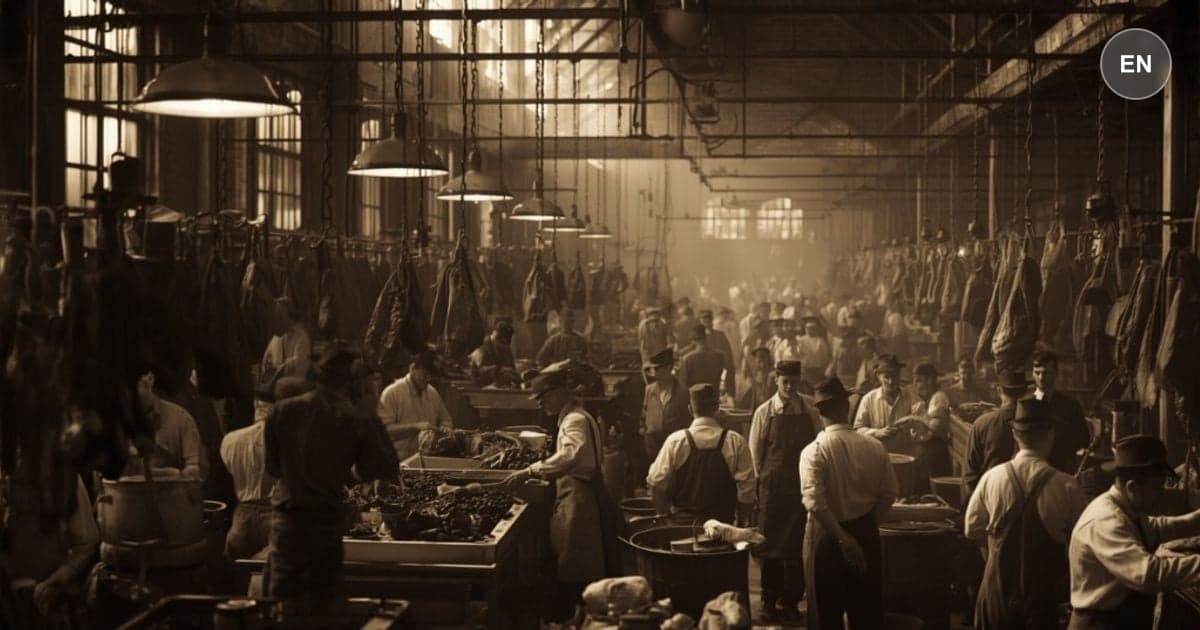
Jurgis begins learning English and discovers the union as his first taste of real democracy, a place where every voice matters and decisions affect everyone. This awakening leads him to understand American politics, but not in the way he expected. Through his rushed naturalization and paid voting experience, Jurgis learns that his citizenship was bought and sold like meat at the stockyards. The union men explain how political boss Mike Scully controls everything in their district through a web of corruption that touches every aspect of life, from garbage dumps to ice sales to building permits. Meanwhile, Jurgis discovers the horrifying reality behind the meat industry's public face. Government inspectors exist only to certify diseased meat for interstate commerce, while local inspection has been abolished entirely. Workers share stories of the grotesque ingredients in canned goods, from 'potted chicken' made without chicken to 'pure leaf lard' that sometimes contains human remains. Each department creates its own hell for workers, from pickle room acids that eat away fingers to fertilizer vats that swallow men whole. This chapter reveals how systems that appear legitimate, citizenship, food safety, democratic processes, can be corrupted to serve the powerful while exploiting the vulnerable. Jurgis's political education shows him that freedom requires vigilance and collective action. This chapter's pattern, The Manufactured Consent Loop, appears through concrete choices by Jurgis, Ona, Marija, or the family. In the opening, Jurgis begins learning English and discovers the union as his first taste of real democracy, a place where every voice matters and decisions affect everyone. This awakening leads him to understand Ame, which shows who controls information, wages, or housing. In the middle, The union men explain how political boss Mike Scully controls everything in their district through a web of corruption that touches every aspect of life, from garbage dumps to ice sales to building pe, and that scene tests whether harder work can solve a structural trap. In the closing, Workers share stories of the grotesque ingredients in canned goods, from 'potted chicken' made without chicken to 'pure leaf lard' that sometimes contains human remains. Each department creates its ow, narrowing what the family can do next. Sinclair ties private shame to public machinery: packers, landlords, police, and politicians who profit from worker desperation. Read the chapter as one causal arc: opening pressure, middle complication, and closing cost that feeds the next disaster. This chapter's pattern, The Manufactured Consent Loop, appears through concrete choices by Jurgis, Ona, Marija, or the family.

In this chapter: Terms Characters Key Quotes Themes Modern Story

Why This Matters

Connect literature to life

Skill: Detecting Manufactured Consent

What looks like bad luck is often policy, speed-up, or graft wearing a friendly face. One of the first consequences of the discovery of the union was that Jurgis became desirous of learning English. Ask whether the person offering help also controls the debt, the job, or the inspection that follows.

Coming Up in Chapter 10

As winter deepens, the family's financial situation becomes desperate. With Jurgis earning less and bills mounting, they face a crisis that will test everything they've learned about survival in America.

Share it with friends

PreviousPrevious ChapterNextNext Chapter
Original text
3,911 wordscomplete

Chapter 09

Democracy and Corruption Unveiled

One of the first consequences of the discovery of the union was that Jurgis became desirous of learning English. He wanted to know what was going on at the meetings, and to be able to take part in them, and so he began to look about him, and to try to pick up words. The children, who were at school, and learning fast, would teach him a few; and a friend loaned him a little book that had some in it, and Ona would read them to him. Then Jurgis became sorry that he could not read himself; and later…

Public-domain chapter text, formatted for reading.

Master this chapter. Complete your experience

Purchase the complete book to access all chapters and support classic literature

Buy at Powell'sBuy on Amazon

Available in paperback, hardcover, and e-book formats

Now let's explore the literary elements.

Key Quotes & Analysis

"It was the beginning of democracy with him. It was a little state, the union, a miniature republic; its affairs were every man's affairs, and every man had a real say about them."

— Narrator

Context: Describing Jurgis's first experience with the union and how it introduced him to democratic participation

This quote shows how the union provided Jurgis's first taste of real democracy, where his voice actually mattered. It contrasts sharply with the corrupt political system he encounters outside the union, highlighting how genuine democracy requires active participation and shared power.

In Today's Words:

When politics and business share the same back room, This quote shows how the union provided Jurgis's first taste of real democracy, where his voice actually mattered. It contrasts sharply with the corrupt political system he encounters outside the union, highlighting how genuine democracy requires active participation and shared power. Collective action starts when one.

"The children, who were at school, and learning fast, would teach him a few; and a friend loaned him a little book that had some in it, and Ona would read them to him."

— Narrator

Context: From Democracy and Corruption Unveiled

In Democracy and Corruption Unveiled, Sinclair uses this line to anchor the chapter's argument: "The children, who were at school, and learning fast, would teach him a few;..."

In Today's Words:

When a job offer sounds too easy for the work ahead, In Democracy and Corruption Unveiled, Sinclair uses this line to anchor the chapter's argument: "The children, who were at school, and learning fast, would teach him a few;...". The pattern still runs through warehouses, hospitals, and gig platforms.

"After that, every evening that he got home from the yards in time, he would go to the school; he would go even if he were in time for only half an hour."

— Narrator

Context: From Democracy and Corruption Unveiled

In Democracy and Corruption Unveiled, Sinclair uses this line to anchor the chapter's argument: "After that, every evening that he got home from the yards in time, he..."

In Today's Words:

If rent and fees climb faster than your paycheck, In Democracy and Corruption Unveiled, Sinclair uses this line to anchor the chapter's argument: "After that, every evening that he got home from the yards in time, he...". Document conditions before injuries get rewritten as personal failure.

"They were teaching him both to read and to speak English—and they would have taught him other things, if only he had had a little time."

— Narrator

Context: From Democracy and Corruption Unveiled

In Democracy and Corruption Unveiled, Sinclair uses this line to anchor the chapter's argument: "They were teaching him both to read and to speak English, and they would have..."

In Today's Words:

When a celebration hides debt everyone pretends not to see, In Democracy and Corruption Unveiled, Sinclair uses this line to anchor the chapter's argument: "They were teaching him both to read and to speak English, and they would have...". Sinclair shows how optimism becomes leverage against people with no exit.

Thematic Threads

Power

In This Chapter

Jurgis learns that real power operates invisibly—Mike Scully controls everything while remaining in the shadows

Development

Evolved from powerlessness to recognizing how power actually functions in corrupt systems

In Your Life:

You might recognize this when workplace decisions seem predetermined despite employee input sessions

Identity

In This Chapter

Jurgis's American citizenship becomes a commodity bought and sold rather than earned status

Development

Deepened from earlier struggles with belonging to understanding how identity can be manipulated

In Your Life:

You might feel this when professional certifications or titles don't translate to actual respect or security

Deception

In This Chapter

Government inspection stamps legitimize poisonous food while creating illusion of safety

Development

Expanded from personal betrayals to systematic institutional deception

In Your Life:

You might see this in healthcare when insurance 'approvals' come with hidden restrictions that deny actual care

Class

In This Chapter

Union solidarity offers real democracy while political system turns working-class votes into commodities

Development

Contrasted genuine working-class power with how that power gets captured by elites

In Your Life:

You might experience this when community organizing creates real change while electoral politics feels meaningless

Awakening

In This Chapter

Learning English and joining the union opens Jurgis's eyes to both possibilities and systematic corruption

Development

Progressed from survival mode to political consciousness and pattern recognition

In Your Life:

You might feel this when gaining new skills or knowledge reveals how much you've been kept in the dark

You now have the context. Time to form your own thoughts.

Discussion Questions

This is not a test. Five prompts guide you through the chapter, from how it opens to how it closes, so you notice context and rhythm rather than facts to memorize. Sit with each question in your own words. When you see "One way to read it," treat it as a starting point, not the only answer.

  1. 1

    In the opening of Chapter 9, how does the scene where Jurgis begins learning English and discovers the union as his first taste of real democracy, a place where every voice matters and decisions affect everyone. This awa

    ▶One way to read it

    The opening ties emotion to economics: Jurgis still believes effort can win, but the scene shows how quickly debt, tradition, or bosses set the real rules.

    analysis • surface
  2. 2

    What does the middle sequence where The union men explain how political boss Mike Scully controls everything in their district through a web of corruption that touches every aspect of life, from garbage dumps to ice sale

    ▶One way to read it

    The middle shows power moving to whoever controls pace, information, or enforcement, while workers compete for scraps of safety and pay.

    analysis • medium
  3. 3

    How does the closing turn where Workers share stories of the grotesque ingredients in canned goods, from 'potted chicken' made without chicken to 'pure leaf lard' that sometimes contains human remains. Each department cr

    ▶One way to read it

    The closing narrows options and usually pushes the family from optimism toward damage control, injury, or political awakening.

    application • medium
  4. 4

    Where do you see The Manufactured Consent Loop in wages, contracts, politics, or workplace safety today?

    ▶One way to read it

    One reading: the same pattern appears in gig work, predatory loans, captured regulators, and speed-up jobs that treat bodies as disposable.

    application • deep
  5. 5

    What immediate cost does The Manufactured Consent Loop extract from Jurgis or his family inside this chapter?

    ▶One way to read it

    The Manufactured Consent Loop costs time, health, money, or trust through specific actions in Democracy and Corruption Unveiled, not through vague bad luck.

    reflection • deep

Critical Thinking Exercise

15 minutes

Map Your Power Network

Choose one area of your life where you feel like you should have more say—your workplace, your child's school, your neighborhood, or your healthcare. Draw a simple map showing who officially makes decisions, who really influences those decisions, and where your voice actually goes when you speak up. Include the 'Mike Scully' figure if there is one—the person everyone mentions but no one directly challenges.

Consider:

  • •Look for gaps between official channels and actual influence
  • •Notice who benefits from keeping the real power structure hidden
  • •Identify potential allies who might also feel shut out of real decision-making

Journaling Prompt

Write about a time when you participated in a process that felt democratic but left you wondering if your input actually mattered. What would you do differently now?

Coming Up Next...

Chapter 10: The Crushing Weight of Hidden Costs

As winter deepens, the family's financial situation becomes desperate. With Jurgis earning less and bills mounting, they face a crisis that will test everything they've learned about survival in America.

Continue to Chapter 10
Previous
Love and Labor Organize
Contents
Next
The Crushing Weight of Hidden Costs
Keep exploring

Continue Exploring

Study guides, teaching tools, themes, and the full library.More ways to read The Jungle: study guides, teaching tools, and the wider library.

  • The Jungle Study Guide
  • Teaching Resources
  • Essential Life Index
  • Browse by Theme
  • All Books

What this chapter teaches

Theme analyses that draw on this chapter and apply it to modern life.

  • Understanding Reform MovementsJurgis encounters labor organizing and discovers that workers can speak together about conditions bosses prefer to keep private. The union is not perfect, but it introduces a new idea: problems shared by many people may require answers larger than individual hustle.

You Might Also Like

A Tale of Two Cities cover

A Tale of Two Cities

Charles Dickens

Explores justice & fairness

Hard Times cover

Hard Times

Charles Dickens

Explores justice & fairness

Jude the Obscure cover

Jude the Obscure

Thomas Hardy

Explores society & class

Les Misérables: Essential Edition cover

Les Misérables: Essential Edition

Victor Hugo

Explores justice & fairness

Browse all 106+ books

Share This Chapter

Know someone who'd enjoy this? Spread the wisdom!

TwitterFacebookLinkedInEmail

Go further with Prestige

Unlock study guides and downloads, early access, and exclusive content — and support free access for everyone.

Subscribe to PrestigeCreate free account
Intelligence Amplifier
Intelligence Amplifier™Powering Wide Reads

Exploring human-AI collaboration through books, essays, and philosophical dialogues. Classic literature transformed into navigational maps for modern life.

2025 Books

→ The Amplified Human Spirit→ The Alarming Rise of Stupidity Amplified→ San Francisco: The AI Capital of the World
Visit intelligenceamplifier.org
hello@widereads.com

WideReads Originals

→ You Are Not Lost→ The Last Chapter First→ The Lit of Love→ Wealth and Poverty→ Wisdom for the Wounded
Arvintech
arvintechAmplify your Mind
Visit at arvintech.com

Navigate

  • Home
  • Library
  • Essential Life Index
  • How It Works
  • Subscribe
  • Account
  • About
  • Contact
  • Authors
  • Suggest a Book
  • Landings

Made For You

  • Trending
  • Students
  • Educators
  • Families
  • Readers
  • Literary Analysis
  • Finding Purpose
  • Letting Go
  • Recovering from a Breakup
  • Corruption
  • Gaslighting in the Classics

Newsletter

Weekly insights from the classics. Amplify Your Mind.

Legal

  • Privacy Policy
  • Terms of Service
  • Editorial Standards
  • Cookie Policy
  • Accessibility

Why Public Domain?

We focus on public domain classics because these timeless works belong to everyone. No paywalls, no restrictions—just wisdom that has stood the test of centuries, freely accessible to all readers.

Public domain books have shaped humanity's understanding of love, justice, ambition, and the human condition. By amplifying these works, we help preserve and share literature that truly belongs to the world.

A Pilgrimage

Powell's City of Books

Portland, Oregon

If you ever find yourself in Portland, walk to the corner of Burnside and 10th. The building takes up an entire city block. Inside is over a million books, new and used on the same shelf, organized by color-coded rooms with names like the Rose Room and the Pearl Room. You can lose an afternoon. You can lose a weekend. You will find a book you have been looking for your whole life, and three you did not know existed.

It is a pilgrimage. We cannot find a bookstore like it anywhere on earth. If you read the classics, and you ever get the chance, go. It belongs on every reader's bucket list.

Visit powells.com

We are not in any way affiliated with Powell's. We are just a very big fan.

© 2026 Wide Reads™. All Rights Reserved.

Intelligence Amplifier™ and Wide Reads™ are proprietary trademarks of Arvin Lioanag.

Copyright Protection: All original content, analyses, discussion questions, pedagogical frameworks, and methodology are protected by U.S. and international copyright law. Unauthorized reproduction, distribution, web scraping, or use for AI training is strictly prohibited. See our Copyright Notice for details.

Disclaimer: The information provided on this website is for general informational and educational purposes only and does not constitute professional, legal, financial, or technical advice. While we strive to ensure accuracy and relevance, we make no warranties regarding completeness, reliability, or suitability. Any reliance on such information is at your own risk. We are not liable for any losses or damages arising from use of this site. By using this site, you agree to these terms.