Chapter 04
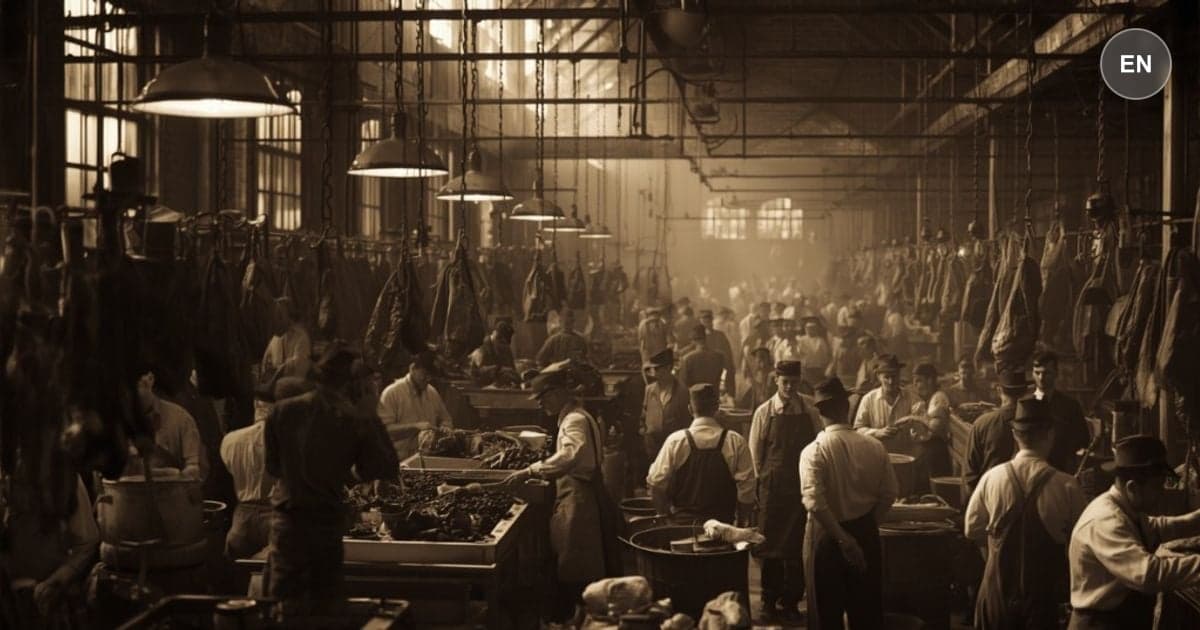
First Day at the Killing Beds
Promptly at seven the next morning Jurgis reported for work. He came to the door that had been pointed out to him, and there he waited for nearly two hours. The boss had meant for him to enter, but had not said this, and so it was only when on his way out to hire another man that he came upon Jurgis. He gave him a good cursing, but as Jurgis did not understand a word of it he did not object. He followed the boss, who showed him where to put his street clothes, and waited while he donned…
Public-domain chapter text, formatted for reading.
Master this chapter. Complete your experience
Purchase the complete book to access all chapters and support classic literature
Available in paperback, hardcover, and e-book formats
Now let's explore the literary elements.
Key Quotes & Analysis
"He gave him a good cursing, but as Jurgis did not understand a word of it he did not object."
Context: When Jurgis waits outside for two hours because he doesn't understand he should enter
This shows how language barriers make immigrants vulnerable to abuse. Jurgis can't even defend himself because he doesn't understand the insults. It reveals the power imbalance that will define his entire experience.
In Today's Words:
When politics and business share the same back room, This shows how language barriers make immigrants vulnerable to abuse. Jurgis can't even defend himself because he doesn't understand the insults. It reveals the power imbalance that will define his entire experience. Collective action starts when one worker stops performing gratitude.
"He came to the door that had been pointed out to him, and there he waited for nearly two hours."
Context: From First Day at the Killing Beds
In First Day at the Killing Beds, Sinclair uses this line to anchor the chapter's argument: "He came to the door that had been pointed out to him, and there..."
In Today's Words:
When a job offer sounds too easy for the work ahead, In First Day at the Killing Beds, Sinclair uses this line to anchor the chapter's argument: "He came to the door that had been pointed out to him, and there...". The pattern still runs through warehouses, hospitals, and gig platforms.
"All day long he was figuring to himself."
Context: From First Day at the Killing Beds
In First Day at the Killing Beds, Sinclair uses this line to anchor the chapter's argument: "All day long he was figuring to himself."
In Today's Words:
If rent and fees climb faster than your paycheck, In First Day at the Killing Beds, Sinclair uses this line to anchor the chapter's argument: "All day long he was figuring to himself.". Document conditions before injuries get rewritten as personal failure. Ask who profits when workers are told to be grateful for dangerous jobs.
"Jonas had been to have an interview with the special policeman to whom Szedvilas had introduced him, and had been taken to see several of the bosses, with the result that one had promised him a job the beginning of the next week."
Context: From First Day at the Killing Beds
In First Day at the Killing Beds, Sinclair uses this line to anchor the chapter's argument: "Jonas had been to have an interview with the special policeman to whom Szedvilas..."
In Today's Words:
When a celebration hides debt everyone pretends not to see, In First Day at the Killing Beds, Sinclair uses this line to anchor the chapter's argument: "Jonas had been to have an interview with the special policeman to whom Szedvilas...". Sinclair shows how optimism becomes leverage against people with no exit.
Thematic Threads
Exploitation
In This Chapter
The housing scam targets the family's legitimate hope and financial vulnerability through complex contracts and pressure tactics
Development
Escalated from workplace exploitation to systematic targeting of immigrant dreams
In Your Life:
You might face this when car dealers, loan companies, or MLM recruiters pressure you during hopeful moments
Language Barriers
In This Chapter
The family's limited English makes them unable to understand the rental vs. sale contract distinction
Development
Introduced here as a specific vulnerability in legal and financial situations
In Your Life:
You might experience this with medical forms, legal documents, or financial contracts that use confusing terminology
Class Vulnerability
In This Chapter
Working-class immigrants lack cultural knowledge to recognize standard predatory practices that middle-class Americans might spot
Development
Evolved from workplace powerlessness to systematic exclusion from protective knowledge
In Your Life:
You might face this when navigating systems designed for people with different educational or cultural backgrounds
False Security
In This Chapter
Multiple family incomes create overconfidence that leads to major financial commitment without proper understanding
Development
Introduced here as hope-based decision making replacing careful planning
In Your Life:
You might experience this when a good month financially makes you consider major purchases or commitments
Institutional Deception
In This Chapter
Legal and real estate systems are structured to confuse rather than clarify, with professionals who profit from confusion
Development
Introduced here as systematic rather than individual corruption
In Your Life:
You might encounter this in healthcare billing, insurance claims, or any complex service industry
You now have the context. Time to form your own thoughts.
Discussion Questions
This is not a test. Five prompts guide you through the chapter, from how it opens to how it closes, so you notice context and rhythm rather than facts to memorize. Sit with each question in your own words. When you see "One way to read it," treat it as a starting point, not the only answer.
- 1
In the opening of Chapter 4, how does the scene where Jurgis starts his first day at the meatpacking plant, earning seventeen and a half cents an hour sweeping entrails from cattle carcasses. Despite the horrific conditi
analysis • surfaceOne way to read it
The opening ties emotion to economics: Jurgis still believes effort can win, but the scene shows how quickly debt, tradition, or bosses set the real rules.
- 2
What does the middle sequence where With three incomes secured, the family considers buying a house advertised in a colorful flyer promising homeownership for less than rent. The advertisement shows a beautiful home avai
analysis • mediumOne way to read it
The middle shows power moving to whoever controls pace, information, or enforcement, while workers compete for scraps of safety and pay.
- 3
How does the closing turn where When they visit the house, reality doesn't match the advertisement, it's smaller, different colors, and the basement and attic are unfinished. But the smooth-talking agent overwhelms them
application • mediumOne way to read it
The closing narrows options and usually pushes the family from optimism toward damage control, injury, or political awakening.
- 4
Where do you see The Predatory Hope Trap in wages, contracts, politics, or workplace safety today?
application • deepOne way to read it
One reading: the same pattern appears in gig work, predatory loans, captured regulators, and speed-up jobs that treat bodies as disposable.
- 5
What immediate cost does The Predatory Hope Trap extract from Jurgis or his family inside this chapter?
reflection • deepOne way to read it
The Predatory Hope Trap costs time, health, money, or trust through specific actions in First Day at the Killing Beds, not through vague bad luck.
Critical Thinking Exercise
Rewrite the Sales Pitch
Imagine you're the house salesman, but you're actually honest and ethical. Rewrite his sales pitch to give Jurgis's family the information they actually need to make a good decision. What would you tell them about homeownership, the contract terms, and the real costs involved?
Consider:
- •What information did the original salesman deliberately hide or confuse?
- •What questions should buyers always ask before signing any major contract?
- •How can you present realistic expectations without crushing legitimate dreams?
Journaling Prompt
Write about a time when someone used your hope or excitement to pressure you into a decision. What warning signs did you miss, and what would you do differently now?
Coming Up Next...
Chapter 5: The First Taste of Home
The family prepares to move into their new home, but the reality of homeownership brings unexpected challenges. As they furnish their house and settle into their new life, they'll discover that buying the American Dream was just the beginning of their struggles.