
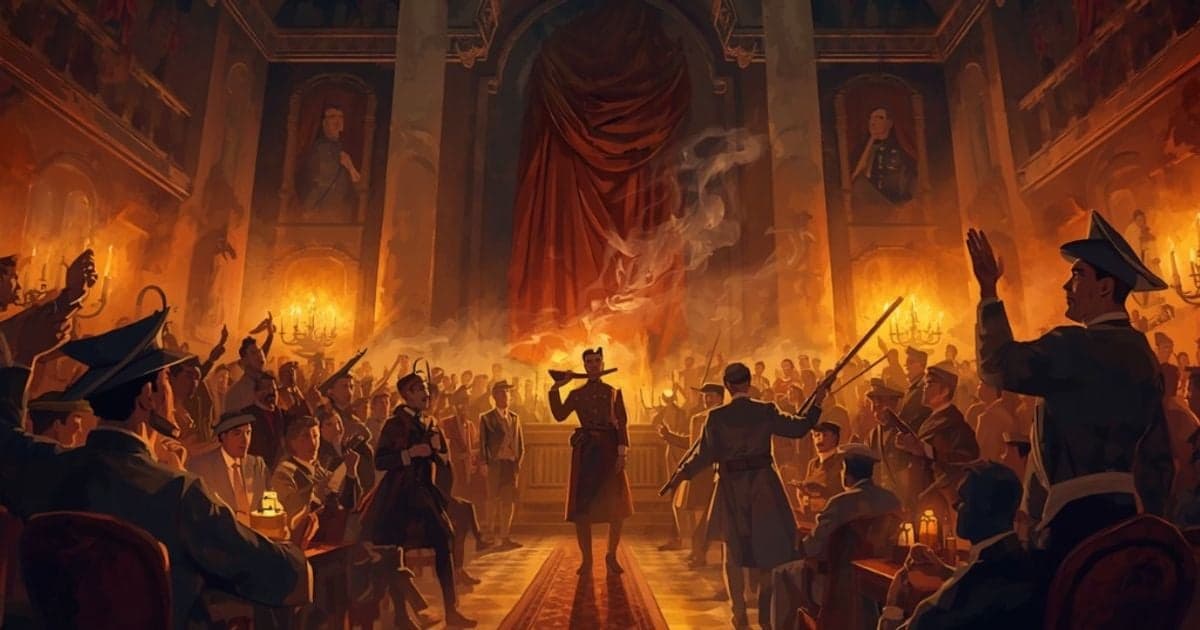
Thirteen years after Noli Me Tángere, Crisóstomo Ibarra returns as Simoun: pale beneath blue goggles, rich enough to rent friars and governors, and tired of asking the same men to bless a schoolhouse. The opening on the Tabo is not a battle scene. It is a dinner where progress is performed while the lower deck carries the people who will pay for the joke. Rizal wrote the sequel in Ghent in 1891 because the first novel's question had already been answered in practice.
Reform offered to a system that profits from corruption meets planted letters, jailed students, and land taken in God's name. Simoun's turn is not Rizal's moral recommendation. It is a diagnostic of what patience costs when the powerful keep calling delay virtue and clemency arrives only in a line at the bottom of a card game, as when Cabesang Tales's granddaughter pleads three days for her grandfather and the General frees him so Spain may look merciful after postponing the academy again.
This lesson tracks the channel, not the fuse. Before you admire the jeweler's plan, ask what Padre Florentino will ask at the sea: whether the next generation can use power without becoming the greed it fought, and whether any formal path you still trust has actually changed since Ibarra's schoolhouse burned.
The Central Lesson
When reform runs out, some survivors stop petitioning and start purchasing leverage. Rizal keeps Simoun's plot and Padre Florentino's refusal in the same novel so readers cannot treat explosion as the only honest ending after patience fails, and so you can name adjournment, fear, and fixed card games as refusal without calling violence liberation.
Applying This to Your Life
Audit the channel
List every formal path you still use after repeated refusal: HR, council, union, appeal board, ombudsman. If the answer is none, name what you are tempted to do instead and who pays first when patience is treated as virtue.
Separate diagnosis from prescription
Simoun shows what exhaustion looks like when reform is adjourned to dessert. Florentino shows what liberation requires when rage is accurate but still poisonous. Do not treat the first scene as the book's advice.
Pair with Noli
Read Ibarra's schoolhouse before Simoun's lamp. The sequel only hurts if you remember the petition that was already answered with ash, and the lawyer who told both sides to lose quietly.
Other lessons in this book
More life-skill deep dives from the same classic.
Colonial Performance
The Ship of State Joke
Read Doña Victorina, Ben-Zayb, and the Ship of State joke as survival costumes that rent approval upstairs while the lower deck still poles the hull.
18 chapters·Explore AnalysisEducation as Control
The Class That Taught Obedience
Sit in Placido's walkout, the look-but-touch-not physics class, and Bilibid after pasquinades to see when schools train obedience and cells finish the lesson.
12 chapters·Explore AnalysisGrief That Hardens
Basilio, Juli, and the Empty House
Stay with Basilio, Juli, and Capitan Tiago when fiestas march past ransom, newspapers skip a fall, and unacknowledged loss is offered a fuse.
11 chapters·Explore AnalysisNaming Systemic Greed
Rent in a Cassock
Follow Tales's land, Quiroga's tribulations, and every Pilates bowl to see rent renamed as piety, law, or progress before Simoun schedules the room.
11 chapters·Explore AnalysisResistance Versus Revenge
The Fuse and the Priest Who Refused
Track the lamp, the wedding guest list, and Padre Florentino sinking the jewels so you can name real harm without calling a crowd explosion liberation.
9 chapters·Explore Analysis
Continue exploring
Explore this theme
The same lessons in other books
See how other books teach the same life skills.

North and South
Acting on Conscience When It Costs YouWatch Hale leave the church, Margaret lie at the station for Frederick, and Thornton refuse a speculation that would save him.North and South
Navigating Class and Economic PowerTrace Milton from imported Irish hands and Boucher's brook to the inheritance that buys a partnership, not a husband.
Paradise Lost
When Pride Sounds Like PrincipleHear Satan on the burning lake and at Eden's edge: wounded dignity reframed as liberty, and a no that is only a refusal to be second.
Where the lesson lives in the book
Canal on a Napkin
On the Tabo steamer Simoun sketches a canal through Manila while friars treat the Pasig as a property dispute and joke that the boat is the Ship of State: stuck on sandbars, split between an awning and a lower deck of brown faces who pole the hull through the same curves every day.
Key Insight:
Progress language can mask clearance. When reform is only a line on a napkin, ask who must move before the map is approved, and who profits if the old channel is filled.
“Dig a canal straight from the source to the mouth of the river, passing through Manila”
The Judge in the Wood
After his vigil at Sisa's stones, Basilio meets Simoun by lantern light in the Ibarras wood and learns the stranger who buried his mother thirteen years ago is Ibarra returned: white-haired, bitter, and planning to castigate the system by flattering its defects.
Key Insight:
When reformers become judges in secret, they often adopt the system's tools before the public ever sees a petition answered. Basilio's riddle is not only who Simoun was, but what patience costs once the schoolhouse is ash.
“I am the Judge who wishes to castigate this system by making use of its own defects”
Placido Walks Out
Placido Penitente enters Santo Tomas noisily on his heels because quiet compliance has failed him, already writing his mother to abandon studies where the university treats inquiry as filibusterism and signing papers without understanding is the real curriculum.
Key Insight:
A walkout is what reform looks like when the channel still exists but the institution has stopped listening. Placido pays before Simoun pays, and the lesson is that leaving can be the last honest petition.
“Excuse me, but I can't sign anything without first understanding what it's about.”
Reform at Dessert
At Los Baños the Captain-General wins card hands while Padre Sibyla and Padre Irene quietly throw the game tied to the Castilian academy petition. When the students' request finally surfaces after six months, the General says weighty matters belong at dessert and leaves the vote for tomorrow.
Key Insight:
Polite adjournment is refusal with better manners. When reform is always the next course, the delay is the decision, and the people still waiting are being trained to accept that their turn will not come.
“we’ve worked like niggers and yet we’re on a vacation”
Lose Quietly
Isagani waits in Señor Pasta's bufete while the lawyer tells each side that honesty is a luxury neither faction can afford and that the safest career move is defeat before anyone writes a name on a charge sheet.
Key Insight:
When the expert both sides hire counsels silence, reform has already left the room. The advice is not neutral; it is the verdict dressed as prudence.
“What I advise is that you let the government attend to its own business.”
The Lamp and the Hour
Simoun prepares the rigged lamp for a wedding that will gather colonial Manila in one cathedral room while he tells Basilio that within an hour revolution will break out and orders him to lead men into St Clara for Maria Clara.
Key Insight:
When polite channels fail, some survivors schedule the room instead of writing another letter. That is not yet justice; it is exhaustion with a fuse and a guest list chosen by the wounded.
“At the first cannon-shot!”
The Arbiter Who Sleeps
Don Custodio, praised by Ben-Zayb as the world's most active arbiter, dozes through the Castilian academy file he was meant to settle while students circulate petitions and friars treat every signature as sedition on stamped paper.
Key Insight:
Reform can die in a drawer that never opens. Sleep at the desk is still a decision against the petitioners, and the label arbiter buys time while nothing moves.
“the world's most active arbiter”
Curtain for His Excellency
Packed boxes pound canes because the operetta cannot begin until the governor arrives, while a smoking hero on stage refuses Spanish decorum and the audience learns to applaud delay as loyalty.
Key Insight:
Colonial audiences are trained in patience when art must pause for a uniform. The wait teaches who owns the clock, and who must perform gratitude for being allowed to wait.
“wait on his Excellency”
Pasquinades on the Door
Basilio heads to hospital duty while students whisper about a discovered conspiracy; pasquinades on the University doors become the pretext for arrests, and a professor tells him to destroy compromising papers even though Simoun, wounded and bedridden, is first cleared of the plot.
Key Insight:
When satire on a door replaces debate in a chamber, reform has already lost the public square. The next memo is a cell, and the lesson is that posters can close a channel faster than a petition in a drawer.
“Seditious pasquinades have been found”
Dreams on the Promenade
Isagani walks the promenade with Paulita's letters and chooses a future that sounds like duty to the nation while jealousy from the theatre still burns and Doña Victorina's household performs Europe badly within earshot.
Key Insight:
Love can become a reform project that asks you to swallow humiliation for a country not yet born. Notice when idealism replaces an honest no, and when private pain is offered up as public virtue.
“My love died fighting for the rights of my fatherland!”
Toast Before Proof
Fourteen students celebrate Padre Irene's happy solution in a pansiteria hung with red lanterns while a wall verse turns their supper into theatre of victory before anyone reads the fine print or sees the trap closing.
Key Insight:
Celebration before verification is how movements get disarmed. A toast is not permission from power, and victory staged too early flatter the winners who were never in the room.
“happy solution”
Fear Instead of Answer
After pasquinades, Ben-Zayb crows that education is disastrous while advisers urge mass shootings and the General blocks departures, jails readers, and lets Irene claim moderation after Basilio's arrest breaks Capitan Tiago.
Key Insight:
When petitions are answered with tatakut, the channel is closed without a signature. Fear is the final memo, and the street learns obedience faster than any syllabus could teach it.
“tatakut”