
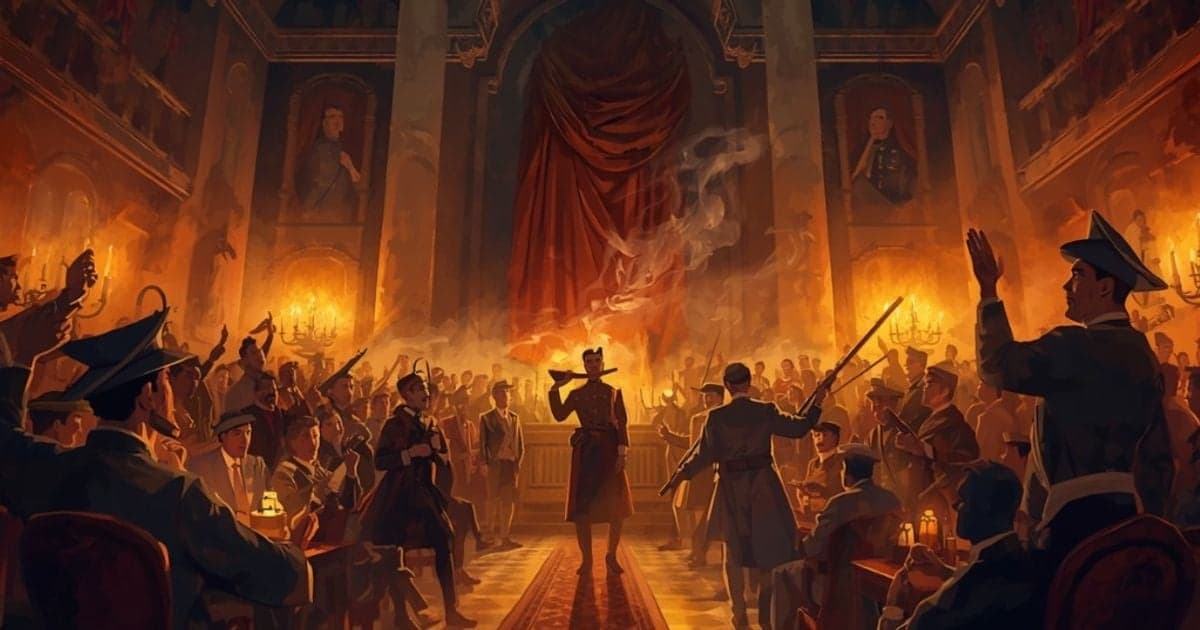
The Defeat That Came Back Rich
El Filibusterismo is often retold as the sequel in which the hero of Noli Me Tángere returns with a bomb. Rizal writes a harder claim. The novel's psychological core is a defeat that refuses to be mourned, and so hires itself out to the power that caused it. Crisóstomo Ibarra tried the lawful path: a school, a marriage, a belief that the colony could be argued with. The path answered with a false uprising and a grave that was not his. Thirteen years later he sits on the steamer Tabo as Simoun, blue goggles over the face, jewels in the cases, and a plan to end the regime at the Captain-General's table. The grievances are not in doubt. Land, cells, and a permit that never comes have settled that. The book asks what a mind does when the only future it can picture is the room where the powerful finally feel the harm, and whether that picture can produce anything but the next monster.
The Lawful Path Was the Injury
The wound is not a private slight that grew into a temper. It is a moral injury: a betrayal by authorities a person was still trying to treat as legitimate. Simoun tells Basilio, under the balete where a mother was buried, that he is the man who came thirteen years ago to honour a soul that died so he could live, and that he has worked ever since to amass a fortune and break a system he now calls condemned. He will not die before he has seen it in fragments. Grief has been refiled as a verdict. If the colony is already sentenced, patience is not a virtue. It is collaboration.
A mother's warning to Placido Penitente makes the same logic in a smaller room. Protest, she tells him, means filibuster and the garrote. The title of the novel is that accusation. Spanish law already had a name for asking too loudly, and Rizal inhabits the name in order to test it. The stake is whether a person can keep the fact of the injury without accepting either conclusion on offer: that any answer except silence is a crime, or that any answer except ruin is a lie.
Blue Goggles Rent the Awning
Simoun's disguise is the colony's public self, worn as a weapon. On the upper deck he passes for a British Indian, a Portuguese, an American, a mulatto, the Brown Cardinal beside the Captain-General. The labels do not need to agree. They need to be legible to the awning. Blue goggles finish what a costume began. The face that loved Maria Clara and planned a school is not available to the men who would recognise it and have him shot. What they may see is a jeweler who can be useful.
Usefulness is the method. He does not storm the palace. He rents it. He sells jewels to the officials he means to ruin and uses the General's favour to weaken them, while the city calls him devil or locust and still takes the gift. A man who has learned that open speech is filed as rebellion will try to win by becoming indispensable to the filer. The cost is that the renter starts to resemble the table. Doña Victorina is the comic twin: rouge, a borrowed gown, and a rage at the boats that actually pole the hull. The opening notes that she would read as Indian if the costume came off. Ben-Zayb turns every scare into a column that flatters the captain. Simoun's goggles are that performance with the motive reversed. He flatters in order to destroy, and a convincing flattery is a second life.
The Daughter Pays What the Court Will Not
If the novel were only Simoun's biography, the injury could be mistaken for a lover's madness. Cabesang Tales stops that reading. He clears forest the family believes no one owns. Malaria takes his wife and a daughter in the breaking of the soil. A religious corporation then plants boundary marks and, in the language of humanity, leaves him the use of his own clearing for a rent that rises with the crop. He hates lawsuits, knows no Spanish, and pays. Judges can pity him and still rule for the friars. The lawful path here is a receipt. Each payment trains the conclusion Simoun reached by another road. The institution that names the land will not be argued out of the name.
Juli is where that training becomes a body. She enters service to ransom a father the courts will not protect. When Basilio is taken after the pasquinades, and Capitan Tiago is dead, the town's practical wisdom has one remaining door: Padre Camorra, who jokes, pinches, and is said to be the only man who can touch a Manila prisoner. She goes. A girl leaps from a window of the convento onto stones and is killed. Whispers replace the name. This is not a metaphor for the jeweler's rage. It is the prior fact his rage claims to answer, and it has already happened to someone who never held a fuse. A reading that stays with Simoun's grandeur will repeat the upper deck. It will hear the whistle and miss the person who paid.
A Gentle Student Files the Room as Fuel
Basilio is the argument that the avenger is not a special temperament. He is a medical student who keeps vigils, cuts a patron's opium, and has already refused one rising. He knows the grave under the balete and the face behind the goggles. For a long stretch he can still say no, because a future remains that he is willing to inhabit: examinations, Juli, a life that is not a verdict. Prison and her death close it. He comes to Simoun hollow and asks to return evil for evil. The jeweler's doubt vanishes. A gentle student has become proof that force is the lesson everyone eventually learns.
Watch what the lesson does to bystanders. At the wedding Basilio sees guests who have done him no particular harm and feels the old pity. Then friars pass, and the pity is refiled. Let the righteous suffer with the sinners. He owes Simoun more than he owes them. That sentence is the break. It is not bloodlust as a trait. It is bookkeeping after a closed door: if the house is the system, a person in the house no longer has to be warned. He tells himself Isagani would reject the butchery, and so he almost does not tell him either. The defence that began as a school has ended as a classification. Anyone still inside the lighted room can be counted as timber.
The Book Will Not Name the Hand on the Lamp
Satire is not decoration around a conspiracy. It is how the novel stays sane where sincerity has become expensive. Students may look at the physics book and not touch it. A lawyer tells each side to lose quietly. A feast proceeds under the heading of dancing on a volcano, while the host bows like a toy and the General's last triumph feels like a setting sun. After the lamp is in the river, Ben-Zayb drafts a sublime article, turns a dive under the table into submarine valour, and meets a censor who forbids the piece. His Excellency wants no mention. The public file will not even hold the scare.
The same withholding governs the act that stops the massacre. Basilio warns Isagani and runs. Isagani stays for a last look at Paulita, who will marry someone else in the morning, and says that tomorrow she will be something different. Then a figure the diners do not know seizes the lamp, throws it into the river, and follows it over the rail. The text puts no name on that hand. The next night Isagani smiles, says it is always wicked to take what is not yours, and leaves for his uncle's house. A reader can be sure and still not be given a caption. Violence wants an author. The refusal is written so that it cannot be worn.
The Bells Close the Last Private Reason
An earlier plot fails for a reason the city misnames. Simoun paces outside the nunnery of St Clara while the bells toll a funeral. He asks Basilio to force the doors in the confusion and bring out the one person both of them can still recognise. The rising, he says, in a voice that becomes human for a moment, is how the convent opens. Basilio tells him Maria Clara is dead. Simoun calls it a lie. She must live, because the rescue is why he returned. The rising then miscarries, and Manila explains the collapse as a sudden illness of the rich jeweler. The text places the knell, the refusal, and the illness side by side, and writes no doctor's note. The last private errand has been cancelled. A man who organised a rising to open one door is left with the destruction.
Before the bells, the massacre still has a hostage it claims to love. After them, love is no longer a limit inside the plan. It is a fuel with nowhere to go. The wedding lamp is built for a room of tyrants hidden, as Simoun tells Basilio, behind God and the State. The General will ask for more light. Padre Irene will be invited to raise the wick. Innocents are no longer a cost the plot hopes to shrink. They sit inside the target, because the target has become the feast. A defence that cannot rescue the beloved will try to make the world match the size of the loss. The lamp is that attempt, given as a gift.
The Chest Sinks, and the Answer Is Postponed
The ending does not give Simoun time to stop his own design. The unnamed hand has already done that. What remains is a wounded jeweler in Padre Florentino's bedroom, windows open to the sea, poison chosen so torture cannot take the secret. He confesses the thirteen years: the return to marry and do good, the frame, the fortune, the enemies ruined through the General, the lamp that death and chance both thwarted. Florentino does not deny the grievances. He denies the alchemy. Hate produces monsters. Redemption presupposes virtue, virtue sacrifice, and sacrifice love. The speech can sound like a sermon laid over a political novel. It is also the jurisdiction Basilio lost at the feast: a true injury does not excuse every method that can picture the injurer's table.
Florentino then throws the chest into the sea and asks nature to guard it until a generation can touch the gold without becoming greed. He calls on youth who still have the vigour and the fire the old no longer trust in themselves. The gesture settles one tension and delays another. It refuses to let tainted wealth fund the next plot before the plotter is buried. It does not say what the living are to do when the rent is still due and the permit is still a rumour. The youth are summoned because the people in the room have used up their warrant to act. That summons is hope, and it is also a postponement. A chest on the sea floor cannot clear a field or give Juli a door that is not a curate's. The novel ends with a requiem and a refusal. It does not end with a method.
Why It Resonates Now
Readers still meet the moment when every lawful channel has answered a real harm with delay, a fee, or a file that calls the complainant the danger. A petition adjourned until dessert. A story about progress told from the cool side of a boat whose lower deck does the poling. The fantasy that follows is a single lighted room in which the people who never hear that deck would finally be unable to leave. Simoun is that fantasy with a fortune attached. Its exhilaration is the classification: once the house is the crime, you no longer have to sort the guests.
The other current fact is the rented face. People still learn which accent, costume, and column will be treated as competence, and which will be treated as noise. Some wear the face to survive the dinner. Some wear it to get close enough to spoil the dinner. From the awning the two can look identical, and a long performance changes the wearer even when the motive stays bitter. Florentino's sea is not a technique for argument. It is the book's insistence that a grievance can be wholly right and still be a bad author of the next world. The chest is sunk because the hand that gathered it no longer knows how to spend without repeating the reign it hates.
Limits of This Reading
This frame can shrink a colonial novel into one man's bitterness. Land, the religious corporations, the cedula, the garrote, and the ban on the book are political facts in the late nineteenth-century Philippines, not symbols of a mood. Rizal wrote in Spanish, in Ghent, in 1891, so the governing class could not claim misunderstanding. Moral injury is a later clinical analogy. It illuminates a betrayed lawful hope. It is not a diagnosis, and it must not turn the colony into a patient. Simoun is not a secret self-portrait, and Florentino is not a pure conscience dropped in to correct the plot. Rizal opposed the armed rising of 1896 and was executed anyway. Readers who take the lamp as his instructions, and readers who take the seaside speech as his whole politics, both leave the book smaller than it is.
Maria Clara is the sharpest limit inside the psychology itself. She dies offstage, behind a convent bell, and returns as the reason a massacre nearly found a gentler name. To centre Simoun's grief is to risk doing what he does: to treat her as the private warrant for a public blast. Juli, named and then reduced to a whisper after the window, is the correction already in the text. Derbyshire's English title, The Reign of Greed, moves the accusation again, from filibusterism, the crime of wanting change, toward the appetite of the rulers. That shift is useful and it is not neutral. A reading in translation is already a second filing of the book.
Across the Shelf
Noli Me Tángere is the same life before the goggles. Ibarra still believes a schoolhouse can be an argument, and that argument can still be framed as sedition. El Filibusterismo begins after the argument has been closed. Read as a pair, they are two moments in one injury: the attempt to be legible to the law, and the life built once legibility has been refused. The Count of Monte Cristo is the other near book, and the enemy is a different size. Edmond Dantès returns rich and disguised because three men buried him, and a child's death inside his design finally breaks the private court. Simoun's table replaces itself. Ruin one General and a model of rectitude is already rumoured on the next boat. Dumas lets the avenger step down. The priest speaks over the poison, and the fortune goes into the sea, because a system that keeps producing Julis cannot be settled by one feast.