Dead Souls
Nikolai Gogol
0:000:00
0:00 / 0:00

Prestige · $2.99/month
Chapter audio, theme analysis, and downloads
Nikolai Gogol
0:00 / 0:00
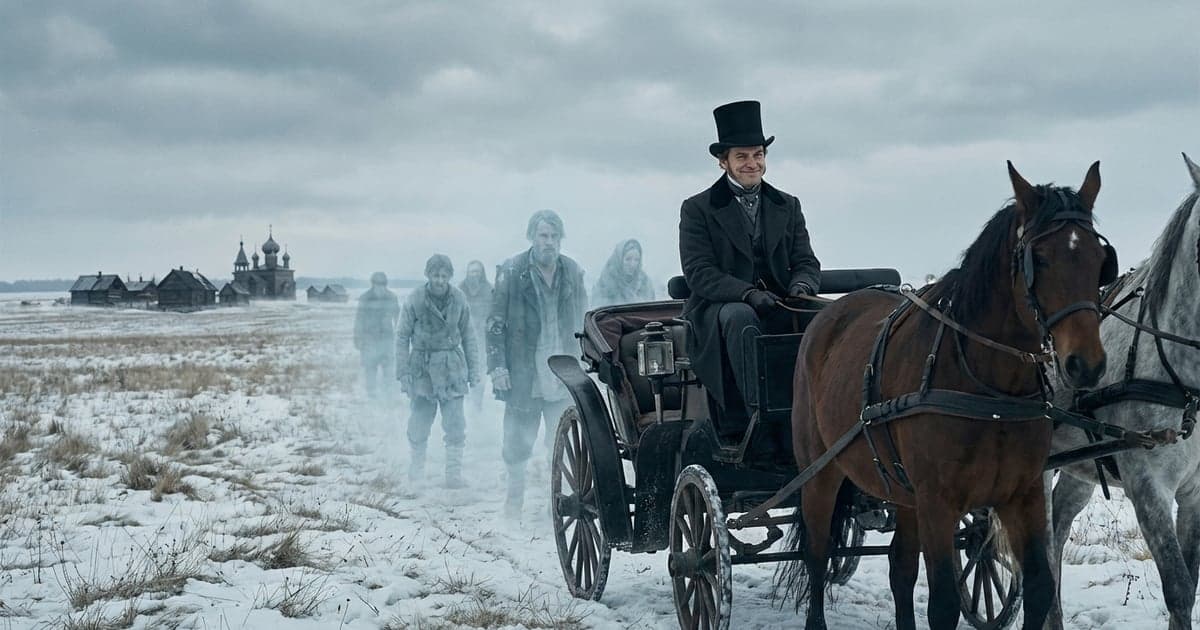
A britchka draws up to an inn in the provincial town of N. Pavel Ivanovich Chichikov steps down: not handsome, not ill-favoured, not over-fat, not over-thin, a gentleman of middling age whose only striking feature is how hard he works to have none. He asks the waiter who the governor is, who the president of the board is, who the chief of police is, and which landowners live nearby. Then he spends his first days calling on each of them, praising the town, the roads, and the governor's daughter, until every official believes he has found a thoroughly agreeable fellow. Then he sets out into the countryside. He is buying dead serfs.
The scheme is simple and audacious. Under imperial law, serfs are counted for tax on census rolls updated only every few years. Serfs who die between counts remain on the rolls as dead souls, and their owners keep paying tax on names that no longer eat. Chichikov offers to buy legal title to those names for a few roubles, freeing the landowner of the burden. He will then present the accumulated serfs as living property and mortgage them against a country estate. The whole plan turns on paperwork. At Manilov's estate the furniture is unfinished and the conversation is all sweetness. Manilov cannot understand the request and then gives the souls away for nothing, overcome by the pleasure of being useful. Korobotchka, an elderly widow who sells honey and hemp, cannot understand why anyone would buy what no longer exists. She haggles anyway, then drives into town later to ask if she has been cheated.
Nozdrev is loud, lying, and drunk before noon. He tries to make Chichikov buy a dog, a barrel-organ, and then the whole estate, and when the deal sours he nearly has him beaten. Sobakevitch, built like a bear, treats the dead as merchandise: he names each soul's former trade, inflates the price, and slips a woman's name onto a list of dead men. Plushkin, last and worst, has hoarded himself into a ruin. His house is a warehouse of rotting cloth and broken furniture. He sells more souls than anyone because he has let more people die. Back in town the purchases become public and rumour takes over. One story has Chichikov planning to abduct the governor's daughter. Another casts him as Napoleon escaped from St. Helena. The public prosecutor, panicking for reasons he cannot explain, dies of fright.
Gogol published Volume One of Dead Souls in 1842 and meant it as the Inferno of a Russian Divine Comedy. In the last chapter he steps back and tells us who Chichikov actually is. He was not born to anything. A father left him a rule about kopecks: save every one, and make friends only with the rich. He made himself through school scams, a Building Commission, and Customs bribes, until a secretary's remark about dead souls on the census sparked the inventory fraud. He is not a villain in the operatic sense. He is something more ordinary and more damning: a man formed entirely by the society that condemns him. Gogol burned the manuscript of Volume Two in 1852, ten days before his death. Chapters 12 through 15 in this guide are surviving drafts from that burned volume: Tientietnikov's idle dressing gown, the General's explosive laughter, Kostanzhoglo's honest wealth beside Colonel Koshkarev's paperwork maze, and an unfinished fragment that ends mid-scene. There is no completed ending. The hell, apparently, was easier to write.
The census rolls and the deed registry treat Chichikov's purchase as ordinary paperwork, because no clerk in town is paid to ask why a dead man is buying land, and that gap is where systemic corruption actually lives; Korobotchka's confused trip into town later only proves nobody closed it. Social performance is the cover charge that gets him through every gate first: his first-day compliments, Manilov's unfinished furniture, and the governor's ball all read as warmth until the deal is finally named out loud. Self-deception is what keeps the fraud running past the point it should have collapsed, in Plushkin's hoard, in Chichikov's own tidy account of his rise from nothing, and in officials who would rather invent a fugitive Napoleon than sit with what a ledger of dead names actually proves. Bureaucracy supplies the shelter underneath all of it: Ivan Antonovitch's desk and Koshkarev's paperwork maze can turn an absurd purchase into a legal one, as long as the forms are filled in correctly. Spotting a con artist means reading the town mapping and the inflated price on Sobakevitch's list before the charm has time to work, which is exactly what none of the landowners manage in time. What is left once the fraud is exposed is spiritual death: Manilov's contentless sweetness, Plushkin's living tomb of a house, and Tientietnikov's dressing gown are three ways of still moving through a life that stopped a long time ago.
What the fraud leaves standing, once the paperwork stops moving, is a town that mistook courtesy and finished forms for a working conscience. Wide Reads walks all 15 chapters, from the britchka pulling into N to the unfinished page where the burned second volume breaks off mid-scene, with summaries, quotes, and audio for the full ledger of names Chichikov bought and never had to answer for.
Chapters 1–11 are Gogol's complete Volume One (1842). Chapters 12–15 are surviving drafts from the burned second volume: the manuscript ends abruptly in chapter 15, not at a finished conclusion.
A britchka draws up to a provincial inn. The man inside is described with characteristic Gogol preci...
For more than two weeks Chichikov has lived amid dinners and card parties in town, spending, as the ...
Chichikov leaves Manilovka pleased, his face lit by pleasant calculations. Thunder breaks; rain slan...
At a roadside tavern Chichikov halts to rest the horses and eat. Chichikov orders sucking pig with h...
Fleeing Nozdrev's estate, Chichikov trembles like a quail in a net and curses under his breath while...
A peasant's profanity sends Chichikov toward Plushkin's village, where wooden pavements bounce the b...
Chichikov wakes owning nearly four hundred souls, skips his mirror, cuts capers in Moroccan slippers...
Word spreads that Chichikov bought peasants for transfer; some citizens advise an armed escort, whic...
Before the usual calling hour a lady in a plaid cloak races her koliaska across town, cursing the en...
At the Chief of Police's the tchinovniks look thinner; frockcoats hang loose; even ring-flashing Sem...
The departure Chichikov planned does not go smoothly. Chichikov rages, orders blacksmiths who multip...
Volume Two opens with Gogol asking why he paints poverty and imperfection, why he delves into Russia...
Chichikov arrives at the General's house in Tientietnikov's koliaska, having attuned his features to...
Chichikov wakes on the road worrying that Colonel Koshkarev will prove as mad as the last landowner....
The last surviving fragment of Dead Souls begins where Gogol's manuscript will soon break off. Chich...
Published 1842
Nikolai Gogol (1809-1852) was a Ukrainian-born writer who turned Russian provincial life into a comedy so exact it still reads as accusation. Born in Sorochyntsi, he lost his father young, moved to St. Petersburg in 1828, and first found readers with Ukrainian folk tales and the surreal story "The Nose." Government clerk work taught him the desks, fees, and empty compliments that later fill Dead Souls.
Dead Souls appeared in 1842 as the first panel of a planned Divine Comedy for Russia: Inferno, then Purgatorio, then Paradiso. The satire made him famous and unsafe. Officials recognised themselves. Readers laughed and then felt watched. Gogol's mix of realism and grotesque, a man who is also a pile of coats, a town that dies of a rumour, shaped Dostoevsky, Chekhov, and Nabokov.
In his last years religious panic overtook the comedy. He burned the manuscript of Volume Two in 1852, ten days before he died, having starved himself under a priest's direction. What survives of the second part is a fragment. The first volume is complete, and it is still the sharpest portrait of a society that can file a soul, tax it, and never notice it is gone.
Gogol speaks to the moment a system runs perfectly and still produces nothing but paperwork: the audit that checks the form but never the fact, the deal that closes because everyone in the room agreed to be charmed, the ledger that keeps a name on the books long after the person behind it is gone. He grew up inside the same clerks' offices he later put on trial, and knew exactly how a fee, a stamp, and a compliment could dress a fraud up as ordinary business.
Plot, characters, and themes — plus audio, source text, and patterns you can use after class
Two ways in
Chapter by chapter, with audio. The meaning arrives because you experienced it — not because someone listed bullet points.
Start with this.
The actual words the author wrote, alongside every summary. Use the guide, then step into the source.
Then step into the source.
Either way, the door opens inward.
— and most of all, Why does this matter?
Purchase the complete book to access all chapters and support classic literature
Available in paperback, hardcover, and e-book formats
Free to read • No account required

Weekly insights from the classics. Amplify Your Mind.
We focus on public domain classics because these timeless works belong to everyone. No paywalls, no restrictions—just wisdom that has stood the test of centuries, freely accessible to all readers.
Public domain books have shaped humanity's understanding of love, justice, ambition, and the human condition. By amplifying these works, we help preserve and share literature that truly belongs to the world.
© 2026 Wide Reads™. All Rights Reserved.
Intelligence Amplifier™ and Wide Reads™ are proprietary trademarks of Arvin Lioanag.
Copyright Protection: All original content, analyses, discussion questions, pedagogical frameworks, and methodology are protected by U.S. and international copyright law. Unauthorized reproduction, distribution, web scraping, or use for AI training is strictly prohibited. See our Copyright Notice for details.
Disclaimer: The information provided on this website is for general informational and educational purposes only and does not constitute professional, legal, financial, or technical advice. While we strive to ensure accuracy and relevance, we make no warranties regarding completeness, reliability, or suitability. Any reliance on such information is at your own risk. We are not liable for any losses or damages arising from use of this site. By using this site, you agree to these terms.
Deep dives
Notice when Plushkin's hoard, Chichikov's biography, or a town rumor keeps a flattering story running after the facts have left.
But sympathy does not put anything into one's pocket
Read how desks, fees, and correct forms can legalize absurdity, from Ivan Antonovitch to Koshkarev's office maze.
This is NOT the desk for serf affairs.
Trending search questions mapped to the six lessons in this novel: what readers actually ask Google about Chichikov's scheme, the landowners he cons, Plushkin's hoard, and why Gogol burned Volume Two.
Under Russian law, serfs are counted on census rolls updated only every few years, so a landowner keeps paying tax on a serf who died the day after the last count. Chichikov offers a few roubles for legal title to those dead names, meaning to present them as living property and mortgage them against an estate. His first days in town, calling on the governor, the police chief, and every local official, are reconnaissance for exactly this: he needs to know which landowners are burdened enough to sell before anyone asks why.
Explore Recognizing Systemic CorruptionYes. Gogol meant Volume One as the Inferno of a Russian Divine Comedy, and its comedy is aimed at real habits: Manilov's furniture stays unfinished because his sweetness never turns into action, and Chichikov's first days of praising the town, the roads, and the governor's daughter work because provincial courtesy asks for nothing more than a pleasant guest. The satire made Gogol famous and unsafe at once. Officials who read it recognised their own desks.
Explore Seeing Through Social PerformanceHe learns the circuit before he makes the ask: who signs, who hosts, who gossips. He addresses two men as Your Excellency before either holds the rank, and the blunder delights them rather than exposing him. Only after each host has decided he is agreeable does the inventory question appear. Korobotchka sells because the offer sounds like help with her taxes; Sobakevitch inflates his price and still sells, because he believes the paper favours him.
Explore Detecting Con ArtistsPlushkin was not always this way. Gogol shows a man who once managed a full, orderly estate collapse into suspicion after his family scattered, until saving became the only feeling he still trusts. By the time Chichikov arrives, his house is a warehouse of rotting cloth and broken furniture, and he sells more souls than any other landowner because he has let more of his own serfs starve. His hoard is grief that never found another shape.
Explore Recognizing Spiritual DeathGogol planned Dead Souls as a three-part Divine Comedy: Inferno, Purgatorio, Paradiso, with Chichikov eventually redeemed. He spent a decade trying to write that redemption and could not make it convincing even to himself. Ten days before he died in 1852, under a priest's direction and in religious panic, he burned the manuscript. What survives are earlier drafts, published as fragments: chapters 12 through 15 in this guide, ending mid-scene with no completed conclusion.
Explore Understanding Self-DeceptionSix lessons run through the novel: recognise corruption that hides inside ordinary paperwork; see through social performance that mistakes charm for character; catch self-deception before it hardens into a life story; notice bureaucracy that can legalise absurdity if the forms are correct; detect a con artist by watching what they want rather than how warmly they ask; and recognise spiritual death in a life that still moves but has already stopped.
What makes him indispensable is that he never let the joke cool into safety. Dead Souls named the exact bribe, form, and flattering phrase provincial Russia used to run itself, and it made him famous and unsafe for the same reason: officials read it and recognised their own desks. He meant Volume One as the hell in a Russian Divine Comedy, spent a decade trying to write the redemption that was supposed to follow it, and burned that manuscript ten days before he died rather than publish a heaven he could not make himself believe.
Gogol never showed Chichikov redeemed, and that unfinished shape is the honest part of what he left behind. What survives is the harder half of the argument: an exact, comic account of how a soul goes missing inside paperwork that everyone agrees is in order.