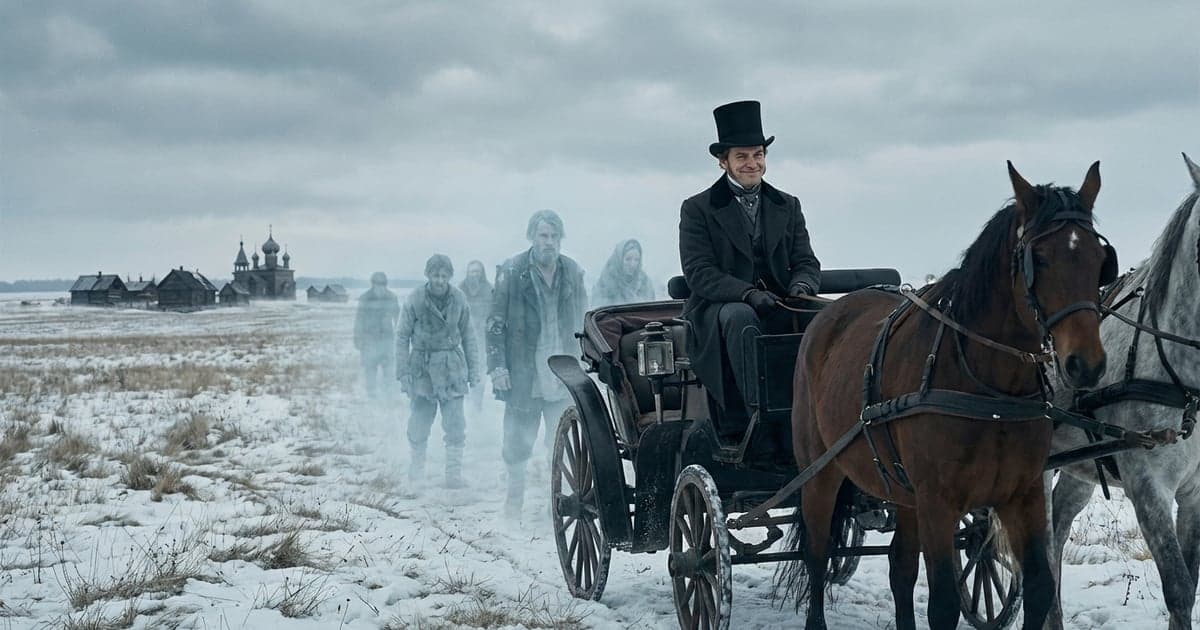
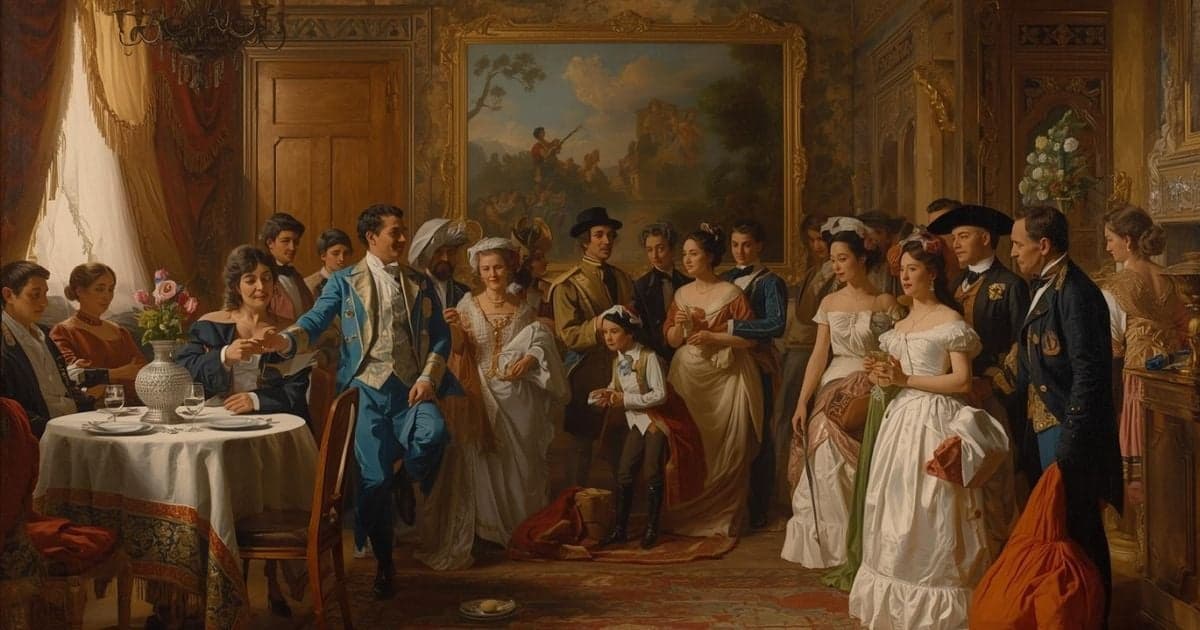
For more than two weeks Chichikov has lived amid dinners and card parties in town, spending, as the saying goes, a very pleasant time. One evening Selifan receives orders to harness the horses at dawn; Petrushka stays behind to guard the portmanteau and fill the room with his immovable smell. Selifan will lose the road, praise the horses, and blame the britchka when it capsizes. Chichikov awakens on Sunday, sponges his face to satin smoothness, dons his bilberry frockcoat and bearskin coat, and rattles out of the inn yard past priests and orphans until macadam replaces cobblestones. Women wade in the pond disputing over a net that holds two crawfish and a roach; a plucked cock crows on the grey day. Manilov waits on the verandah, hand shielding his eyes, smile broadening as the britchka nears. Gogol pauses to classify him: neither Bogdan of the city nor Selifan of the village, pleasant at first glance, empty by the third minute, a man without hobby except vague meditation and smoke. Manilov and his wife exchange bonbons and birthday-of-the-heart kisses, lisp compliments, and praise officials they barely know. At the doorway host and guest argue over who shall enter first until they jam sideways through the opening. Chichikov praises the children's wit, hears that Themistocleus will be an ambassador, and declares himself satisfied though he has eaten almost nothing. They dispute the settee until Chichikov sits where commanded. Then the strange question: how many serfs have died since the last census? Chichikov wants a list; Manilov asks why. Manilov drops his pipe and gapes. Chichikov insists he means it literally, will record them as living on paper, and will not step outside civil law because obligation is sacred.
Finally he decides to visit landowners Manilov and Sobakevitch on promises made at whist, though Gogol hints that a purpose nearer his heart than courtesy now drives him into the countryside. Gogol lingers over the servants because Russian authors love circumstantiality. Petrushka reads any book for the act of reading, not comprehension, and sleeps in his clothes on a mattress worn thin as a wafer. Manilov said fifteen versts; the fifteenth verst stone passes, then the sixteenth, and still no house. Peasants correct the name: not Zamanilovka but Manilovka, another two versts on a by-road. The mansion when it appears stands on an isolated rise open to every wind, with English flower beds, a green-coated pond, an arbour labelled This is the Temple of Solitary Thought, and two hundred log huts counted by Chichikov because no tree relieves the view. The bailiff runs the estate while Manilov says "Yes, not a bad idea" to every suggestion and never acts. The drawing room holds silk-covered furniture beside two chairs still wrapped in bast, a bronze candelabrum and Three Graces thick with grease, and a book with the fourteenth page turned down for two years. Lunch follows: shtchi, boys Themistocleus and Alkid in high chairs, the tutor laughing when the parents laugh and tapping the table when Themistocleus bites Alkid. After lunch Manilov leads him to the study, sanctum of scattered tobacco and ash arranged in rows. Manilov offers a pipe; Chichikov declines with medical excuses. The bailiff hiccups that many have died, none knows how many. The guest explains he wishes to purchase dead peasants still returned as living.
Manilov worries about statutes; Chichikov promises benefit to the Treasury. When price arises, Manilov offers the souls unconditionally, moved by psychic magnetism. Chichikov's gratitude bursts into tears about his life as a barque on billows, persecutions endured for keeping truth inviolate. They weep and clasp hands. Paperwork is ordered; Chichikov prepares to leave though clouds gather. Manilov directs Selifan to Sobakevitch's by two turnings and a third. Long after the britchka vanishes Manilov stands smoking, then sits dreaming of a bridge, afternoon tea on a facade facing Moscow, and promotion to General, until the dead-souls request interrupts the reverie and cannot be digested. Chichikov rolls away pleased, his face showing calculations pleasant as the turnpike softens under the wheels. The first landowner has given names for nothing; the tour has begun in sentiment instead of commerce, which is exactly why later hosts will matter. Meanwhile the britchka bowls along the turnpike and Chichikov feels greatly pleased with himself. From the preceding days the reader already knows the bent of his inclinations; it is no wonder body and soul have immersed themselves therein. Thoughts and projects reflected in his face partake of a pleasant nature, for he has secured dead names at no cost and may present them as living when the moment requires. Manilov will dream of bridges until supper; Sobakevitch waits down the road with a different arithmetic. Between sentiment and greed the census fraud will grow, and the provincial tour will teach Chichikov which souls are cheap and which merely seem so.