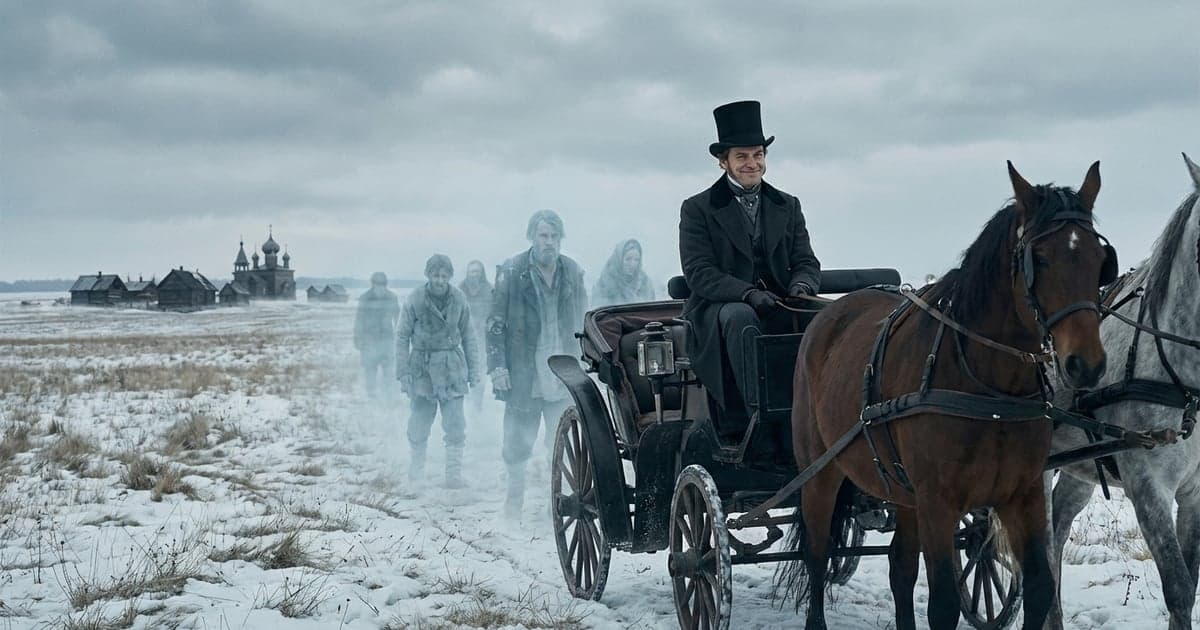
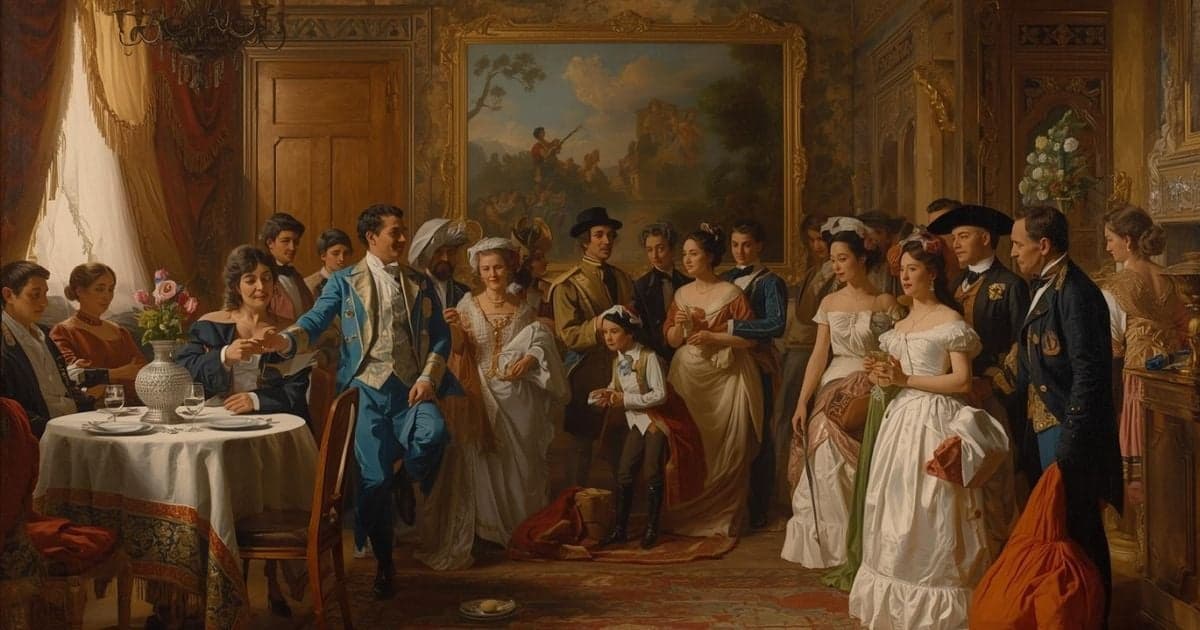
At a roadside tavern Chichikov halts to rest the horses and eat. Chichikov orders sucking pig with horseradish and sour cream and chats up the landlady until he learns the neighbourhood roster: Blochin, Potchitaev, Minoi, Cheprakov, Sobakevitch. She knows Sobakevitch eats one dish clean and demands seconds; Manilov orders three meats and tastes a morsel of each. Nozdrev arrives in a light britchka drawn by three horses, cleaned out at the fair, missing a whisker and his watch, trailing an empty four-horse turnout and stage horses too exhausted to impress. Chichikov calculates that need may make even this liar useful, accepts, and is embraced on the neck. Mizhuev tries to leave; Nozdrev will not excuse him, makes him pay eighty kopecks of vodka the host cannot cover, and parades a flea-ridden puppy whose ears and cold nose Chichikov must feel to keep the peace. At thirty-five he is what he was at eighteen: cards, fairs, insults offered as friendship, and barter proposals for guns, dogs, nursemaids' dresses, and dried herrings whether you want them or not. The tour is a running lie. He shows a colt allegedly bought for ten thousand roubles, empty stalls where fine horses "recently stood," a wolf fed raw meat to grow fierce, fish supposedly requiring two men to lift, and a pack of dogs so affectionate one stands on hind legs and licks Chichikov's mouth until he spits. Mizhuev contradicts every price and every catch; Chichikov only grows hungry, tired, and wary. Nozdrev pours port, sauterne, madeira, and special blends into everyone else's glass while topping his own sparingly; Chichikov upsets his tumbler when the host is not looking.
Gogol breaks in to praise a type the novel will need again: not the fashionable hypochondriacs who swallow pills before oysters, but middle-class travelers who order bacon, sucking pig, or sturgeon at every posthouse and eat as though hunger were a virtue money cannot buy. That small intelligence matters because Chichikov is still hunting paper souls and measuring which landowners might sell. His brother-in-law Mizhuev, flaxen-haired and stubborn, disputes every boast: not seventeen bottles of champagne, not the winnings Nozdrev claims he would have made with twenty more roubles. Nozdrev already addresses Chichikov as an old friend, blocks his plan to visit Sobakevitch, and insists he come five versts to Nozdrev's place instead. Gogol then pauses the plot to etch Nozdrev's type for the rest of the book: the "gay young spark" who speaks in the familiar singular after one meeting, lies about horses he does not own, buys random junk at fairs and loses it the same day, regrows whiskers after brawls, and makes up with the men who beat him by nightfall. At the house peasants still whitewash the dining-room ceiling while Nozdrev shouts dinner orders audible from the yard. There is a blind Crimean bitch he swears was magnificent two years ago, a water-mill missing its upper stone, a blacksmith's shop, and a molehill field where the party squelches through mud for a boundary post and a forest Nozdrev claims he bought three days ago while still at the fair. Dinner arrives near five o'clock, composed by a cook who grabs whatever is nearest and hopes heat will disguise it. After Mizhuev staggers into his britchka still apologising to his "dear good wife," Nozdrev produces cards and proposes banker for three hundred.
Chichikov finally asks for dead souls on the revision lists. Nozdrev traps him with a word of honor, demands the real purpose, and calls both the marriage excuse and the social-climbing lie what they are. When straight purchase fails, the host pivots to barter: a colt for four thousand, then mares, grey horses, quiver-eared hunting dogs, a barrel-organ that plays Marlborough went to the war at wrong tempo, and finally dead souls plus organ plus replacement britchka for Chichikov's carriage and three hundred roubles. Chichikov refuses every bundle because each offer is another way to strip his mobility. Cards fail when he will not drink or gamble. At breakfast Nozdrev tries again, then chess for fifty roubles and the souls, demanding two moves in advance. Chichikov agrees because skill might beat chaos, but chaos wins: sleeves knock pieces off the board, a third queen appears from nowhere, Nozdrev reddens, accuses him of cheating, sweeps the men into confusion, and orders Porphyri and Pavlushka to thrash him with a cherrywood pipe-stem. Chichikov blocks the fist, then sees the britchka ready and the doorway blocked by servants. Rescue comes as comedy's other face. A Rural Police Superintendent enters asking which man is Nozdrev and announces arrest for drunkenly beating landowner Maksimov with a walking-stick. While Nozdrev argues that he has never seen Maksimov, Chichikov slips behind the official, runs to the britchka, and tells Selifan to drive like the wind. He escapes with his carriage and his skin, but not with his scheme intact: he confided the dead-souls project to the province's loudest, most vindictive gossip. The chapter turns hospitality into capture, bargaining into farce, and farce into violence because Chichikov's appetite for the census trick outran his judgment about company.