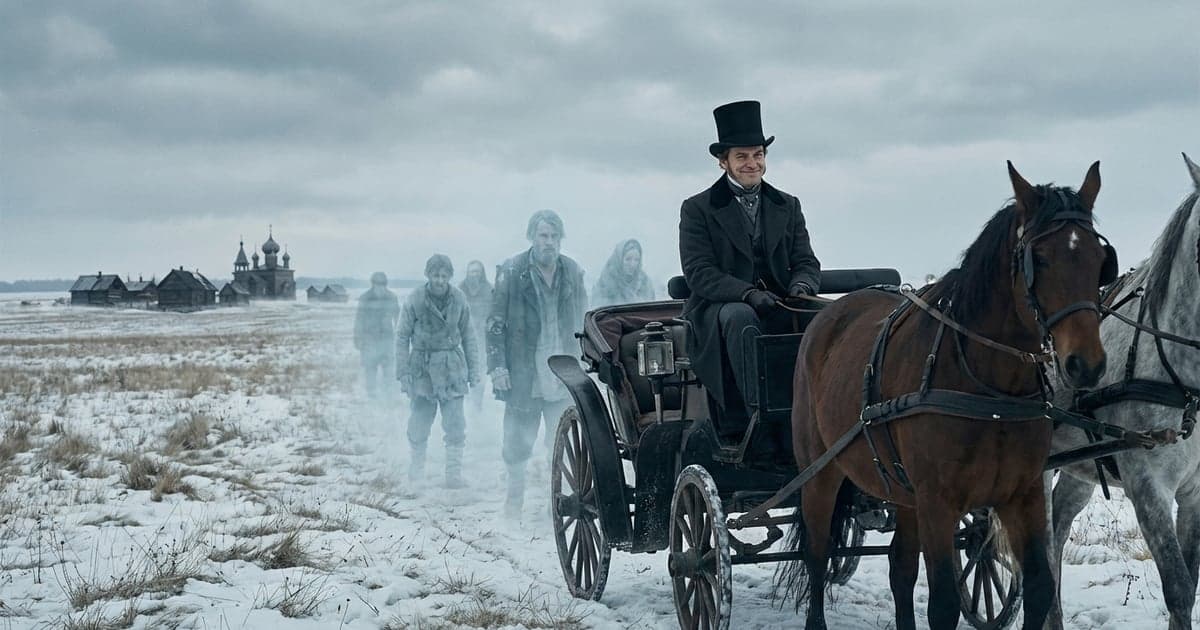
The departure Chichikov planned does not go smoothly. Chichikov rages, orders blacksmiths who multiply prices because hurry is leverage, and waits hours in a littered room while repairs crawl. Chichikov draws the curtains and mocks the dead man: newspapers will call him a kind father though only his thick eyebrows justified the eulogy. What follows is Chichikov's complete history, the inferno panel Gogol intended before burned manuscripts took the rest. His invalid father paced, spat into a sandbox, and on parting day preached: keep and save every kopeck; make friends only with the rich; never entertain, let others entertain you. When the old schoolmaster starved, Chichikov gave one coin and kept the rest. He flattered a chief clerk's ugly daughter, called him Papenka, kissed his hand, then vanished once promoted. In Customs he developed the nose of a bloodhound and the smile of a saint, weighing cloth by touch, finding contraband in carriage poles and boot linings. He joined a smuggling ring that passed Spanish sheep in double fleeces until a quarrel with his partner exposed the trade. While handling serfs for a collapsed estate, a secretary asked whether dead souls were on the lists and said one death would be replaced by a birth. He crossed himself and set out, selecting landowners by appetite and fear, befriending some only to take souls for nothing. He compares virtuous heroes to overworked horses and "men of worth" starved until only ribs remain. The narrative returns to the road: Selifan half asleep, Petrushka lolling against his master's knees, Chichikov smiling as Russia flies past.
Selifan has not shod the horses, the wheel needs a tyre, and the britchka is rickety. When the britchka finally passes the gates, they meet the Public Prosecutor's funeral procession. Gogol steps forward to address his reader. Virtuous heroes have been ridden to death in Russian fiction; it is time to yoke a rascal to the shafts. He was born into minor nobility in a tiny room with casements never opened. At school Pavlushka sold gingerbread from under the desk, trained a mouse to stand on command and sold it, anticipated the master's bell until full marks and a gilt inscription praised his diligence. Each civil post became a ladder built on vanity. He smiled while suitors waited days for documents, then paid copyists while calling himself above bribes. On the Building Commission the official edifice stalled at basement level for six years while each commissioner erected a private house; a new director caught them, and Chichikov survived by charm and hidden coin. Stripped to ten thousand roubles, Selifan, Petrushka, and the britchka, he worked as an attorney mortgaging ruined estates. The idea struck Chichikov: buy the dead before revision, collect two hundred roubles a head from the Trust, transfer them on paper to Kherson. Gogol defends his portrait against readers who want flattering mirrors, asks whether patriotism is only excusing violent sons, and demands we recognise the Chichikov in ourselves. Kifa Mokievitch philosophizes while his son breaks furniture; Russian "patriots" fear the eye that sees. Gogol's odes to the highway and to Russia as troika follow: the country speeding like a bird-troika no nation can overtake, while other peoples stand aside wondering what force drives the mysterious steeds.
The author confesses he may incur censure for depth of probing; ladies may want comely distraction; landowners want auditors who tell them affairs are fine. He insists the rascal must be yoked so the truth of Russian appetite and bureaucracy can be told. Chichikov's britchka rolls on; the scheme is named; the first volume's inferno is complete in biography if not in morality. Town lies behind; more souls wait in villages where poll-tax makes ghosts expensive. The funeral reminded him that officials die as well as serfs, but only one class leaves lists worth buying. The biography is the novel's confession: Chichikov's father counted kopecks while spitting into sand; the schoolmaster twisted ears for embellished copies; the chief clerk's daughter received courtship without love; the Building Commission enriched commissioners while public stone stayed underground; Customs searches mixed politeness with theft; the partner's quarrel exposed Spanish sheep in fleece; the attorney's mortgaging scene turned a secretary's joke into empire. Each episode teaches the same lesson: systems reward flexibility, and the flexible man stores ten thousand roubles when the storm passes. Gogol's digressions on ladies who want handsome heroes, patriots who fear mirrors, and landowners who want flattering auditors are part of the chapter's argument. He will not give virtuous stock figures; he will show acquisition as passion. The troika finale lifts the britchka into myth: Russia flying, Chichikov scheming, Selifan drowsing, the author chasing both with a pen he will partly burn. Volume One ends its explanatory work here; what follows in town is consequence, not origin. The Public Prosecutor's funeral cortege passes while blacksmiths shoe the horses, official death beside petty delay.