Wide Reads
Literature MattersLife IndexEducators
Sign in
Where to Begin
The Republic - The Tyrant's Prison

Plato

The Republic

The Tyrant's Prison

Home›Books›The Republic›Chapter 9
Previous
9 of 10
Next

Summary

The Tyrant's Prison

The Republic by Plato

0:000:00
Listen to Next Chapter

Plato reveals the tyrannical man as the ultimate cautionary tale - someone enslaved by his own desires. Starting with how appetites can overwhelm reason when we sleep (those wild dreams that would shame us awake), he traces how a young person becomes tyrannical. It begins with rebelling against a strict parent, progresses through indulgence, and ends with Love as a tyrant-master driving increasingly desperate acts. The tyrannical soul mirrors the tyrannical state - both appear powerful but are actually imprisoned. Plato then offers three proofs that the just person is happiest. First, the tyrant is like a slave-owner transported to a wilderness where his slaves might turn on him - perpetually terrified despite apparent power. Second, only the philosophical soul can judge all pleasures, having experienced them, while those driven by money or honor know nothing of wisdom's joys. Third, most pleasures are mere illusions - like someone in a cave thinking the middle is the top because they've never seen daylight. True pleasure comes from feeding the immortal part of ourselves with knowledge, not stuffing the leaky vessel of bodily desires. The tyrant is 729 times more miserable than the philosopher-king - a mathematical way of saying the gap is nearly infinite. The chapter concludes with a powerful image: we each contain a many-headed beast, a lion, and a human. Justice means the human rules with the lion's help; injustice means feeding the beast until it devours everything. Even if injustice goes unpunished externally, it corrupts the soul internally. The pattern of the just city exists in heaven for anyone who wishes to order their life by it, whether or not it exists on earth.

Coming Up in Chapter 10

Plato returns to poetry's danger to the soul, revealing why even beloved Homer must be excluded from the ideal state. The conversation then turns to the ultimate question - what happens to just and unjust souls after death.

Share it with friends

Previous ChapterNext Chapter
GO ADS FREE — JOIN US
Original text
complete·4,559 words
B

OOK IX. Last of all comes the tyrannical man, about whom we have to enquire, Whence is he, and how does he live—in happiness or in misery? There is, however, a previous question of the nature and number of the appetites, which I should like to consider first. Some of them are unlawful, and yet admit of being chastened and weakened in various degrees by the power of reason and law. ‘What appetites do you mean?’ I mean those which are awake when the reasoning powers are asleep, which get up and walk about naked without any self-respect or shame; and there is no conceivable folly or crime, however cruel or unnatural, of which, in imagination, they may not be guilty. ‘True,’ he said; ‘very true.’ But when a man’s pulse beats temperately; and he has supped on a feast of reason and come to a knowledge of himself before going to rest, and has satisfied his desires just enough to prevent their perturbing his reason, which remains clear and luminous, and when he is free from quarrel and heat,—the visions which he has on his bed are least irregular and abnormal. Even in good men there is such an irregular wild-beast nature, which peers out in sleep.

1 / 17

Master this chapter. Complete your experience

Purchase the complete book to access all chapters and support classic literature

Read Free on GutenbergBuy at Powell'sBuy on Amazon

As an Amazon Associate, we earn a small commission from qualifying purchases at no additional cost to you.

Available in paperback, hardcover, and e-book formats

GO ADS FREE — JOIN US

Why This Matters

Connect literature to life

Skill: Recognizing Internal Tyrants

This chapter teaches you to identify when appetites or emotions have overthrown reason in yourself and others.

Practice This Today

This week, notice when you feel compelled to do something you know you'll regret - that's your beast trying to rule your human.

GO ADS FREE — JOIN US

Now let's explore the literary elements.

Key Quotes & Analysis

"There is no conceivable folly or crime, however cruel or unnatural, of which, in imagination, they may not be guilty."

— Socrates

Context: Describing the wild dreams and desires that emerge when reason sleeps

This reveals how even good people have dark impulses lurking beneath. The difference between just and unjust isn't the absence of bad thoughts but whether we let them control us. It's deeply honest about human nature.

In Today's Words:

We all have intrusive thoughts and messed-up dreams - what matters is whether we act on them when we're awake.

"The tyrant is 729 times more miserable than the philosopher-king."

— Socrates

Context: Calculating the exact difference in happiness between the best and worst lives

This mathematical precision shows Plato's belief that ethics can be as certain as geometry. The huge number emphasizes that this isn't a small difference - the gap between a life ruled by wisdom versus desires is astronomical.

In Today's Words:

The difference between someone who's got their life together and someone controlled by their addictions isn't just a little bit - it's like comparing a mansion to a cardboard box.

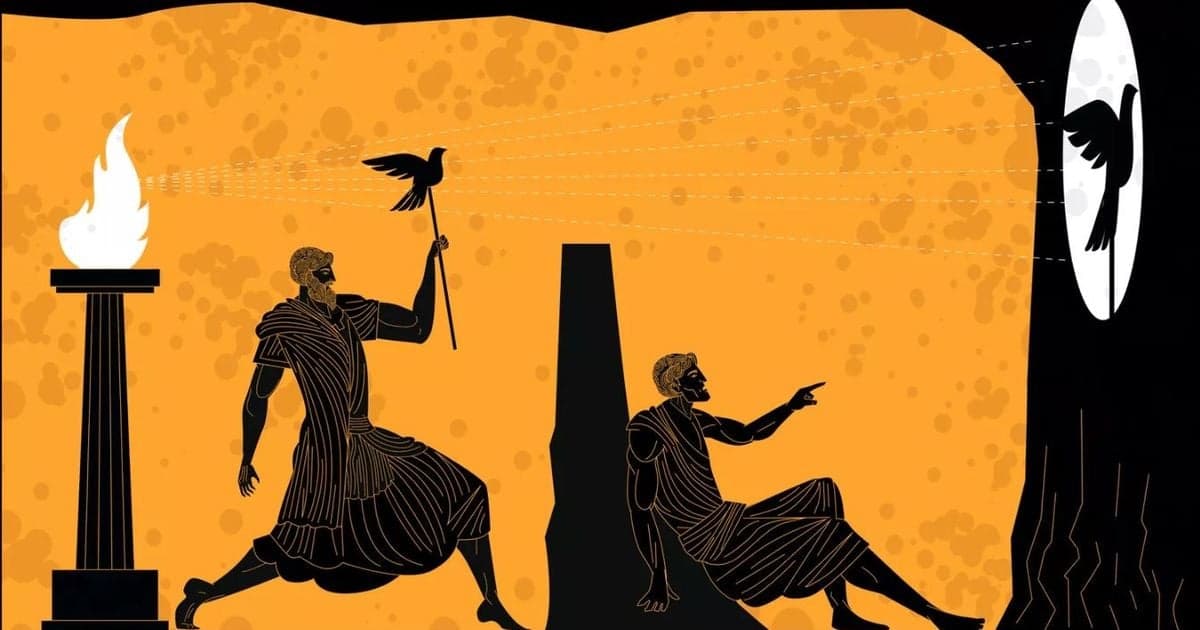
"Most pleasures are mere illusions - like someone in a cave thinking the middle is the top because they've never seen daylight."

— Socrates

Context: Explaining why bodily pleasures aren't real happiness

This transforms how we think about pleasure and pain. Most of what we call pleasure is just temporary relief from discomfort, not positive joy. Real happiness comes from feeding our higher nature with lasting goods like knowledge.

In Today's Words:

That feeling when your headache goes away isn't happiness - it's just not being in pain. Real joy is something positive, not just the absence of something negative.

"We each contain a many-headed beast, a lion, and a human."

— Socrates

Context: Creating an image of the three parts of the soul

This vivid metaphor makes abstract psychology concrete. The beast represents appetites, the lion is our spirited anger and courage, and the human is reason. Justice means keeping them in proper order, with the human in charge.

In Today's Words:

Inside you there's an animal that just wants to feed, a fighter that gets angry, and a thinker that makes plans - mental health means keeping the thinker in charge.

Thematic Threads

Power

In This Chapter

The tyrant appears powerful but is actually the most enslaved person, controlled by desires and fears

Development

Completes the progression from philosopher-kings (true power through wisdom) to tyrants (false power through appetite)

In Your Life:

The coworker who bullies others is usually the most insecure person in the room

Self-Deception

In This Chapter

People mistake the absence of pain for pleasure, like prisoners thinking the middle of a cave is the top

Development

Extends the cave allegory to show how we deceive ourselves about what makes us happy

In Your Life:

Thinking a day without crisis is good when you've never experienced real peace

Internal Order

In This Chapter

Justice means the human ruling with the lion's help over the beast - proper hierarchy within the soul

Development

Crystallizes the entire book's argument: external justice mirrors internal order

In Your Life:

Your worst days are when your emotions run your decisions instead of your thinking mind

Compound Effects

In This Chapter

The tyrannical person develops gradually - from rebellious youth to indulgent adult to enslaved tyrant

Development

Shows how the character types aren't fixed but evolve through accumulated choices

In Your Life:

That 'harmless' habit that now controls your evenings started with 'just this once'

GO ADS FREE — JOIN US

You now have the context. Time to form your own thoughts.

Discussion Questions

  1. 1

    What are the three creatures Plato says live inside every person, and what happens when we 'feed' one more than the others?

    analysis • surface
  2. 2

    Why does Plato say the tyrant is actually the most enslaved person, even though they seem to have all the power?

    analysis • medium
  3. 3

    Think about social media or shopping habits - how do you see the 'beast' getting fed in small ways that grow into bigger problems?

    application • medium
  4. 4

    If you were helping a friend who keeps making the same bad choice (overspending, toxic relationships, etc.), how would you use Plato's three-creature framework to help them see what's happening?

    application • deep
  5. 5

    What does this chapter teach us about why self-control gets harder the more we give in to temptation, and easier the more we practice it?

    reflection • deep

Critical Thinking Exercise

10 minutes

Track Your Inner Kingdom

For the next week, keep a simple log of your daily choices. Mark each significant decision with B (fed the beast), H (fed the human), or L (fed the lion). At the end of each day, tally them up. Don't judge yourself - just observe the pattern. Which creature is winning in your inner kingdom?

Consider:

  • •The beast isn't just obvious vices - it includes procrastination, gossip, and avoiding hard conversations
  • •The lion can be positive (standing up for yourself) or negative (losing your temper)
  • •Small choices count - hitting snooze vs getting up, scrolling vs reading, complaining vs problem-solving

Journaling Prompt

After tracking for a week, write about one area where the beast has been winning. What would it look like if the human took charge instead? What specific systems could you set up to make that easier?

GO ADS FREE — JOIN US

Coming Up Next...

Chapter 10: The Immortal Soul and the Myth of Er

Plato returns to poetry's danger to the soul, revealing why even beloved Homer must be excluded from the ideal state. The conversation then turns to the ultimate question - what happens to just and unjust souls after death.

Continue to Chapter 10
Previous
The Decline of States and Souls
Contents
Next
The Immortal Soul and the Myth of Er

Continue Exploring

The Republic Study GuideTeaching ResourcesEssential Life IndexBrowse by ThemeAll Books
Moral Dilemmas & EthicsPower & CorruptionIdentity & Self-Discovery

You Might Also Like

On Liberty cover

On Liberty

John Stuart Mill

Explores justice & fairness

The Analects cover

The Analects

Confucius

Explores society & class

The Idiot cover

The Idiot

Fyodor Dostoevsky

Explores society & class

Nicomachean Ethics cover

Nicomachean Ethics

Aristotle

Explores morality & ethics

Browse all 47+ books
GO ADS FREE — JOIN US

Share This Chapter

Know someone who'd enjoy this? Spread the wisdom!

TwitterFacebookLinkedInEmail

Read ad-free with Prestige

Get rid of ads, unlock study guides and downloads, and support free access for everyone.

Subscribe to PrestigeCreate free account
Intelligence Amplifier
Intelligence Amplifier™Powering Wide Reads

Exploring human-AI collaboration through books, essays, and philosophical dialogues. Classic literature transformed into navigational maps for modern life.

2025 Books

→ The Amplified Human Spirit→ The Alarming Rise of Stupidity Amplified→ San Francisco: The AI Capital of the World
Visit intelligenceamplifier.org
hello@widereads.com

WideReads Originals

→ You Are Not Lost→ The Last Chapter First→ The Lit of Love→ Wealth and Poverty→ 10 Paradoxes in the Classics · coming soon
Arvintech
arvintechAmplify your Mind
Visit at arvintech.com

Navigate

  • Home
  • Library
  • Essential Life Index
  • How It Works
  • Subscribe
  • Account
  • About
  • Contact
  • Authors
  • Suggest a Book
  • Landings

Made For You

  • Students
  • Educators
  • Families
  • Readers
  • Literary Analysis
  • Finding Purpose
  • Letting Go
  • Recovering from a Breakup
  • Corruption
  • Gaslighting in the Classics

Newsletter

Weekly insights from the classics. Amplify Your Mind.

Legal

  • Privacy Policy
  • Terms of Service
  • Cookie Policy
  • Accessibility

Why Public Domain?

We focus on public domain classics because these timeless works belong to everyone. No paywalls, no restrictions—just wisdom that has stood the test of centuries, freely accessible to all readers.

Public domain books have shaped humanity's understanding of love, justice, ambition, and the human condition. By amplifying these works, we help preserve and share literature that truly belongs to the world.

A Pilgrimage

Powell's City of Books

Portland, Oregon

If you ever find yourself in Portland, walk to the corner of Burnside and 10th. The building takes up an entire city block. Inside is over a million books, new and used on the same shelf, organized by color-coded rooms with names like the Rose Room and the Pearl Room. You can lose an afternoon. You can lose a weekend. You will find a book you have been looking for your whole life, and three you did not know existed.

It is a pilgrimage. We cannot find a bookstore like it anywhere on earth. If you read the classics, and you ever get the chance, go. It belongs on every reader's bucket list.

Visit powells.com

We are not in any way affiliated with Powell's. We are just a very big fan.

© 2026 Wide Reads™. All Rights Reserved.

Intelligence Amplifier™ and Wide Reads™ are proprietary trademarks of Arvin Lioanag.

Copyright Protection: All original content, analyses, discussion questions, pedagogical frameworks, and methodology are protected by U.S. and international copyright law. Unauthorized reproduction, distribution, web scraping, or use for AI training is strictly prohibited. See our Copyright Notice for details.

Disclaimer: The information provided on this website is for general informational and educational purposes only and does not constitute professional, legal, financial, or technical advice. While we strive to ensure accuracy and relevance, we make no warranties regarding completeness, reliability, or suitability. Any reliance on such information is at your own risk. We are not liable for any losses or damages arising from use of this site. By using this site, you agree to these terms.