
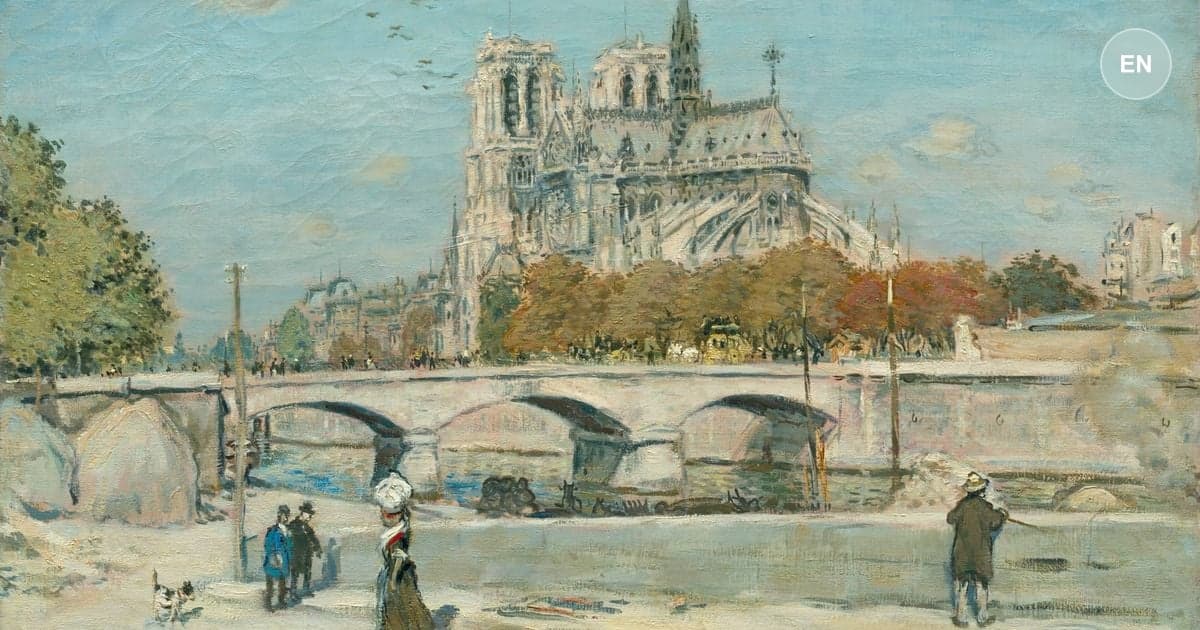
Hugo published Notre-Dame de Paris in 1831 so a Gothic church would not be scraped smooth. The chapters that stop the plot are the plot. He walks the damage: steps swallowed as the street rose, portal statues felled, kings taken off the gallery, coloured glass swapped for white, a bell tower cut away and called taste. From the towers he rebuilds the Paris of 1482 as a chronicle you could read, three towns bound by two streets and a river, whole only for a moment. A city that cannot read its buildings, he argues, has already begun to forget the people those buildings held.
Claude is the character who can still read them. He points from a printed book to the black church and says this will kill that. The press, cheaper and harder to burn, will replace architecture as the book of humanity. Hugo agrees with the history and refuses the priest's fear. The printed book does not automatically make the city kinder. It can also let a crowd keep the bell-ringer and drop the church, which is what later ages did with this novel. The stone remembers the gibbet in the middle of the Grève, the cell with no door at the Tour-Roland, and the lead poured from the gutters on the night of the assault.
The last memory is Montfaucon. The searchers come for a courtier's body and find two skeletons that will not be parted. The building, the square, and the gallows have been keeping a record the living misread as a monster story. The lesson is to treat the set of a life as an argument, not as scenery. Ask what a room, a church, or a public square was built to do to the person standing in it. Stone is patient. It will still be holding the answer when the crowd has renamed the book.
The Central Lesson
What Stone Remembers is Hugo's reason for stopping the story. The cathedral, the Grève, the rat-hole, and Montfaucon are not backgrounds. They are the city's memory, and they are being scraped, whitewashed, and misread. This will kill that: the cheap book replaces the stone book, and a crowd that cannot read either will see only the monster it elected. The lesson is to look at the building before you trust the story told about the person inside it.
Prestige deep dive
A Psychological Reading of The Hunchback of Notre-Dame
Notre-Dame studies a city that finishes a marked body into a monster so the room can stay innocent, and a priest who renames desire as fate so he never has to ask.
Read the full psychological readingApplying This to Your Life
Read the Room You Were Given
A square with a gibbet in the middle is already a sentence. Before you debate the person, look at what the place was built to do. The furniture often knows the ending.
A Cheaper Record Can Drop the Building
Claude fears the printed book will kill the church. Later readers kept the bell-ringer and lost the argument about the stone. When a short version circulates, ask what it scraped off.
Memory Can Be a Locked Cell
The Tour-Roland keeps a grief by never opening a door. Holding on is not the same as understanding. A record that cannot be left will punish the next person who fits it.
Other lessons in this book
More life-skill deep dives from the same classic.
A Crowd That Makes a Monster
The Hall and the Pillory
Stay with the hall, the pillory, and the square that decides a face.
10 chapters·Explore AnalysisBeauty Used as a Verdict
The Goat Spells a Name
Notice when a dance, a goat, or a smile is treated as proof.
9 chapters·Explore AnalysisBelonging When You Are Shut Out
The Gourd, the Cell and Montfaucon
Watch the bell-ringer the crowd crowns, mocks, and then needs.
13 chapters·Explore AnalysisDesire That Turns into Possession
The Word Cut into the Wall
See what a priest does when he names want as fate.
15 chapters·Explore AnalysisSanctuary and the Law
The King Cancels the Refuge
Ask how long a church can hide someone once the king is bored.
14 chapters·Explore Analysis
Continue exploring
The same lessons in other books
See how other books teach the same life skills.
Les Misérables: Essential Edition
Navigating Poverty and Social ClassTrace Fantine from 1817 hope to factory gossip, and the class that treats need as indictment.
The Jungle
Reading Graft as Everyday GovernmentStay with Duane's cell and chapter 25: votes, inspectors, and a city that prices justice.
Hard Times
Understanding Worker DignityWatch Stephen refuse both mill-owner and union when each side treats him as a unit, and see what integrity costs when neither camp will have you.
Where the lesson lives in the book
The Square That Keeps a Gibbet
Little of the fifteenth-century Place de Grève remains except a turret choked with plaster. In 1482 the place was a trapezoid of tall houses, with the House of the Dauphin, the Marchandise, and the Pillared House on the east. In the centre of the pavement stood a gibbet and a pillory, a justice and a ladder. The square Esmeralda dances on is already a place of execution.
Key Insight:
The stone remembers the sentence before the sentence is passed. The dance and the rope share a floor.
Men Have Done Worse Than Time
Notre-Dame is still majestic, but time and men have scarred it, and men have done the worse. The eleven steps are gone, swallowed as Paris rose. The portal statues are gone. The row of twenty-eight kings is gone. Time only wrinkles the surface. Revolutions strip and smash. Fashions since the Renaissance cut into the frame and call the wounds good taste. The church is not one pure style. The pointed arch was set on pillars built for the round arch.
Key Insight:
The building is a record of what later ages decided to scrape off. Forgetting is a kind of demolition.
A Chronicle in Stone
From the towers the narrator rebuilds the Paris of 1482. The City, the University, and the Town cannot live apart. The island is a ship of roofs. The left bank is colleges. The right bank is palaces, the Bastille, and the Louvre, with Montfaucon beyond. This medieval Paris, he argues, was a chronicle in stone, Romanesque under Gothic, and whole only for a moment. The Renaissance will spend that whole.
Key Insight:
A city you can read from a tower is a city that still agrees about what its buildings mean.
He Talks to the Statues
Quasimodo climbs the towers as if he had tamed them. He fits the church as a snail fits its shell. The statues do not laugh, so he talks to the stone for hours and flees if someone living comes. At a full peal he rides the swinging bronze of big Marie until man and bell are one storm. People come to think him the soul of the church.
Key Insight:
The building keeps him because it does not judge his face. Stone is the only public that stays.
The Book Will Kill the Building
Dom Claude tells the king's physician and a stranger that he believes in alchemy, and that to make gold is to be God. He has not done it. Asked for the true books, he points through the window at Notre-Dame, black against the stars. He looks from the printed folio to the church and says that this will kill that. The book will kill the building.
Key Insight:
He can read the church as a book and still fear the cheaper book that is about to replace it.
“this will kill that.”
Letters of Lead
The narrator stops to explain the archdeacon's words. One face of the saying is a priest's fear of the press: opinion will push belief aside, and the world will shake off Rome. Under that fear is a wider thought. Until the fifteenth century, architecture was the great book of humanity. A stone was a letter, a temple a book. Then letters of lead replace letters of stone. From the sixteenth century the building grows bare.
Key Insight:
Hugo is not pausing the plot. The plot's argument is that a city which forgets how to read its churches will forget how to see a person.
A Cell with No Door
Beside the Tour-Roland a narrow window is barred with a cross of iron. Behind it lies a cell with no door, cut into the wall. Centuries earlier a woman shut herself in there for life, mourning a father lost in the Crusades, and left the cell to women who wished to bury a great grief. Two Latin words stand over the window. The stone has been asked to hold a person.
Key Insight:
The city builds rooms that remember by refusing to let anyone out. Memory and burial share a wall.
Melted Lead and the Gallery of Kings
The outcasts turn a beam into a ram against the door. Quasimodo melts lead above two gutters, and boiling metal clears the square. In the flame they see the bellringer and call him a demon. Jehan climbs a ladder to the gallery of the kings, the same kings whose statues the later city will scrape away. The building is no longer a book in this chapter. It is a weapon, and it kills the priest's brother.
Key Insight:
Stone that once held the city's story is used, that night, as weight and heat. The gallery of kings becomes a place to fall from.
The Cellar That Keeps Them
Montfaucon stands outside Paris on a low hill. Pillars, chains, and skeletons crown a stone mass, with a barred charnel house below. Grass grows on the platform where no one walks. Searchers enter that cavern for another man's body and find two skeletons clasped together. The silk bag is open and empty. When they try to separate the pair, the crooked one falls to dust.
Key Insight:
The last stone in the book is a gibbet. It remembers longer than the city does, and it remembers a hold, not a moral.