
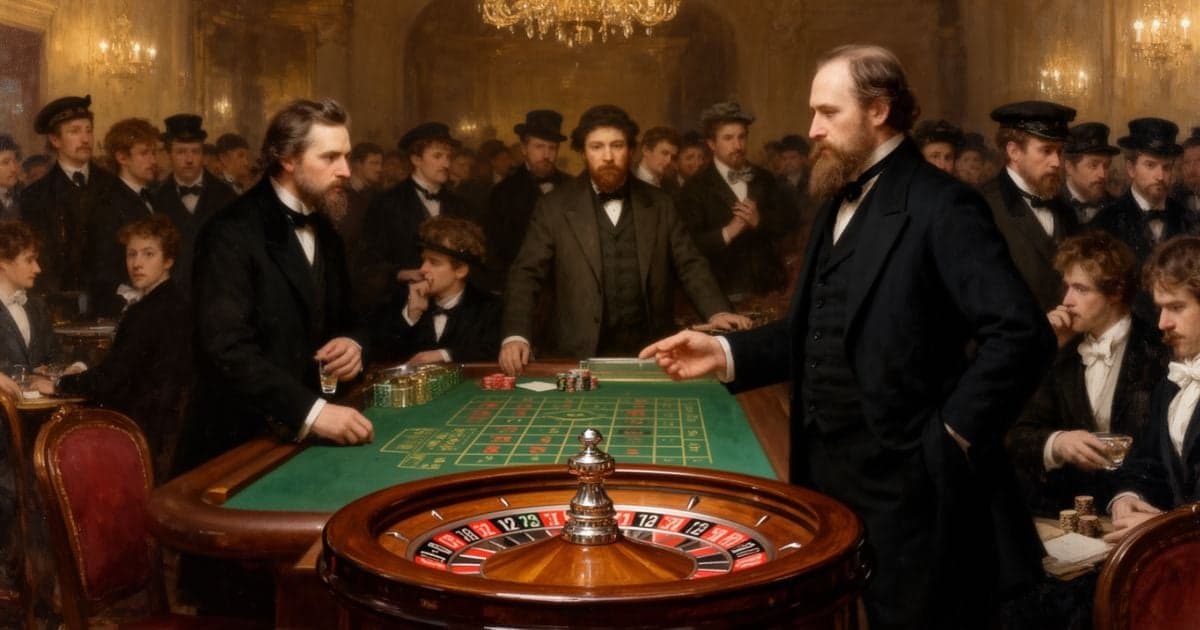
Dostoevsky does not open the spiral with a sermon about odds. He opens it with a man who can already name a bad day and still convert the evening into a duel. Chapter 4 is the diagnostic: folly, stupidity, ineptness, spoken in a rented room, followed by the wish to strike Fate on the cheek. That sequence is the whole machine. The label is accurate. The interpretation that follows the label is the disease. A correctable error is not a confession. It is a work order for the next session.
The grandmother compresses the same sequence into hours, which is why she is useful. Zero pays. The chair becomes a stage. Relatives rearrange their faces. Then the beloved number is sent to the devil, the servants are dismissed, and the one remaining escort is the man who will not stop her. In the carriage she calls herself a fool. The fool speech is not recovery. It is the invoice. Alexei watches this and still, two chapters later, surveys the cloth like a conqueror. Seeing the pattern in someone else does not retire the premise in yourself.
What the novel refuses is the comfort that intelligence would have helped. Alexei is quicker than the General, ruder than De Griers, and perfectly able to describe the rooms. The spiral uses that intelligence. It writes better reasons: play for myself, slap Fate, refine the system, fear nothing. Recognizing the gambling spiral is not spotting that roulette is risky. It is catching the moment a loss stops being a number and becomes an insult that must be answered, or a win stops being luck and becomes proof you have a faculty. Once the table is a court of honour, walking away is not prudence. It is cowardice. That is the trap Dostoevsky knew from the inside.
The Central Lesson
The gambling spiral is not ignorance of the odds. It is a story that turns every outcome into a reason to sit down again. A loss becomes a slap you must return. A win becomes a faculty you must prove. The grandmother can curse zero and still roll toward the door. Alexei can call the day folly and still look around like a conqueror. If you need the next hour to correct the last one, you are not managing risk. You are answering a court that will never adjourn. Leave before the story needs another exhibit.
Applying This to Your Life
Notice When a Loss Becomes an Insult
Alexei's maximum stake is not a budget decision. It is a slap at Fate. If your last bad night still feels like something that owes you a reply, you are already in chase logic. Name the feeling as honour, not as maths, before you call the next session a plan.
Do Not Trust the Honest Label Alone
He can say folly in the morning and still mythologize the evening by lunch. Insight that does not change the next stake is not insight. It is narration. Ask what you did after you named the damage, not whether you can describe it well.
Watch the Win That Rewrites Identity
Zero, twelve thousand florins, a conqueror's glance: each win is a costume. If a good outcome makes you someone the room must watch, the next risk is not about money. It is about keeping the costume on. Treat that hunger as the signal to leave, not as proof you have arrived.
Other lessons in this book
More life-skill deep dives from the same classic.
The One Big Win Illusion
Sit with De Griers's visit, the desperate run to the tables, and the fortune Polina throws back because cash was never the problem.
5 chapters·Explore AnalysisWhen You Become the Instrument
See Alexei play her money, insult a stranger on command, and watch the General live as Blanche's ledger.
5 chapters·Explore AnalysisHumiliation as a Way of Life
Stay with the tutor's place in the household, the Baroness dare, and a devotion that uses contempt as proof of intensity.
5 chapters·Explore AnalysisStatus as the Real Stake
Read the inheritance telegrams, the Russians at the spa, and the wish that Baden talk about him as money that is really admission.
6 chapters·Explore AnalysisWhat Happens After
Follow Paris with Blanche, debtor's prison, and Astley on the Homburg bench while tomorrow is still the plan.
3 chapters·Explore Analysis
Continue exploring
Explore this theme
The same lessons in other books
See how other books teach the same life skills.
The Jungle
Reading Graft as Everyday GovernmentStay with Duane's cell and chapter 25: votes, inspectors, and a city that prices justice.
The Idiot
Maintaining Goodness Without NaivetySit with Myshkin on the train in chapter 1: honesty with no angle, and a city that can only call it idiocy.
Jude the Obscure
When Desire Becomes a TrapTrack the pig, the dimple, the false pregnancy, and the second marriage arranged over gin.
Where the lesson lives in the book
He Wishes to Play for Himself
Alexei enters the rooms already decided to play, and already irritated that the stake is not his. He wins sixteen hundred, pockets the pile, and goes looking for Polina. The table has done two things at once: it has paid, and it has taught him that playing as someone else's hands is the wrong kind of thrill. The next hunger is ownership of the risk.
Key Insight:
The spiral does not start with ruin. It starts with a win that feels like a faculty you were not allowed to use in your own name. If the first session makes you want the next one to be yours, the mechanism is already running.
“wish to play for myself”
A Blow on Fate's Cheek
He opens the next day by calling it folly, stupidity, and ineptness. Then he retraces the evening and finds a different story: after four thousand gulden, the maximum stake was not greed. It was combat. He wanted to deal Fate a blow on the cheek. Lunch will dress the wreck as Russian character rather than a private error. The naming and the myth arrive in the same chapter.
Key Insight:
Honest labels do not stop a spiral if they are immediately converted into a duel. A loss that means you lost to chance can end. A loss that means Fate insulted you must be answered. Watch which story you tell between the table and the walk home.
“Today has been a day of folly, stupidity, and ineptness.”
Zero, Then the Order to Stake
The grandmother has the croupier call zero and the room rearranges around her chair. She is not a strategist. She is a person who has just been paid by a number, and she shouts at the narrator to stake because the money is not his. The first public win is already an instruction to continue. The pile is still growing. The interpretation has already changed.
Key Insight:
A win on zero is not information about the next spin. It is a costume: skill, luck as alliance, a right to keep going. The person holding the chips will hear that costume even if they did not sew it.
“"Zero!" called the croupier.”
Twelve Thousand, and None for You
She has won twelve thousand florins by dinner and the household's faces have changed. Relatives who needed her to die now soothe her like a child. She tells the narrator not to expect a share. The number has made her a public event. It has not made her generous, and it has not made her done. The win is a new identity, not a settlement.
Key Insight:
Watch what a pile does to the room before you watch what it does to the wallet. Compliments, sudden sweetness, and a refusal to share are the same fact: the win has become rank. Rank wants another performance.
“Yes, I have won twelve thousand florins”
To the Devil with That Zero
The number that made her a spectacle is now the number she curses. She sends the servants away and keeps the one escort who will not argue. The system dies in a sentence. Red, a larger stake, rage choosing the size. In the carriage she calls herself a silly old fool. The insight arrives with the empty purse, not before it.
Key Insight:
Chase logic is a rewrite of the rules to match the mood. The grandmother's clarity in the chair is real. It is also late. A spiral can include self-knowledge and still roll the next street toward the same door.
“To the devil with that zero!”
The Conqueror Who Fears Nothing
He looks around the table like a conqueror. Fear is gone. The room is an audience. Later he wakes from mechanical play to a total he can barely believe: a hundred thousand florins, arriving like news about someone else. The trance and the arithmetic are not the same person. The spiral's peak is dissociation with a pile in front of it.
Key Insight:
Winning can teach a worse theology than losing. Loss at least argues with you. A coup tells you the universe chose you, which is the moment the next stake feels like destiny rather than a decision.
“Once more I looked around me like a conqueror—once more I feared nothing”