
Lessons
Lessons from The Gambler
Six lessons from this classic work, traced chapter by chapter.
0:00 / 0:00
The General's circle has already spent the inheritance. They are waiting for a telegram that the Moscow grandmother is dead so the French debts can clear and Blanche can be paid in a wedding. Then the old woman arrives in an armchair, very much alive, and asks the way to the casino. Dostoevsky published the novella in 1866. Seeing the trap is not the same as leaving it. The tutor who can name every mechanism will still sit down at the wheel.
Continue the summary
Alexei Ivanovich is a tutor in a Russian household stranded at a German spa called Roulettenburg: quick, proud, broke, and so sure that intensity counts as love that Polina's contempt feels like a form of attention. Polina Alexandrovna is the General's stepdaughter, used by the Marquis de Griers and using Alexei in turn, asking him to play her money and then to make a fool of himself in public. The General waits for his grandmother, Antonida Tarasevicheva, to die so he can marry Mlle Blanche and settle what he has already mortgaged. Mr. Astley, the English sugar refiner, sees the whole arrangement and cannot make anyone leave it. De Griers treats people as accounts, and Blanche prices a husband by the telegram.
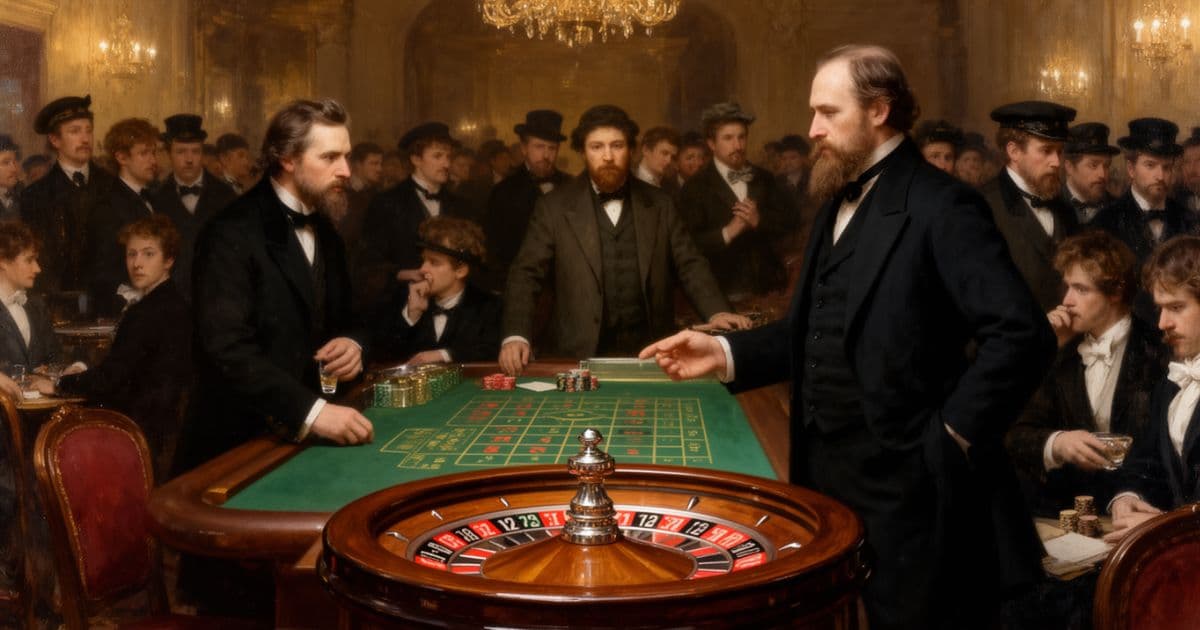
Alexei enters the casino with Polina's six hundred gulden, angry at playing for someone else, and wins enough to mistake luck for a faculty. She then sends him to bow to a Baroness and speak broken French; he does it, and the household treats the insult as a scandal he chose. The grandmother arrives on the verandah, mocks De Griers as a mountebank, and asks to see roulette. She wins on zero, becomes imperious by dinner, and ruins herself in days. Alexei runs back to the tables to rescue Polina from De Griers, piles a fortune on the cloth, and brings it home; she throws the money at him and leaves. He burns the winnings in three weeks of Paris with Blanche. A year and eight months later Astley finds him at Homburg, reports that Polina inherited seven thousand pounds and that the General is dead, and still cannot buy him off the wheel.
Dostoevsky dictated the book in twenty-six days to Anna Snitkina because a contract would have stripped him of every future work if he missed the deadline, and because he already knew the tables from the inside. He never treats roulette as local colour, or the first win as a cute initiation. Compulsion here is not ignorance. It is a premise that survives evidence: the loss was an error, the next system will correct it, one hour of patience will raise the dead. What remains is not a sermon against risk. It is a picture of how a rescue fantasy, a humiliating attachment, and a public score can share one mechanism, and how intelligence will refine the method rather than abandon the premise.
The first stake is already the first pressure. Recognizing the Gambling Spiral is Polina's six hundred gulden, the grandmother winning on zero then ruining herself in days, and the chase that treats every loss as a correctable error. The One Big Win Illusion is the desperate run to rescue Polina from De Griers, the fortune piled on the cloth, and the money she throws back because cash was never the problem. Humiliation as a Way of Life is the Baroness dare, the broken French, and a devotion that uses contempt as proof. When You Become the Instrument is playing her money, insulting a stranger on command, and watching the General live as Blanche's ledger. Status as the Real Stake is the inheritance telegram they needed her to die for, the Russians at the spa, and the wish that Baden talk about him. What Happens After is three weeks of Paris with Blanche, then Astley on a Homburg bench a year and eight months later, reporting that Polina inherited seven thousand pounds while tomorrow is still the plan.
She wins on zero and is ruined before the week is out. He brings a fortune home and she throws it at him. Wide Reads gathers summaries, quotes, and audio on all seventeen chapters, from an armchair on the verandah to a last gulden at Homburg.
Why this matters
People still arrive at this book when someone they love can describe exactly why a habit is destroying them and still will not stop. Dostoevsky does not offer a cure. He offers one of the clearest pictures in fiction of how a rescue fantasy, a humiliating attachment, and a public score can share one mechanism, and how intelligence refines the method rather than abandoning the premise. This guide keeps that argument tied to a specific table, a specific woman, and a specific number.
Prestige deep dive
A Psychological Reading of The Gambler
The Gambler shows a man who can name every mechanism of the wheel, of a humiliating love, and of a household waiting on a death, and who still treats that clarity as a reason to sit down again, because one turn is asked to reverse a life that ordinary time will not.
- The Diagnosis Does Not Open the Door
- Hatred Is the Sentence That Keeps Him
- He Refuses the Father on the Roof
Theme breakdowns
Explore the lessons
The Gambler is a story about a tutor who can explain exactly how the wheel destroys people and still cannot make himself stand up from the table: a fortune won on zero and lost within days, a woman who sends him to insult a Baroness on command, and a rescue that fails the moment the money lands in her hands.
Each card traces a pattern through named chapters — summaries, quotes, and key insights tied to the scenes that prove it. Start with the featured lessons, then open the deep dives below.
Deep dives
Chapter-by-chapter breakdowns
Humiliation as a Way of Life
Stay with the tutor's place in the household, the Baroness dare, and a devotion that uses contempt as proof of intensity.
What Happens After
Follow Paris with Blanche, debtor's prison, and Astley on the Homburg bench while tomorrow is still the plan.
Continue Exploring
Guides, life skills, and the full library.More ways to read The Gambler: guides, life skills, and the wider library.