
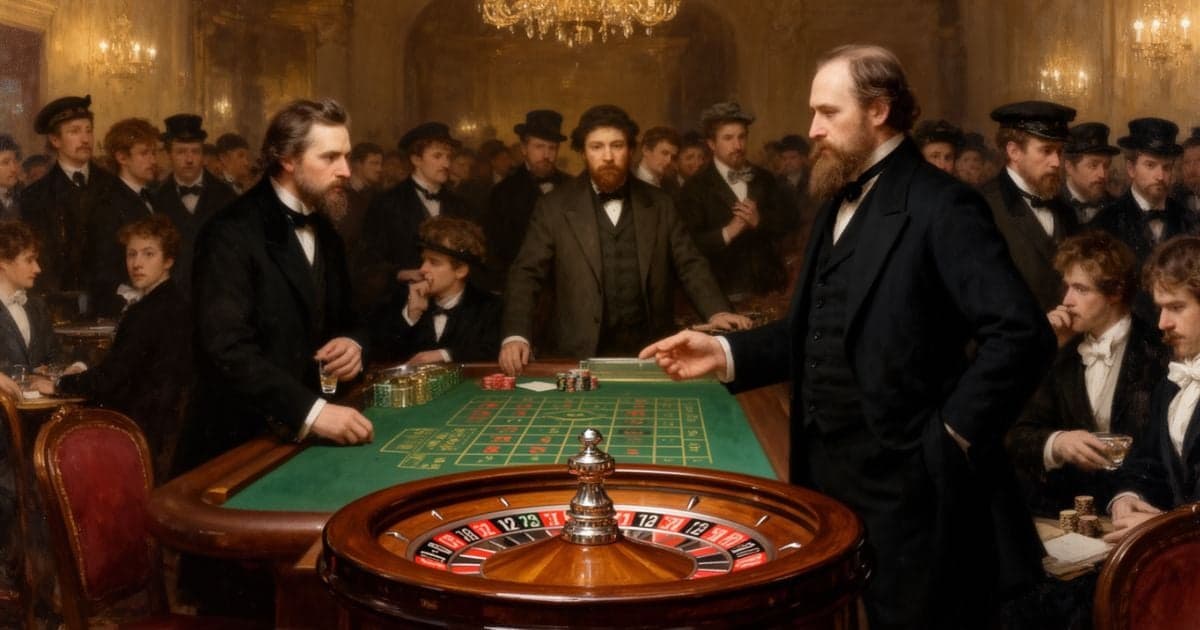
Roulettenburg's Russians are not only counting florins. They are counting who still has to wait in the corridor. Money from somewhere has already changed the General's face before the grandmother arrives. Then a woman who was never a princess draws a court around an armchair because zero paid her. The title is issued by the wheel. The family, which had spent her death in conversation, must now invent manners for a living creditor who will not let them have any of it.
Dostoevsky makes rank visible in small betrayals of tone. The General feared being seen with a strange old woman, then smiles as if soothing a child. De Griers pours compliments the moment the pile is public. Blanche turns sweet toward the tutor. None of this is affection. It is a bid. The grandmother's sentence is the audit: you need not expect to receive any. The crowd was never hers. It was rented from the chips, and the lease is hourly.
Alexei says the quiet part only when he is already wrecked. He wanted Heintzes and hotel proprietors and fine ladies to talk about him. Until that sentence, the novel can be misread as a book about money. After it, every stake is an application to be narrated as someone. Ruin dressed as Russian character, a princess who never was, a last gulden that still feels like a plan: the same hunger. The room the chips rent will never give a permanent key. That is why the door keeps being bought.
The Central Lesson
The real stake at Roulettenburg is not a hoard. It is a room. Zero mints a princess who never was. Compliments arrive with the florins and will not survive their departure. Alexei, late, admits he wanted hotel proprietors and fine ladies to talk about him. If the cash is only a ticket into being taken seriously, the wheel will never sell you a permanent key. Name the room. Then find a door that does not require a death, a crowd, or a last gulden that still feels like a plan.
Prestige deep dive
A Psychological Reading of The Gambler
The Gambler shows a man who can name every mechanism of the wheel, of a humiliating love, and of a household waiting on a death, and who still treats that clarity as a reason to sit down again, because one turn is asked to reverse a life that ordinary time will not.
Read the full psychological readingApplying This to Your Life
Name the Room Before You Name the Number
A bonus, a house, a public win can be a tool. It can also be a ticket into a circle that will not otherwise admit you. Ask which corridor the money is supposed to open. If you cannot name the room, you are not making a budget. You are buying a headline.
Believe Who Arrives When You Become Visible
The grandmother's crowd after zero is a clean test. Relatives, colleagues, and old friends who appear when the figure gets large are often collecting on a story they told in advance. Timing is the evidence. Tenderness is the costume.
Separate Cash from Being Talked About
Alexei wants Baden to recount him more than he wants to keep a pile. If your plan only works when other people narrate it, you are not building security. You are renting an audience that resets overnight. Find a door that does not require a croupier.
Other lessons in this book
More life-skill deep dives from the same classic.
The One Big Win Illusion
Sit with De Griers's visit, the desperate run to the tables, and the fortune Polina throws back because cash was never the problem.
5 chapters·Explore AnalysisWhen You Become the Instrument
See Alexei play her money, insult a stranger on command, and watch the General live as Blanche's ledger.
5 chapters·Explore AnalysisHumiliation as a Way of Life
Stay with the tutor's place in the household, the Baroness dare, and a devotion that uses contempt as proof of intensity.
5 chapters·Explore AnalysisRecognizing the Gambling Spiral
Watch Polina's first stake, the grandmother's afternoon transformation, and the chase that treats every loss as a correctable error.
6 chapters·Explore AnalysisWhat Happens After
Follow Paris with Blanche, debtor's prison, and Astley on the Homburg bench while tomorrow is still the plan.
3 chapters·Explore Analysis
Continue exploring
Explore this theme
The same lessons in other books
See how other books teach the same life skills.
The Jungle
Reading Graft as Everyday GovernmentStay with Duane's cell and chapter 25: votes, inspectors, and a city that prices justice.
The Idiot
Maintaining Goodness Without NaivetySit with Myshkin on the train in chapter 1: honesty with no angle, and a city that can only call it idiocy.
Jude the Obscure
When Desire Becomes a TrapTrack the pig, the dimple, the false pregnancy, and the second marriage arranged over gin.
Where the lesson lives in the book
Money From Somewhere
Alexei comes back to a household that has acquired funds from an unnamed source. Faces have changed. The General warns the tutor not to take the children to roulette while flashing a new confidence that only cash can rent. The first status lesson is local: respectability is a costume that arrived with a sum, not with character.
Key Insight:
When money shows up without a story, watch who gets polite and who gets pushed to the margin. Display is often a claim on a room, not a settlement of a life.
“It was clear that from somewhere money had been acquired.”
The Mountebank Meets a Living Creditor
The grandmother sits in the armchair, very much present, and names De Griers what the family would not: a mountebank she trusts no more than this. The social script had spent her as a dying account. A living woman with a purse is a different rank. She is not going to let them have any of her money. The room has to invent manners for a person it had already spent.
Key Insight:
Status schemes fail when the discounted person walks in. Every polite face in the study had already assigned her a funeral. Arrival is an audit.
“I happen to know you as a mountebank, and therefore trust you no more than this.”
A Princess She Never Was
The crowd treats the chair as a court, although she had never been a princess in her life. Zero has issued a title the family name could not. Visibility is rented from the croupier. The narrator is told to stake because the money is not his. He is a clerk to her new rank, not a guest in it.
Key Insight:
A win can mint a kind of nobility that birth never gave you. That nobility is hourly. If attention arrived with the score, it will leave with the score. Do not confuse a crowd with a class.
“although she had never been a princess in her life.”
None of It Is Yours
Twelve thousand florins later, the General smiles as if soothing a child. De Griers overflows. Blanche turns sweet toward the narrator. The grandmother is blunt: you need not expect to receive any. The pile has rewritten the household's faces without rewriting the will. Compliments are a bid on a fortune that still has a living owner.
Key Insight:
Windfalls audit relationships. The people who appear when a number gets large are often collecting on a story they told in advance. Believe the timing more than the tenderness.
“But you need not expect to receive any.”
Ruin Dressed as National Character
After his own wreck, Alexei would rather grow fat after the Russian manner, or squander his substance at roulette, than save like a German clerk. The speech is not economics. It is a bid to make loss look like rank: recklessness as pedigree, thrift as a foreign stain. Status can be performed even in a emptied pocket.
Key Insight:
When a loss needs a culture to justify it, you are no longer talking about money. You are talking about how you wish to be seen while broke. Pride will spend the next stake to keep the costume from looking like a mistake.
“I would rather grow fat after the Russian manner, or squander my whole substance at roulette.”
Heintzes, Hotel Proprietors, Fine Ladies
Late, and clearly, he names the audience. He did not want a hoard. He wanted the mob of Heintzes, hotel proprietors, and fine ladies of Baden to talk about him. Even ruined, the stake is still a room that would have to take him seriously. The last gulden is an application for narration.
Key Insight:
Status hunger outlives cash. If the fantasy is that strangers will finally tell your story, no win is large enough, because the audience resets every night. That is why the last coin still feels like a plan.
“what I wanted was to make all this mob of Heintzes, hotel proprietors, and fine ladies of Baden talk about me”