
Clarity at the Same Table
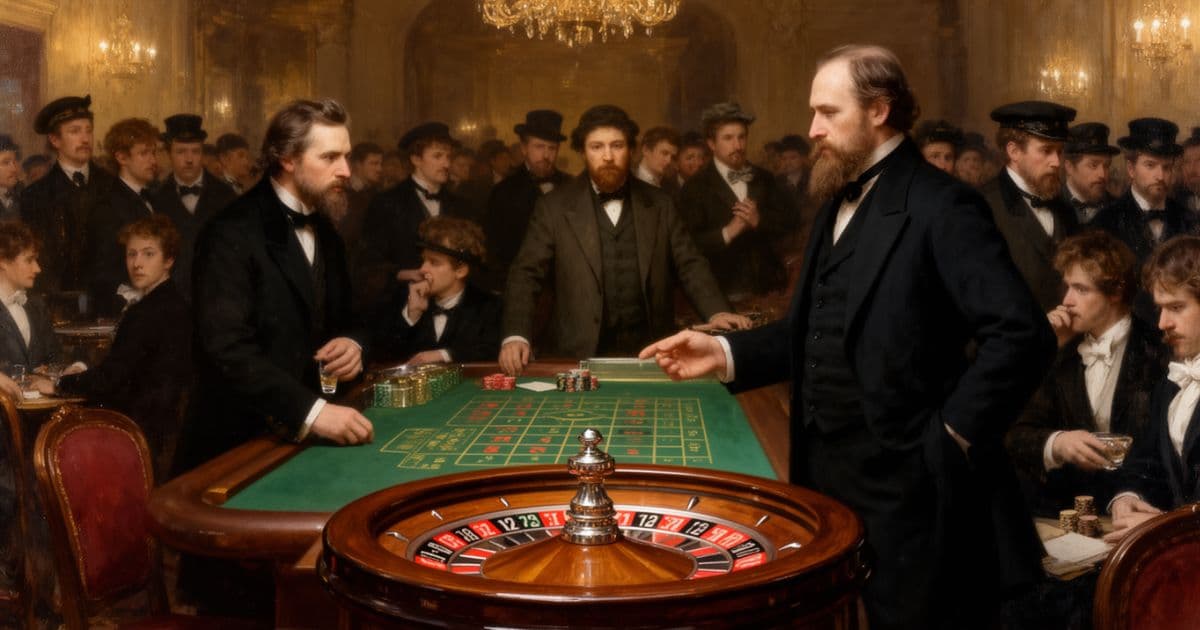
The Gambler is not the story of a man who fails to see the wheel. Alexei Ivanovich sees it with a tutor's precision: the crowd with ruled papers, the order he thinks he can read in chance, the household waiting for a telegram that a Moscow grandmother is dead, the Frenchman who holds their notes, the woman who hates him because she needs him. Dostoevsky's psychological core is what that clarity does not do. It does not open a door. It becomes the instrument that keeps him at the table. A mind that can name every mechanism will still stake the last gulden, because the naming has been asked to stand in for leaving. Love, rank, and roulette share that mechanism. Each promises that one turn can reverse a position that work and ordinary time will not.
The Diagnosis Does Not Open the Door
He returns from two weeks away to a colder welcome. Money has appeared from somewhere. The General will not meet his stare, counts out a hundred thalers of Alexei's own money, and orders the children kept clear of the casino. A tutor at the tables would compromise a house that wants to look like millionaires for a week. The habit is already public. Naming, in this book, is how people manage one another. It is not how anyone stops.
Polina puts six hundred gulden in his hand, and he sets conditions so the errand cannot be mistaken for a wage. He will not take half the winnings, and she must explain that evening why she needs the sum. At the table he decides that calculation is superfluous. Men with papers lose as the simple players lose. From that he draws the conclusion that keeps the book alive: in the flow of chance there is, if not a system, at all events a sort of order. A compulsion this intelligent does not deny the risk. It promotes the risk into a faculty. A later loss can be filed as a failure of patience, not of premise.
Hatred Is the Sentence That Keeps Him
On a bench by the fountain she tells him she hates him because she has allowed him to go so far, and hates him still more because he is necessary to her. For the time being she wants him, so she must keep him. A plainer rejection would release him. Necessity does not. He hears the hatred as a bond, because a bond that includes contempt still includes him. Otherwise the household has a place for him only as the man who changes notes and walks the children away from the doors.
The dare makes the bond visible. She points to the Baroness Burmergelm and the tall Prussian with the stick, and tells him to take off his hat and say something in French. He has already sworn he would leap from the Schlangenberg, or kill on command. She wants a laugh, and she wants to see the Baron thrash him. He goes, excited as a schoolboy. Later, telling the grandmother, he revises the scene: German without the Berlin accent, a stick raised, the Baron as the aggressor, and no mention of Polina. The notes keep both versions. Chosen, the humiliation proves devotion. Revised, it proves he was not merely used.
He Refuses the Father on the Roof
After the losses, De Griers remarks that many Russians gamble and are no good at it. Alexei's reply is the book's theory of itself, and it is not a theory of odds. Roulette, he says, suits people who need money and will not acquire it by accumulating capital, because it can make a man rich in a couple of hours without work. Against that he sets the German father under the elms, the stork on the gable, the daughter left without a dowry, the younger son sold into the ranks, Gretchen waiting twenty years until the gulden are virtuous enough for a wedding. He would rather squander his substance at roulette than bow to that idol. He wants the money for himself. He will not hand his personality over to capital.
The speech is a refusal of slow time. The father under the lime trees, reading aloud, is remembered and rejected in the same breath. Ordinary accumulation asks a person to wait and to let the self be pledged. The wheel offers the opposite contract: the self stays intact, and the fortune arrives as an event. That is why one hour of holding his nature in check can feel, at the end, like manhood. Patience here is not the father's patience. It is a technique for forcing tomorrow into this afternoon.
The Grandmother Has No Romance to Blame
Antonida Tarasevicheva arrives in an armchair, very much alive, and the plot the household has been living collapses. They needed her dead so the French debts could clear and Blanche could be paid in a wedding. She asks what zero means and has herself wheeled to the cloth. She wins, near thirteen thousand florins once the gold is counted, and by dinner she is imperious. The landlord enters her as a princess. She scatters gulden on bearers, a man who smells of liquor, a soldier with a wooden leg.
Then the same mechanism, with no Polina in it. She stakes on zero until she is begging the number she has been refused all morning. A win on the red is not the point. The point is to get back what zero took. The next day men stand on either side of the chair, and a man who calls himself a Polish gentleman of honour cannot be sent away because he begins to win. When she plays her last note, the men behind the chair stake it themselves. Potapitch reckons ninety thousand roubles in a day, after the day before. Three times she had begun to win, and could not leave. Remove the love story, and Alexei's sequence is already here: a first win that feels like a faculty, a self enlarged by the room, a chase that treats every loss as a correctable error. The death they were waiting for has been replaced by a living ruin.
Fifty Thousand Francs Is the Wrong Currency
De Griers writes and goes. The letter hopes she has found nothing unworthy of a man of honour, and arranges that friends in Petersburg will sell what the General mortgaged. She had read him long ago. If the telegram of a death had come, she would have flung him a quittance and dismissed him. She would throw fifty thousand roubles in his face. She will not go to the grandmother, and she will not kneel.
Alexei's answer is the wheel. He begins as a systematic gambler would, then abandons the system, and comes back with two hundred thousand francs. He counts out fifty thousand francs and tells her to throw them in De Griers's face tomorrow. She laughs. She is not in the habit of receiving money for nothing. The beloved of De Griers, she says, is not worth fifty thousand francs. Would he buy her, as De Griers did? The night does not settle it. She draws him close and pushes him away. In the morning she hurls the notes in his face and leaves with Astley.
He has done what the speech promised: wealth without the father's years, in an afternoon, for a person. She reads the gift in the only grammar the household has taught her, which is purchase. Cash was the problem De Griers could solve. It was not the problem between them. A fortune offered as proof of devotion lands as the same instrument the marquis used.
Blanche Charges for the Delirium
What he does with the money he still holds is the confession that scene would not allow. Blanche takes him to Paris. A hundred thousand francs are gone in a little over three weeks, and another hundred thousand he has already assigned to her. She inspects his purse every day. It never holds more than a hundred francs. She ties his tie, calls him the tutor who won two hundred thousand francs, and wants him to walk behind her with a pencil. She names the price of the flat, the carriage, the horses. He stares at the ceiling and does not dispute the accounts.
Blanche will not pretend the stake is love. Where Polina throws the notes, Blanche spends them, and she says so. The General has already spent the inheritance, and Blanche prices a husband by the telegram. When that fortune fails, the feeling becomes a different bill. She will later have transferred to herself whatever he received from the grandmother, and he will die in Paris of a stroke. Alexei knew, even afterwards, that another win would go to another Blanche. The knowing sits beside the stake and does not touch it.
The Notes Know, and the Notes Continue
These are notes, written in the evenings by a man who already understands. A day of stupidity. A noise he caused. A melancholy town where he is afraid of any serious book and reads Paul de Kock. The form withholds the editor who would turn a true sentence into an exit. Insight is the genre. Departure is not a scene the notes can stage, because the writer still needs tomorrow.
A year and eight months later he picks them up to distract himself. The record of his ruin is a way to avoid the present room. He has been to Homburg, Roulettenburg, Spa, and Baden, lain in prison for two hundred thalers that someone paid (he does not know who), and served five months as lacquey to a Privy Councillor named Heintze. By stinting meat and drink he saves seventy gulden, resigns, and goes to the table. It was not the money. He wanted Baden to talk of him, and perhaps to tell Polina. In the same stretch of notes he knows he would only spend the win on another Blanche. Self-knowledge and desire are allowed to stand together. Clarity is refused the last line.
Tomorrow Is a Date the Notes Never Reach
Astley finds him at Homburg with the report that should end a different book. The grandmother has died and left Polina seven thousand pounds. She was ill, was entertained in the north of England, and is now in Switzerland. She loved him, and still loves him. Astley has come at her request. He will not give a thousand pounds to start a life, because a thousand pounds and ten louis are the same man. He gives the ten and tells him to take care of them. They embrace. Alexei weeps, which he says has not happened before.
Then the notes resume. Astley is wrong about Russians, he decides, and words are only words. He must act, and he must think of Switzerland. Tomorrow he will rise from the dead. Today it is too late. He is holding fifteen louis, and the memory he trusts is a last gulden that rattled as he was leaving. He thought he might need it for a meal. A hundred paces on, he went back, staked it on manque, and in twenty minutes had a hundred and seventy gulden. What am I, he has asked. I am zero. The last line names a date the manuscript does not contain: tomorrow all shall be ended. Resurrection, in his mouth, is the theology of the next spin. The book stops before the hour in which his nature was supposed to be checked.
Why It Resonates Now
Readers still recognise the person who can explain the mechanism and still place the next stake. The loss is filed as an error in timing, a failure to hold off for one hour, a system that would have worked if his nature had not interrupted it. The speech against the patient father remains live wherever slow accumulation looks like disappearance: a life pledged to other people's capital, a self allowed to begin only once the sum is respectable. The wheel, and every later machine that pays in a single public event, offers the contract he took. One turn, and the room will have to talk.
He says the other stake at Baden in plain words. He wants employers, proprietors, and fine ladies to recount his story. Rank is what the win is asked to deliver, and humiliation is what the love is asked to prove. A culture that treats attention as admission will keep producing the man who can describe his ruin accurately and still need the room to narrate him. The novel shows how complete the description can be while the last gulden is still in the pocket.
Limits of This Reading
This reading can flatten a novella into a case of addiction, and the risk is real because the sequence is so exact. Alexei is not a clinical portrait, and the grandmother is not a specimen set beside him. Dostoevsky dictated the book in 1866, in twenty-six days, to Anna Snitkina, under a contract that would have cost him his future work, while he was also inside the tables he was describing. Some of it is testimony. Testimony is not a diagnosis.
The speech about the German father is also a nationalist quarrel, and Astley's claim that Russians resemble Alexei is a stereotype the notes both resent and use. Polina is not a function of his attachment. She is in debt, watched, and finished with a man who priced her. Her refusal of the fifty thousand francs can be read as dignity, as panic, as illness, or as contempt, and the notes are not a reliable witness to which. The night is unstable. He calls it love, and by morning she will not take the money. The cloth pays in gulden. She throws them, and they still hit.
Across the Shelf
Crime and Punishment, written in the same season, builds a theory so a harmful act can feel like proof. The Gambler does not need that essay. The wheel is the proof, and it pays in public. Raskolnikov cannot open the purse, because spending it would make the theory a fact about his hands. Alexei spends two hundred thousand francs in three weeks, because spending was always the fact. One man still has a woman who asks what he has done to himself. The other has Astley, who will report the truth and still will not fund the next life, because the sum is not the variable. Notes from Underground uses consciousness as a reason not to act. Alexei uses it as a reason the next stake is still rational. In both, precise self-understanding does not make a man freer. It makes him harder to embarrass. The last sentence still names tomorrow.