
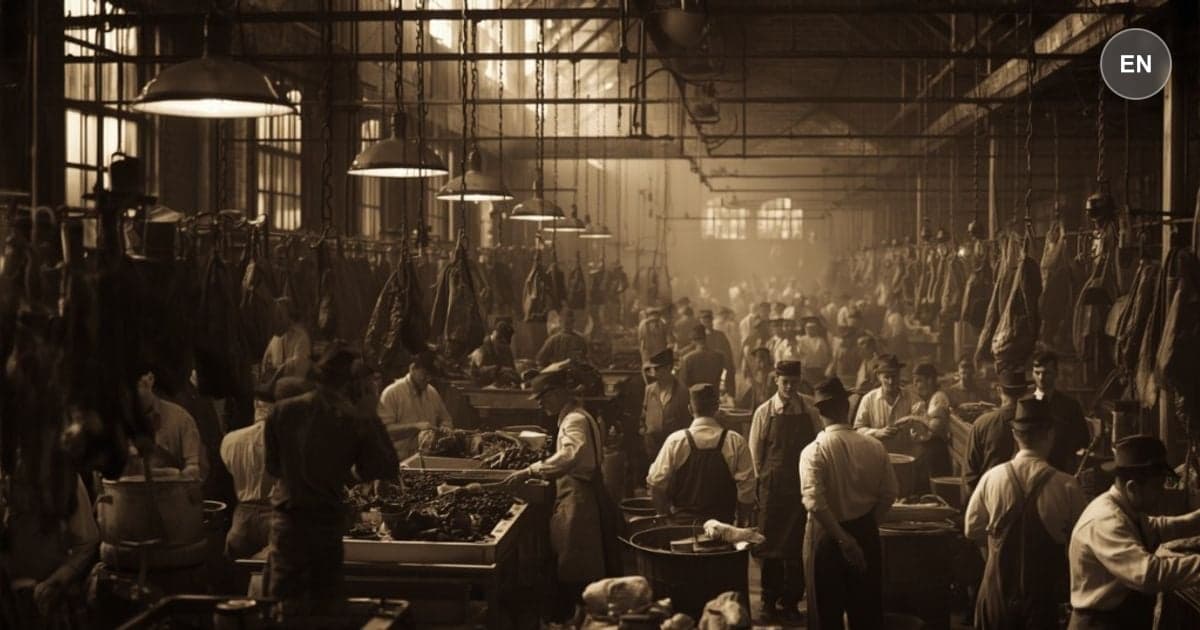
Jurgis laughs. That is the immigrant fact Sinclair starts with after the feast, and it is not stupidity. Older men tell him what the yards do to a body. He has too much health to imagine being beaten, and going back would be a shame the crossing cannot survive. The bosses like to get hold of that man: the one who runs when told to run, the one whose eagerness is still intact. Hope, here, is a resource. Packingtown spends it the way it spends a hog, slowly, and all of it.
The veselija has already shown the other half of the crossing: a compact from the forests of Lithuania that Chicago's air seems to poison. Young men eat and sneak off. Ona names the bills in terror. Jurgis offers harder work as if a back could underwrite a culture. Winter then spends the children. One predator at the plant can unmake a network of cousins who crossed together. Jail can erase the rooms while he is gone. Home, for people without a lawyer's English, is a season, not a title. The brochure never mentioned that clause.
What Sinclair refuses is the gratitude sermon. Jurgis does not fail America in a moral sense. He meets America in a form that treats his labor as disposable and his hope as leverage. The socialist hall does not give him the wedding back. It gives him a public sentence for a private crossing, a way to hear his disasters without translating them into shame at having come. The immigrant perspective at the end is not that the country was a lie in every particular. It is that the country can be contested, and that the laugh at the warnings was the first thing the yards knew how to spend.
The Central Lesson
An immigrant in The Jungle is not a mascot for grit. He is a man whose health, eagerness, and inability to go back are exactly what the yards know how to spend. The laugh at the warnings, the compact the new air poisons, the run when told to run, the rooms that vanish in a season, the hall that finally names the years: these are one crossing. Do not score it as gratitude failed. Score it as a country that could treat a back as raw material and a hope as fuel. The useful ending is not the brochure. It is a language in which the disasters can be spoken without shame.
Applying This to Your Life
Honor What a Crossing Costs
Language, family strain, the pressure to prove the journey was worth it: those costs are not extras. Recognize them before you judge a choice made under them, including your own.
Distrust the Brochure Version
If opportunity requires silence about injury, debt, or abuse, the opportunity is partial. Ask what newcomers are not being shown before they commit the people who came with them.
Seek Company, Not Shame
Jurgis suffers most when he believes the pain is unique and the duty is gratitude. The turn begins when he hears his story in other mouths. Isolation is how a system spends hope. Company is how people stop being inventory.
Other lessons in this book
More life-skill deep dives from the same classic.
Reading Graft as Everyday Government
Stay with Duane's cell and chapter 25: votes, inspectors, and a city that prices justice.
6 chapters·Explore AnalysisUnderstanding Reform Movements
Hear the union hall, the socialist meeting, and the night the country reached for the plate.
6 chapters·Explore AnalysisSeeing Systemic Exploitation
Sit with the house contract and the killing floor: the trap is design, not bad luck.
6 chapters·Explore AnalysisHolding a Family Together Under Scarcity
Watch Ona, Elzbieta, and the children keep a household when the wage cannot cover the winter.
6 chapters·Explore AnalysisSurviving After the System Breaks You
Follow Jurgis from the sprain and the fertilizer mill through jail, the road, and the fall.
6 chapters·Explore Analysis
Continue exploring
Explore this theme
The same lessons in other books
See how other books teach the same life skills.

Les Misérables: Essential Edition
Navigating Poverty and Social ClassTrace Fantine from 1817 hope to factory gossip, and the class that treats need as indictment.
Hard Times
Understanding Worker DignityWatch Stephen refuse both mill-owner and union when each side treats him as a unit, and see what integrity costs when neither camp will have you.
A Tale of Two Cities
Loving Without PossessionTell Lucie you would give your life to keep a life she loves, after you already know she will marry Darnay.
Where the lesson lives in the book
A Compact the New Air Poisons
The veselija is supposed to be a compact: everyone knows his share, and strives to give a little more. In Chicago the young men eat, then sneak off. Bills for hall, ducks, musicians, and an open beer tab gnaw Ona all day. Jurgis answers terror with a sentence he has already used in Lithuania and New York: he will work harder. The feast is not foolishness. It is the last proof they remain people, priced in a city that will charge them for being so.
Key Insight:
Immigrant life often begins with a double bind: keep the ritual that makes survival bearable, and pay a bill the old country never required at this scale. The poison is not the dance. It is an air that teaches the young to eat and run.
“I will work harder.”
Too Much Health to Imagine Being Beaten
Jurgis talks lightly about work because he is young. Older men tell stories of the breaking down of men, stories to make flesh creep. He laughs. He has been in the yards four months, a giant besides. There is too much health in him. He cannot even imagine how it would feel to be beaten. Return is already shame, so the warnings have to be wrong.
Key Insight:
Hope is not only naivety. It is what you need when the bridges behind you are burned. A system that spends that hope slowly is counting on the laugh.
“He was the sort of man the bosses like to get hold of, the sort they make it a grievance they cannot get hold of.”
On the Run When Told to Run
Told to go to a certain place, he would go there on the run. The first killing-bed days teach speed, filth, and injury as weather. His strength impresses bosses without buying the family any security. The immigrant bargain was sold as work hard and rise. The hidden clause is that the body is the down payment, and the clock belongs to someone else.
Key Insight:
Eagerness that looks like character is the trait a plant can most easily convert into waste. If advancement depends on surviving hazards no one explained, the dream is a timed experiment.
“When he was told to go to a certain place, he would go there on the run.”
One Debt Destabilizes the Whole Crossing
Winter, wedding costs, and lost wages compound. Ona faces pressure at work she cannot name. Cousins, elders, and children share the rooms, so one injury or one predator can unmake everyone who crossed the ocean together. Immigrant households survive through interdependence. That is also how the damage multiplies.
Key Insight:
You do not fail alone when the voyage was a group calculation. Sinclair's perspective is communal: a private collapse is a network event. Do not score it as one man's merit.
“Over them, relentless and savage, there cracked the lash of want.”
Home Can Vanish Between Seasons
Jurgis walks out of jail toward rooms that are already gone. For a man without wealth or a language the law respects, catastrophe does not pause for recovery. One arrest can erase years of sacrifice. The address he still carries is a memory, not a fact. What 'home' means when home can vanish is the immigrant question the brochure never asked.
Key Insight:
Coming back is not returning. The life a crossing was supposed to buy can finish collapsing while you are locked away. Name what is left before you name yourself a failure at America.
“Mebbe twenty miles or so.”
A Public Language for a Private Crossing
At a socialist meeting Jurgis hears wage slavery named as if someone had been taking notes on his years. The immigrant worker becomes a citizen of a movement. Suffering stops being proof that he did not try hard enough in a language he was still learning. The brochure version of America is not replaced by despair. It is replaced by a fight that can be spoken.
Key Insight:
Many newcomers are told their pain is private and their duty is quiet gratitude. Political language matters because it converts isolation into company. Naming the system can restore dignity even before it changes a statute.
“By God! By God! By God!”