
Free study guide · no paywall
The Death of Ivan IlyichStudy Guide
by Leo Tolstoy (1886)
A death notice at court, a ladder bump, and Gerasim's plain truth: mapped across 12 chapters and six lessons.
Start here
Plot, characters & chapter jump
12 chapter summaries · 5 key figures · quotes · free
Plot summary
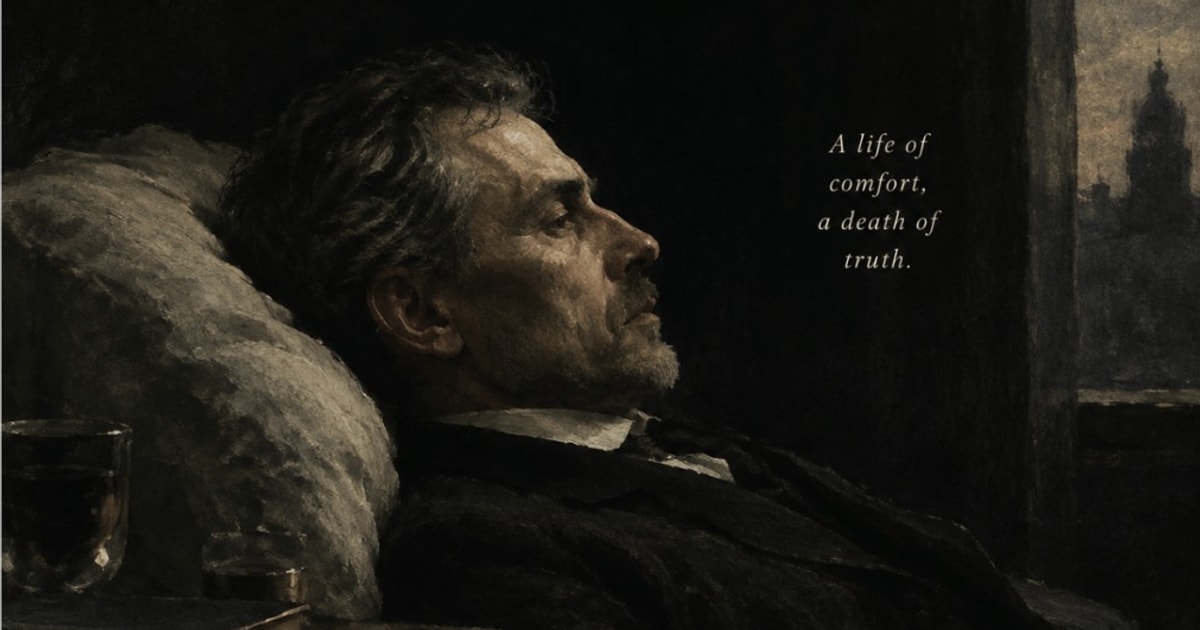
Colleagues learn Ivan Ilyich Golovin has died and think of promotions before pity. Tolstoy then follows Ivan from law school through furnished rooms and card parties until a minor fall becomes pain no doctor will name. Ivan knows he is dying while wife, colleagues, and visitors perform recovery. Only Gerasim, the peasant servant, says everyone dies and holds Ivan's legs without flinching. Ivan almost admits the whole life may have been wrong, rebuilds the verdict by morning, screams through three days of agony, sees a black sack, and dies released from the performance.
Jump to chapter
What readers search for
Common questions about The Death of Ivan Ilyich
What is The Death of Ivan Ilyich about?
Tolstoy opens with colleagues hearing Ivan Ilyich Golovin has died and calculating promotions before pity. The novella rewinds through a respectable career, marriage, and card parties, then a ladder bump that will not heal. Ivan learns he is dying while doctors and family insist on cheerful hope. Only the servant Gerasim speaks plainly that everyone dies. The deathbed question is whether a correct life was ever lived, and what the suffering was for.
Asking What the Suffering Is ForWhat does "Maybe my whole life has been wrong" mean in The Death of Ivan Ilyich?
The line belongs to Ivan's final reckoning, when polite self-justification no longer holds. For pages he rebuilt the case for a correct career and marriage each time the doubt surfaced. Tolstoy does not treat the question as a sudden conversion. It is what the body forces when performance finally fails.
Recognising Self-Deception at the EndWho is Gerasim in The Death of Ivan Ilyich?
Gerasim is the peasant servant who holds Ivan's legs, carries out the chamber pot without disgust, and says simply that we shall all die. He is the one person in the house who does not turn suffering into bad manners. Tolstoy contrasts his plain truth with the theatre of sympathy around the sickroom.
Allowing Honest CompassionWhy do Ivan's colleagues act the way they do in The Death of Ivan Ilyich?
At court they hear of death and think of vacancies. At the house Schwartz plans bridge while Peter Ivanovich crosses himself by habit. Praskovya Federovna weeps on schedule, then asks about the pension. Tolstoy shows respectable society treating mortality as an official inconvenience that must be handled with correct decorum.
When Polite Denial Becomes PoisonHow long is The Death of Ivan Ilyich?
The novella is about ninety pages in most editions, and Wide Reads splits Tolstoy's twelve Roman chapters into twelve listenable units with summaries and quotes. It is short enough to finish in a sitting but dense enough that readers still postpone it until someone else is dying.
Living the Correct Life That Is Not LifeFast track
Short on time? Start here
You do not have to read all 12 chapters in one sprint. These 5 beats hold the book's argument together.
Full coverage
Everything in this study guide
The same surfaces readers expect from a traditional study guide — plot, characters, themes, quotes, and homework help — plus audio and the source text on every chapter. Free, no paywall.
Plot overview
Summary, context, and why the book still matters
12 chapter summaries
Every chapter with audio narration
5 key figures
Who drives the plot and what each one does
6 lessons
Themes traced to scenes, not generic labels
Important quotes
Verified lines with chapter links and analysis
Original text
Author's words beside every summary
This is not a plot cheat sheet. Wide Reads walks The Death of Ivan Ilyich from the colleagues' relief at a funeral through the sickroom where hope is mandatory to the last hour when decorum cannot answer What for. Use the chapter path below, follow the six lesson deep dives when a scene hooks you, and open individual chapters for summaries, quotes, and audio.
For plot and theme questions about The Death of Ivan Ilyich, see Common Questions on the book page.
How to use this guide
How to Read This Book with Wide Reads
Start with the funeral
Read chapters 1 through 3 for the death notice at court, Ivan's ordinary biography, and seventeen years of pleasant propriety that never ask whether the success was a life.
Follow the polite conspiracy
Chapters 4 through 7 bring doctors, the brother-in-law's stare, the Caius syllogism, and colleagues who chat about appointments while Ivan's face swells. Watch pain renamed into inconvenience.
Let Gerasim and the scream finish the argument
Chapters 8 through 12 pair honest compassion with midnight audits, three days of agony, the black sack, and a death that is release rather than sermon. Jump to a lesson page when a scene will not leave you, then return to the chapter list.
Plot & context
Book Overview
During an interval in the Melvinski trial, Peter Ivanovich learns from a newspaper notice that Ivan Ilyich Golovin has died. He feels a brief duty to call on the widow, but his mind already counts vacancies on the court bench. At the house, Schwartz plans bridge while Praskovya Fedorovna mourns on schedule and asks about her pension. Tolstoy published the novella in 1886, after his own crisis of faith. The opening does not comfort the reader with philosophy. It shows a death processed like an administrative event, and asks who in the room is still alive enough to notice.
The biography that follows is Ivan's education in respectability. He is the second son of a well-placed official, neither wild nor cold, and he learns that pleasure must look like duty. Law school, then a provincial post, then promotion to public prosecutor: each step confirmed by furnished rooms, the right curtains, and guests who could be called friends at card tables. His marriage begins as a social calculation and settles into seventeen years of pleasant propriety. When a rival takes the university town he wanted, Ivan turns spite into a new job in a city with higher pay. Nothing in the record is scandalous. That is Tolstoy's verdict. The life was most simple and most ordinary, and therefore most terrible.
The illness starts with a bumped side while hanging curtains. Pain arrives as a queer taste, then as a hollow under the ribs that will not be named. Doctors trade Latin tags and cheerful assurances. Praskovya treats medical obedience as wifely virtue. Colleagues visit and talk of appointments. Ivan discovers he is dying while everyone around him insists on recovery, and the split between what his body knows and what the household will say becomes the novella's central pressure. He tries philosophy, then rage, then the thin hope that Caius may be mortal while he is not.
Only Gerasim, the peasant servant, answers without performance. He says plainly that everyone dies, holds Ivan's legs when the pain is worst, and sleeps in the sickroom because that is the work. Beside him sit Peter Ivanovich's embarrassed cough and the brother-in-law's stare that forbids the obvious question. Ivan reviews the correct life at night and almost reaches the sentence readers still quote: perhaps my whole life has been wrong. By morning the verdict is rebuilt. The polite conspiracy returns with tea, hand-washing instructions, and sympathy that never touches the fear.
Read the full summary on the book page →
Why this book now
People still arrive when a diagnosis turns a household into a theatre of hope, when colleagues treat suffering as bad manners, or when a correct life leaves no room for one honest question. Tolstoy does not offer a recipe for dying well. He wrote after his own religious crisis and compressed decades of observation into a single padded room. This guide keeps the funeral, the ladder bump, Gerasim's legs, and the scream tied to decisions you can still make while the body keeps the secret.
About Leo Tolstoy
Leo Tolstoy (1828-1910) wrote The Death of Ivan Ilyich in 1886, after his religious turn and beside the novels that made him famous. The story is short, but it condenses a lifelong attack on bourgeois propriety into one sickroom. Ivan's ladder bump and three-day scream are fiction; the performance of hope around a dying official was observation. Tolstoy pairs with War and Peace and Anna Karenina on the shelf, but this novella is the Tolstoy readers quote when they ask what a wasted life looks like from the inside. He died in 1910 at the railway station in Astapovo after leaving home — a death that rhymes with the book's refusal of comfortable endings.
Themes with proof
Lessons from The Death of Ivan Ilyich
Six pressures Tolstoy tests from the funeral to the last breath: propriety that replaces living, polite denial that poisons the sickroom, mortality performed or faced, self-deception rebuilt overnight, compassion without theatre, and suffering that demands a question decorum cannot answer. Each spoke ties named chapters to the proof.
Deep dives
Chapter-by-chapter breakdowns
Facing Mortality Without the Performance
Stay with Ivan when he knows he is dying and everyone around him still performs hope.
Recognising Self-Deception at the End
See how quickly he rebuilds the case for a correct life when the deathbed question appears.
Character guide
Key Figures
Who drives the plot, what each one wants, and why they matter to the argument of the book.
Ivan Ilyich Golovin
Public prosecutor who climbed every rung of respectability and discovers too late that propriety replaced living.
Praskovya Fedorovna
Widow and wife who mourns on schedule, treats medical obedience as duty, and manages Ivan's death as a domestic performance.
Gerasim
Peasant servant who says everyone dies, holds Ivan's legs, and gives the only companionship that does not demand a recovered face.
Peter Ivanovich
Colleague who reads the death notice, calculates vacancies, and coughs his way through a funeral where empathy would be impolite.
The Doctors
Experts who trade cheerful Latin and keep hope mandatory while Ivan's body refuses the story.
Memorable lines
Key Quotes
Verified passages with chapter links — the lines teachers and essays keep returning to.
Key quotes with analysis are available in each chapter's detailed view.
Chapter by chapter
All Chapters
Chapter-by-chapter summaries, quotes, and audio.
Ch. 1 · Death Announced Between Court SessionsDeath notice and promotions
A colleague's death is first a vacancy, then a tiresome duty of condolence, and only for a moment a warning the living refuse to keep. In an interval ...
Ch. 2 · A Life Most Ordinary and Most Terrible
A respectable career can be terrible without a crime if every step is the one people of rank would have taken. Tolstoy puts the verdict first: Ivan Il...
Ch. 3 · Seventeen Years of Pleasant Propriety
Once the salary is right, yesterday's injustice vanishes, and the bruise from making the new rooms look correct is treated as a joke. Seventeen years ...
Ch. 4 · The Queer Taste and the AbyssQueer taste and unnamed pain
A body can start dying while everyone around it answers a smaller question than the one being asked. The Golovin house still calls itself healthy if a...
Ch. 5 · The Brother-in-Law's Stare and the Night Realisation
A look can already name a man as dead, and the evening can still be spent mending a small organ until the pain returns in the dark. Just before the Ne...
Ch. 6 · Caius Is Mortal, but Not MeCaius is mortal, but not me
A schoolbook rule can be perfectly true of an abstract man and still feel impossible for the particular life you have lived. Ivan Ilyich knows in the ...
Ch. 7 · The Polite Conspiracy
The kind story a room agrees to tell about a dying man can poison his last days more than the pain, because he is made to take part in it. By the thir...
Ch. 8 · Morning With GerasimMorning with Gerasim
A dying man can see every costume in the room and still have to play his part, because a day of doctors, specialists, and evening dress will not stop ...
Ch. 9 · The Correct Life Reviewed
The sole answer to why a correct life ends in agony is the thought Ivan Ilyich will not keep: maybe he did not live as he ought. Late at night Praskov...
Ch. 10 · No Explanation, Only Agony
Ivan Ilyich can name death, hear that his sufferings have no reason, and still smile as if the correctness of his life were an explanation. A fortnigh...
Ch. 11 · The Black Sack
The thought that had appeared perfectly impossible now holds: Ivan's whole life may have been wrong. Once it holds, every familiar face becomes proof,...
Ch. 12 · It Is No MoreIt is no more
What holds Ivan Ilyich in the black sack is not dying. It is the case that his life was good, and that case drops when he feels sorry for his son and ...
Using this guide
Study Guide FAQ
How to use Wide Reads for class, essays, and revision — and how this guide compares to traditional study sites.
Why Wide ReadsWhat makes this different from SparkNotes or CliffsNotes?
Traditional study guides summarise what happens in The Death of Ivan Ilyich. This guide gives you that coverage: all 12 chapters and five key figures, chapter by chapter. Wide Reads adds Living the Correct Life That Is Not Life and Allowing Honest Compassion traced through named scenes like the furnished rooms and Gerasim's plain truth. Summaries include audio; the original text sits beside every chapter. Free, no paywall.
Is The Death of Ivan Ilyich hard to read?
The Death of Ivan Ilyich is rated intermediate difficulty. Our chapter-by-chapter analysis breaks down complex passages, explains historical context, and highlights key themes to make the text more accessible. Each chapter includes summaries, character analysis, and discussion questions to deepen your understanding.
Can I use this study guide for essays and homework?
Yes — use this reading guide alongside The Death of Ivan Ilyich, not instead of it. Wide Reads exists to show you why the book still matters: lessons, chapter summaries with audio, and life skills you can carry into real life. That context can sharpen essays on themes, characters, and quotes. Always read Leo Tolstoy's original text, though. We are the guide at the trailhead; the classic is still the point.
Begin with the death notice
Chapter 1 opens between court sessions with colleagues who feel relief before grief. Each chapter adds summaries, quotes, audio, and the lesson thread that turns a respectable life into a question you can still ask in time.
Wide Reads is different.
Plot, characters, and themes — plus audio, source text, and patterns you can use after class
Two ways in
Read & listen to the summary
Chapter by chapter, with audio. The meaning arrives because you experienced it — not because someone listed bullet points.
Start with this.
Read the original text
The actual words the author wrote, alongside every summary. Use the guide, then step into the source.
Then step into the source.
Either way, the door opens inward.
— and most of all, Why does this matter?
Continue Exploring
Guides, life skills, and the full library.More ways to read The Death of Ivan Ilyich: guides, life skills, and the wider library.


