
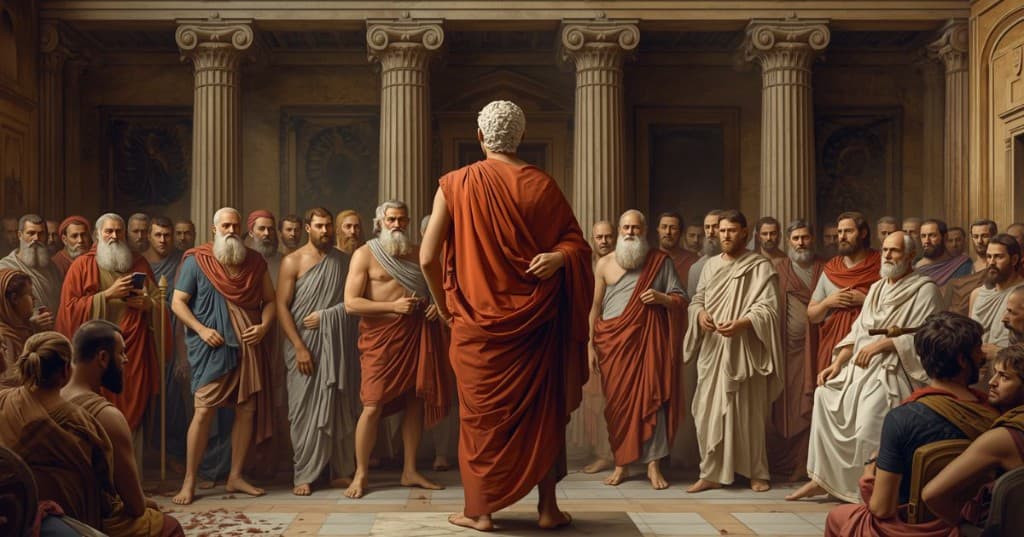
Portrait Before the Verdict
The Apology is not a transcript, and it still has a psyche. Jowett warns before Socrates speaks that Plato's speech is a portrait true to the man, not a line-by-line record. The implied person is a seventy-year-old defendant who must live inside a room that decided who he was before he opened his mouth. The charge is formal, but the real trial is reputation: childhood rumour, Aristophanes' Clouds, and the city's need for a corrupter who asks too many questions. Socrates refuses ornamented rhetoric, cross-examines a careless prosecutor, and will not buy life with a parade of weeping children. The psychological core is integrity under public shame: when safety asks you to perform a softer self, and when the only defence left is to stay the person you have already been.
The Story That Arrives Before You Speak
Jowett's introduction names the defence readers must carry into the courtroom. Plato was present, yet the Apology is composition, like a dialogue shaped for art and argument. That warning matters psychologically because trials are never only about facts. They are about which story the room already believes. Socrates enters with a story attached: curious person, corrupter of youth, enemy of the gods the state recognises. The formal indictment will repeat what gossip rehearsed for decades.
The reader who treats the speech as raw footage will miss the pressure Socrates is under. He is answering a portrait as much as a charge. His task is not only to explain his life but to keep one self intact while five hundred jurors watch for the performance they expect. The introduction trains you to hear both layers at once: Plato's shaping hand and a man who will not falsify his character to survive.
Plain Speech as a Refusal to Play
Socrates opens by admitting his accusers almost made him forget who he was, then adds they said hardly a word of truth. The charge that amazed him is the warning not to be deceived by his eloquence. That claim collapses when he speaks: he is no polished orator. If eloquence means the force of truth, he accepts the title on his own terms. He asks the jury to hear him as he speaks in the agora, not as a juvenile performer trained for court.
The request is psychological, not stylistic. At seventy, appearing for the first time in a law court, he asks to be excused like a foreigner using his native tongue. Never mind the manner, he says; think only whether the words are true. He is refusing a role. The role would be to meet theatre with theatre, to sound like a man who knows how rooms like this are won. His defence begins by naming the split between appearance and substance that will run through the whole trial.
Fighting Accusers You Cannot Cross-Examine
Before Meletus, there are the nameless old accusers: public opinion formed in childhood, reinforced by comedy, and stored as common knowledge. Socrates calls them more dangerous than the men in court because they shaped minds long before this hearing. You cannot question a rumour the way you question a witness. You can only show what living inside that rumour has cost.
The psychological bind is familiar in any institution. By the time a formal complaint arrives, the informal verdict may already be settled. Socrates does not pretend he can erase decades of caricature in one speech. He names the invisible jury inside the visible one. That honesty is part of his method: make the hidden structure visible, even when visibility cannot undo it.
The Oracle and the Humility That Makes Enemies
Chaerephon's question at Delphi returns throughout the middle of the defence. The god says no man is wiser than Socrates, and Socrates spends years trying to refute the answer by testing politicians, poets, and artisans. He finds men who know little yet think they know all things, while he knows he knows nothing worth naming. The oracle, he concludes, uses his name to teach that human wisdom is worth little.
The mission is obedience to a god and a method at once. Each conversation that exposes false expertise creates resentment. Wealthy young men imitate the examinations, and the exposed pretend to wisdom call him a misleader of youth. The psyche here is not smug superiority. It is a person who cannot stop testing claims because stopping would feel like deserting the only honest position he holds: admitted ignorance against inflated certainty. That posture is socially expensive. It converts curiosity into a public crime.
Meletus and the Comfort of a Contradiction
When Socrates turns to the sworn charge, Meletus becomes the face of the indictment. The exchange is quick, public, and designed to show carelessness. If everyone improves the youth except Socrates alone, the city would be uniquely blessed. The horse-trainer analogy reverses the claim: one person can harm horses, not everyone except one trainer. Meletus is caught between saying Socrates is a complete atheist and saying he introduces new divinities.
Psychologically, Meletus represents the prosecutor who has not thought through the story he repeats. Socrates treats the contradiction as a riddle Meletus composed without noticing. The jury sees not only argument but temperament: one man playful under pressure, another rigid and exposed. Cross-examination here is less about legal trickery than about revealing who has lived inside the charge and who has only borrowed it for the day.
Envy, the Gadfly, and the Post You Cannot Leave
After Meletus, Socrates names a deeper danger than the named prosecutors: envy and detraction of the world, which has destroyed many good men. He compares himself to a gadfly on a sluggish steed, sent by the god to stir Athens awake. He has refused public office when the divine sign hindered him, yet he held his post at Potidaea and resisted the Thirty when ordered to fetch Leon of Salamis.
The figure mixes mission with loneliness. A city may need the sting and still hate the insect. Socrates will not stop examining citizens about virtue because stopping would feel like deserting a post assigned by something he trusts more than the court. The anxiety is not only death. It is the fear that a life built on questions has no home in a culture that prefers comfort. He offers acquittal on condition he stop philosophising as a test the jury will fail, not as a bargain he could accept.
Refusing the Spectacle of Grief
Near the close of the defence, Socrates imagines a juror angry that other defendants wept, brought children, and staged moving spectacles while he will not. He has three sons and will not parade them to petition for acquittal. The reason is public dignity and justice itself. A judge swears to decide by law, not by pity bought with theatre. Asking the court to break its oath would teach that oaths mean nothing, which would prove the impiety charge in another form.
The refusal is a defence against a role: the broken father, the penitent elder, the man who performs remorse he does not feel. Socrates admits he is flesh and blood, not wood or stone. He still will not make the city ridiculous by acting as if death were unbearable and the jury could grant immortality. The psychology is pride aligned with principle, not vanity. He would rather lose the case as himself than win it as a character the room could pity.
Death Without a Map
Convicted, Socrates proposes maintenance in the Prytaneum, then a small fine, and refuses to treat death as a known evil. He will not weep or lament in the style jurors expect. The unexamined life is not worth living, he tells those who might have acquitted him, and he prophesies younger accusers who will press the city harder after he is gone. On death he offers two honest possibilities: a dreamless sleep or a journey where he might question heroes and test pretenders again.
The closing holds uncertainty without collapse. He forgives judges who harmed him without meaning good, and asks the city to trouble his sons as he troubled Athens if they care for riches over virtue. The psyche at the end is not fearless in the sense of certainty. It is a person who will not pretend to know what no one knows, and who will not trade that honesty for a few more years. The hour of departure arrives, and he leaves the comparison open: which is better, only God knows.
Why It Resonates Now
Readers still meet rooms where the story was written before they spoke. Human resources packets, disciplinary hearings, and public shaming campaigns reuse the Apology's structure: tone judged before evidence, performance rewarded over plain truth. Socrates' request to be heard in his own manner is the employee who asks to answer facts instead of managing impressions, and the whistleblower who refuses to perform remorse to keep a job.
The oracle chapters also match a culture of assumed expertise. A title, a follower count, or one success invites confidence in unrelated domains. Socrates' test is slow and rude: ask the confident person to explain what they claim to know. The gadfly image remains uneasy because institutions still want comfort more than examination, and still punish the person who will not stop asking. The trial ends in death, yet the psychological question survives: what do you owe the self you have been when mercy arrives only if you become someone else?
Limits of This Reading
This reading treats Plato's Socrates as a psychological portrait, not a historical transcript. We cannot verify single sentences against a record of 399 BC. Jowett's Victorian English carries its own moral tone, and other translations may sharpen or soften irony. Socrates' religious language belongs to his world, not to modern clinical categories. Calling the divine sign an inner warning is interpretation, not diagnosis.
Feminist and democratic readers will note that the ideal jury and the ideal citizen in the text are male Athenians, and that Socrates' method could wound as well as enlighten. Alcibiades and Critias haunt the margins. Plato's apology for the disciples is weaker than Jowett admits. A psychological reading illuminates integrity under accusation; it does not settle whether Socrates' life was just toward everyone he examined. Use the speech as a mirror for pressure, not as a licence to harass neighbours in the name of truth.
Across the Shelf
Enchiridion offers the inner citadel Epictetus tells students to guard when externals turn hostile. Socrates guards something outward-facing: the habit of examination he will not sell for acquittal. Both texts ask what remains yours when reputation, office, or life is threatened. Epictetus names the discipline of assent; Socrates names the discipline of speech. One trains the mind to withdraw from what it cannot control. The other walks into the forum and refuses to speak in a voice that is not his. Read together, they show two defences against the same fear: that pressure will turn you into a performer you would not respect.