
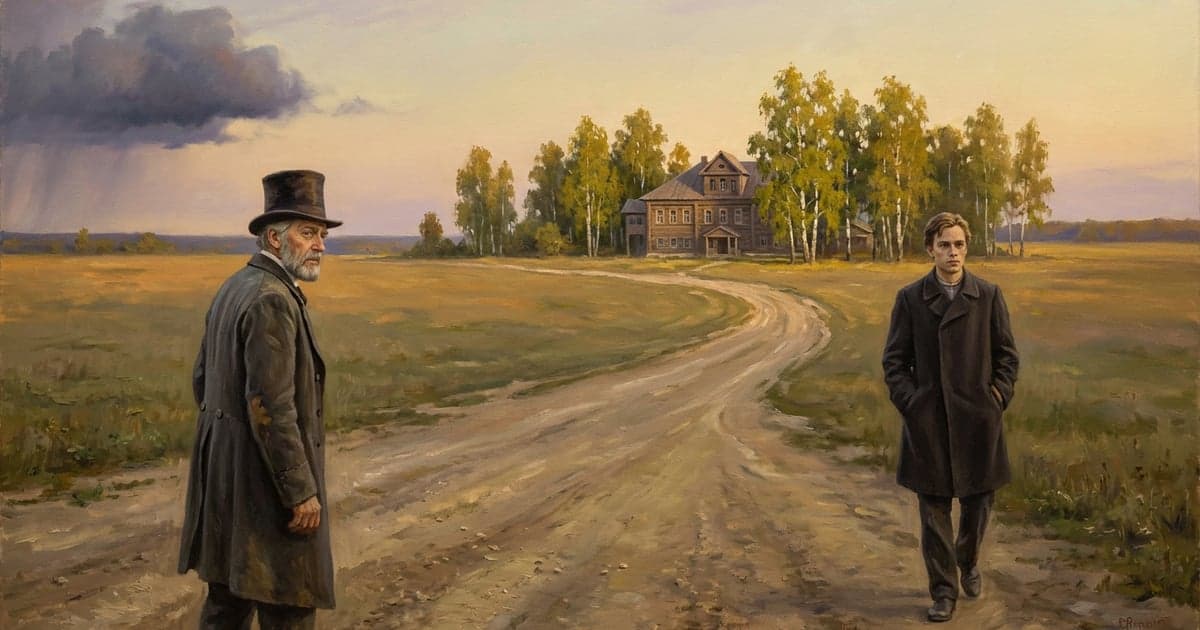
The gap in this novel is not a debate you could settle with better facts. It is a father trying to remain useful in a house his son has already redesigned, and a son trying to become himself without looking like a traitor. Ideas arrive as costumes for that work. Nihilism, art, Germans, principles: all of them are ways of saying I still belong here, or you no longer do.
Turgenev is exact about how the wound is delivered. Nobody needs to shout that Nikolai is wrong. It is enough to treat him as expired. A man on the shelf has no rebuttal. The same pattern runs the other way. Vasili's pride cannot find a form his son can accept, so it leaks into other people's ears. Love is not missing. A usable sentence is.
That is why the book still maps families that have never heard of 1862. Adult children come home quoting a new vocabulary. Parents rehearse a welcome and then hide the one fact that would make the welcome honest. Both sides call it respect. Both sides are stocking the carriage with things unsaid. The novel does not ask you to pick a winner. It asks whether you will stay in the room after you have been filed as finished, and whether you will speak before the garden is the only place left to grieve.
The Central Lesson
A generation gap is rarely a contest of ideas. It is a contest over who still gets to matter in a shared house. Turgenev shows parents rehearsing welcome, children performing transformation, and love failing in both directions because neither side will risk the sentence that would make the other visible. Dismissal feels like progress. Avoidance feels like care. Both stock the distance. The work is smaller and harder than picking a side: stay in the room after you have been treated as expired, and speak before the garden is the only listener left.
Applying This to Your Life
Name the Unsaid Ride
On your next visit home, or your next call with someone a generation away, write the one sentence you keep postponing. You do not have to deliver it that day. You do have to stop pretending the silence is kindness.
Watch for Filing, Not Fighting
Notice when you stop arguing with someone older or younger and simply treat them as irrelevant. That move feels clean. It is the Marino garden in miniature. Contradiction at least grants a person a hearing.
Translate Before You Perform
If your love keeps arriving as bragging, advice, or a borrowed doctrine, try one plain sentence in the other person's dialect. Vasili could not stop praising. Nikolai could not start confessing. The gap is often a translation problem wearing the mask of a values war.
Other lessons in this book
More life-skill deep dives from the same classic.
When Love Refuses Your Terms
Stay for the morning after the confession, when Anna will not leave her régime for a man who calls love a disease.
6 chapters·Explore AnalysisThe Armor We Build Against Feeling
See Pavel's cuffs, Anna's rails, and Bazarov's sneer as the same closed door.
6 chapters·Explore AnalysisOutgrowing Your Teacher
Sit under the ash tree with Arkady and Katya, and watch a borrowed voice finally go quiet.
6 chapters·Explore AnalysisDisagreeing Without Contempt
Follow the breakfast fight to the duel, and notice the one talk that is not a score.
6 chapters·Explore AnalysisWhen Your Certainties Aren't Enough
Name the night in Anna's boudoir when science has no instrument for what Bazarov wants.
7 chapters·Explore Analysis
Continue exploring
The same lessons in other books
See how other books teach the same life skills.

Hamlet
Distinguishing Truth from DeceptionTest a ghost, a play within a play, and a story that only Horatio will carry out.Hamlet
Paralysis in Decision-MakingWatch the ghost's charge, the play that proves the king, and the prayer Hamlet will not interrupt.
King Lear
Recognizing Flattery vs LoyaltyWatch the love test, Kent's exile, and the Fool's crab line show a speech that buys land and a silence that tells the truth.
Where the lesson lives in the book
The Person Who Did Not Come Home
Arkady is still dusty from the road when he asks his father for a rub down. The joy is real. So is the second passenger. He introduces Bazarov as proof that the boy who left is not the one who returned. Nikolai hears love and distance in the same greeting, and already does not know which to answer.
Key Insight:
A generation gap often arrives as a performance, not a speech. The child is showing a new self to the people who knew the old one. The parent is trying to welcome a person who no longer fits the rehearsal. Neither is lying. Both are already late.
“Yes, but first give me a rub down, dearest Papa.”
The Carriage of Things Unsaid
On the ride to Marino, Nikolai chatters about the estate. Arkady answers with half a mind. There is a young woman in the house, and a child, and a truth the father cannot find a sentence for. The miles pass. What they do not say becomes the furniture of the journey.
Key Insight:
Most family estrangement is not an argument. It is a pile of postponed sentences. Parents hide facts they think will cost them respect. Children hide judgments they think will cost them love. The protection widens the distance it was meant to close.
“I could not express to you how much I value his friendship.”
The Uncle Who Has Become a Position
Pavel comes onto the verandah in English clothes and a bow that is already a verdict. He does not need to hear Bazarov speak. The young man's manner is enough. Elegance here is not taste. It is a wall that has been under construction for years, and a guest has just walked into it.
Key Insight:
When a generation stops arguing from values and starts arguing from identity, every new person feels like an invasion. Pavel is not only defending Russia. He is defending the one shape he has left. That is why the first look is already a refusal.
“So here we are at home again!”
Breakfast as a Proxy War
Germans, science, art, faith: the topics change and the fight does not. Bazarov and Pavel are brilliant and certain. Nikolai wants peace. Arkady sides with his friend and already feels the heat of a contempt he did not invent. Nobody is talking about tea.
Key Insight:
When a table explodes this fast, the stated subject is a cover. Each man is protecting a claim about who still gets to matter. Ask what would be lost if the other were right, and you will find the real argument under the vocabulary.
“You think highly of the Germans?”
Expired, Not Wrong
Bazarov calls Nikolai a man whose song has been sung. Arkady lets it stand. Nikolai overhears, does not confront anyone, and goes into the garden to grieve alone. The new generation has not defeated him. It has filed him.
Key Insight:
Dismissal is crueller than contradiction. A person can answer being called wrong. Being called finished leaves no reply. If you have ever been treated as outdated rather than mistaken, you have sat in that garden. If you have ever skipped the argument and simply moved on, you have been Bazarov.
“You say that you deny everything. Rather, that you would consign everything to destruction.”
Love in a Language the Son Cannot Spend
Vasili digs in the vegetable garden at dawn and cannot stop praising his son. He tells other people how remarkable Evgeny is, hoping the message will travel back. Bazarov is tender, impatient, and trapped. The adoration is total. So is the mismatch.
Key Insight:
Parents who cannot reach a child often outsource the love to third parties: neighbours, stories, small services. The child cannot receive it in that form. This is not a failure of affection. It is two emotional dialects that never shared a school.
“When, in the morning, Arkady rose and opened the window, the first object to greet his eyes was Vasili Ivanitch.”
What Outlasts the Fight
Six months later it is a white winter. Arkady has married. Nikolai has married. Pavel has left. The Bazarovs keep visiting a grave. The ideas that filled the summer have not survived as a victory for either side. The ordinary continuities have: land, work, a table laid at three, and a love with no theory in it.
Key Insight:
Turgenev's last word on the gap is not a truce. Most of what people fight about does not last. What lasts is the human texture both sides were using as a battlefield. The old couple at the cemetery are not a verdict on 1862. They are what remains when the song is actually finished.
“At three o'clock precisely the company gathers around the board.”