
The Sentence That Stays Inside
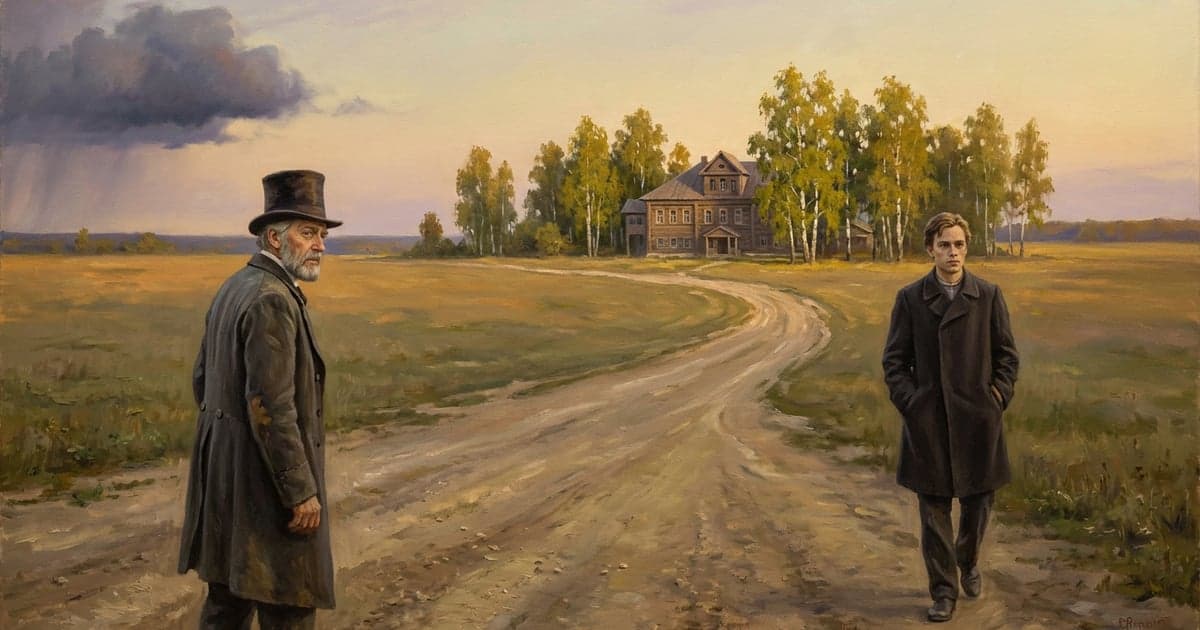
Fathers and Sons is not a story about a generation winning an argument. Ivan Turgenev published the novel in 1862 and let Arkady say the word Nihilist at breakfast, while Paul Petrovitch stopped a knife that still had butter on it. The psychological core is what that word is asked to do. It gives a brilliant man a way to keep need outside the house. Bazarov can dissect a frog, refuse a principle, and still be unable to take a hand offered in pity, because pity would mean he had been given something. Around him, the people who love him learn a matching habit. Nikolai rehearses a welcome the son has already outgrown. Arina will not ask how long the visit will last, in case the answer is two days. At the wedding the friend's name stays a whisper. The book follows the sentences that are not sent, and the care that cannot be received.
The Word Is a Door He Can Close
Arkady defines a Nihilist as a man who declines to bow to authority, or to accept any principle on trust, however sanctified it may be. Paul pauses with the buttered knife. Nikolai, who wants to be modern and is afraid of being left behind, derives the word from the Latin for nothing. The argument can now be about a system. A system is safer than a question about who in the room is lonely. Bazarov has not even arrived. When he does, he comes from the marsh with mud and a bag of frogs. The theory preceded the body. That order matters. The household is given a doctrine to answer, so it does not have to answer the man.
The defence is intellectualization, and it is not a coat he puts on for uncles. It is a way of staying unowed. If no principle deserves trust, then no person's claim has to be trusted either: not a father's music, not a mother's fussing, not a woman's timetable. Feeling can be filed as a specimen. A specimen does not look back and ask to be kept. Arkady borrows the word because it makes him look finished. He is not the inventor of the defence. He is the first person in the house willing to say it aloud, which is why Paul answers the nephew and waits for the friend.
He Assigns Her a Type Before She Speaks
At the hotel he is already assigning Anna Sergievna a category: a woman who married money. Classification is how he enters a room without having to be altered by it. Then he is in the room, and the assignment will not hold. He becomes ill at ease. Scorn arrives afterwards, as a cover, once he has already been moved. The sequence is the book's account of him. The feeling comes first. The theory is the sentence he sends in its place. A man who prides himself on seeing through costumes is, in that staircase, using a costume of his own.
At Nikolskoe the days pass on rails. He calls the life that, and still cannot leave. Katia is sent to the piano so Anna and Bazarov can sit at cards, and Arkady feels got rid of. Later Bazarov will rank Anna as yesterday's loaf and the younger sister as fresh. The contempt sorts what has already stirred him. When he tells Anna that he loves her with a blind, insensate passion, he is asking her to leave the rails. She says he has mistaken her. Only in her mind does she add that she has failed to understand herself. The refusal is not empty. It is a person protecting a life that already has a shape. His love arrives as a demand that she convert. A demand is still a verdict on her composure. She can be moved and still decline to be rebuilt.
The Parents Will Not Ask How Long
The other wound in the book is older, and it belongs to people who have no theory at all. Arina Vlasievna has learned that a clever son is a son you must not clutch. She will not ask how long he means to stay. If she asks, he might say two days. The question is swallowed so the visit can continue. Vasili Ivanitch gives him the study, keeps out of sight, and later sends the horses without mentioning the flowers fetched for the room. Love, in these chapters, practises disappearance. It tries to be small enough to be tolerated. The narrator can call such women extinct and still leave the reader in the room with her, which is a harsher kindness than the son's joke.
Nikolai Petrovitch has been rehearsing since the first page. He waits at the posting-house, lets a sentence about a graduate son circle until it becomes his dead wife, and then spends the novel trying to remain inside a conversation that has already called his song finished. He is not a fool in the argument. He is a man who wants to be loved in a language his son has decided is embarrassing. Attachment here is not a secure base a theory could praise. It is a parent making himself quieter in the hope that quiet will still be allowed to stay. When Bazarov leaves the parents, the embrace is unlike courtship. The father holds on. The son has already gone, even while the body is still in the yard. Three days, after three years. The theory has no instrument for those numbers, so it calls the feeling a weakness and travels on.
Paul Closes the Cuff and Calls It an Insult
Paul Petrovitch is often taken for the father's generation in a better coat. The coat is the psychology. He buttons his cuffs, keeps an English manner, and treats composure as a moral position. When Bazarov kisses Thenichka, Paul cannot say the plain sentence at the table. He has not the honour to understand. At breakfast the darkness is called biliousness. The duel is what a man stages when the sentence he will not say has already happened among the lilacs. He fires. The bone is intact. He wanted practical satisfaction for an insult he had filed as theory. Then he asks his brother to marry her, and decides that he himself must leave, for Dresden or Florence, and remain until he dies. He looks like a corpse. The elegance was a defence against needing a place. Once the place has been rearranged without him, the defence has nowhere to sit.
He is not only a rival. He is the book's other closed door. Bazarov sneers. Paul polishes. Both refuse to be seen wanting in a language someone else could answer. Paul's later life, not reading Russian and crossing himself in a Russian church abroad, continues the same refusal at a distance. At the wedding his English farewell goes unnoticed. Speech, for him, has already failed. What remains is a manner.
He Can Kiss, and He Cannot Be Given To
The defence breaks in a garden and is rebuilt before breakfast. He asks Thenichka for a red rose, not too large, and then he kisses her. He knows it was wrong. The kiss is not a theory. It is a body doing what the word Nihilist was meant to supervise. Paul can name the event. Bazarov cannot stay for the name. By morning it has been translated back into bile. Shame, here, is not the kiss. Shame is being seen as someone who wanted an ordinary tenderness and had no system for it.
With Anna the break is sharper, because she offers him the thing the book has been refusing. A pitying hand. He steps back. Though poor, he has never accepted alms. The sentence is proud, and it is also a terror. If he takes the hand, the passion becomes a need, and a need can be pitied. Pity, in his ear, is the opposite of equality. He would rather part for ever than be the man who was helped. He points Arkady at two jackdaws, and by nightfall the friend has forgotten him. They have already called love a mere empirical sentiment, and neither of them knows whether that is the whole truth. The phrase is the defence returning in academic dress. A feeling that can be named as empirical does not have to be kept. The romantic sentence stays unsaid. This substitution is the plot: a rose where a confession might have been, a specimen where a person is standing, a compliment where a letter would have asked for an answer.
Dying, He Sends a Compliment
He cuts his finger uncovering a typhus body the village had tried to hide. He tells his father that four hours have already made every remedy too late. The fantasy of mastery meets a fact it cannot classify. There is no letter to Anna. The messenger may say that Evgenii Vasilitch sends his compliments, and is dying. A compliment is what you send when a true sentence would obligate the other person to answer. He will not ask her to come as a lover. He will not ask her to come as herself. He asks to be reported. Even the dying message is arranged so that it cannot be refused, because it was never quite a request.
She comes. What she feels is terror, not love, and she thinks that if she had loved him she would not feel that chill. She keeps her glove on and kisses his forehead anyway. One eyelid lifts at the holy oil, as if the ceremony were one more sanctified principle. Vasili cries that he protests. The protest is the father's last theory: a refusal to let the fact be the fact. Bazarov has spent the novel protesting against trust. His father spends the deathbed protesting against loss. Neither protest changes the body. This is where the psychological stakes shift, and the shift is not a moral victory for feeling. It is the moment the defence runs out of objects. There is nothing left to dissect that is not himself.
The Wedding Keeps His Name in a Whisper
The ending does not resolve the tension. It hushes it so the houses can go on. There are two quiet weddings. Arkady marries Katia. Nikolai marries Thenichka. At the feast Katia whispers Bazarov's name, and Arkady will not say it aloud. The toast is the book's last unsent sentence. A man who borrowed a voice has learned not to perform it, and the lesson costs the friend his place in the room. Anna marries a cold statesman, not for love and not from duty. Composure finds a house that will not demand she become someone else. That is a solution for her. It is not a reconciliation with the man who asked her to convert.
Sitnikov says he is carrying on the work of the late Bazarov. The grave does not agree. Two old people kneel at a place the sheep do not trample. The narrator can speak of flowers and of a life that has no end. The parents are still there in the afternoon, with a sprig of fir. What the form withholds is the verdict the title seemed to promise. Youth is not crowned. The estate is not crowned. A passionate, wild, erring heart is not redeemed into a doctrine anyone can inherit. The novel ends by letting ordinary life continue beside a name the wedding could not bear to say. The suppression is not a lie about the feeling. It is a decision that the feeling will not be allowed to govern the table. Speech fails, and the book calls that failure a peace.
Why It Resonates Now
Readers still arrive with the title already explained. Sons against fathers. A young nihilist who wins the talk and is then punished by a cut. That summary does the same work as Arkady's definition. It lets a person discuss a position and never sit with the harder scene, which is a man stepping back from a hand because being helped would shame him. Contemporary life is full of that fluency. A family can be described with accuracy, in the language of politics or taste or self-knowledge, and the description can stand in for the sentence that would cost something: how long are you staying, I am afraid of you, I want you, I will not take this as alms. The argument is easier than the admission. Turgenev's breakfast is still a recognisable room. Someone names a position. Someone else stops a small gesture. The person the word was meant to describe is not yet in the chair.
The deathbed compliment is equally current wherever people send a report of themselves instead of a request. A report only needs to be received. A request can be refused, and refusal would prove the need. A wedding that will not say the difficult name is not a piece of period manners. It is how a household stays pleasant after someone in it has been too much. The anxiety the novel keeps touching is not the anxiety of falling behind a generation. It is the anxiety of being altered by another person, or of being seen to need one. A culture that treats needing help as a loss of rank will keep producing the man who can classify everyone at the table and still cannot take the hand.
Limits of This Reading
The risk is that a psychological reading turns a political novel into a private case. In 1862 the word nihilist was a public fight. Turgenev was attacked for the portrait, and the book is also about estates, emancipation, and young men who believed that refusing an inherited principle was a social programme. Bazarov's frogs are not only a defence against his mother. They are a claim about what kind of knowledge should govern a country. To read the buttered knife only as a family symptom is to miss the argument Paul thinks he is having, and the argument a great many readers in that decade thought the novel was obliged to settle.
Intellectualization and the shame of dependence are later instruments. They fit the scenes in which care is swallowed and theory arrives after feeling. They do not fit every scene, and they can make a historical person look like a patient. Arkady's quieting beside Katia can be read as growth, as retreat, or as the ordinary victory of a manageable life over a borrowed extremity. Anna's terror at the deathbed may be a failure of love, or a precise report of what she feels when a person becomes a body. This reading follows an English text that says Paul Petrovitch and Thenichka. Another translation names them differently, and a Russian reader meets a political lexicon these pages can only approach. The grave will also support a religious consolation the psychology does not cancel. Two old people kneel. The narrator speaks of peace. A reading that hears only suppression has to admit that Turgenev also wrote the flowers.