
The Jungle
Upton Sinclair
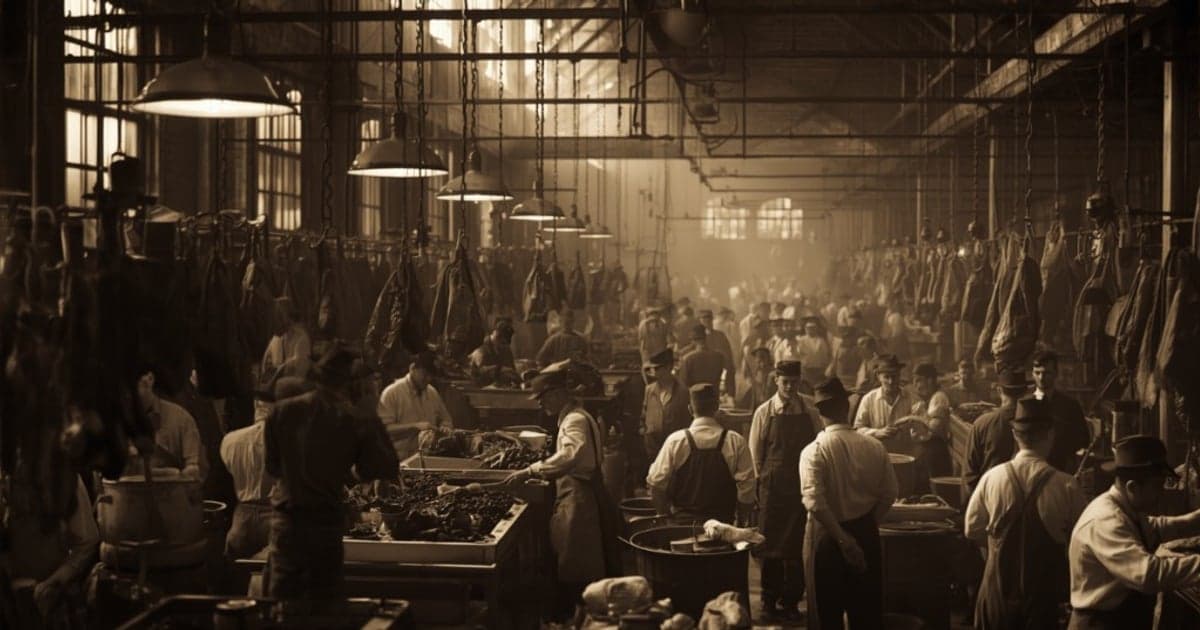
Jurgis Rudkus dances at his own wedding in a hall above a saloon in Packingtown, and when the guests cannot pay their share of the veselija he tells Ona he will work harder. Sinclair published the novel in 1906. The strongest man on the killing floor will still be priced like the cattle, and America will pass a food law before it saves his family.
Jurgis is the Lithuanian who arrives with a back the bosses want and a faith that wages can buy a home. Ona Lukoszaite is the girl he married, slight enough that the winter and the night shift both take her. Teta Elzbieta keeps the household standing after the men fail. Marija Berczynskas is the cousin with a laugh and a job in the canning rooms who will end in a brothel with a needle in her arm. Dede Antanas is the old man who dies coughing fertilizer dust for a job he was too proud to refuse. Stanislovas is the child sent to work before he can keep warm. Phil Connor is the boss who prices Ona's job as a body. Jack Duane is the thief in the cell who teaches Jurgis that the law is a business. Jonas vanishes. Little Antanas drowns in a puddle the city will not pave. Ostrinski finally names the machine. The packers never need to appear as one man. The only opponent who never leaves the page is the claim that harder work can outrun a system built to harvest it.
Chapter 1 opens on the wedding that mortgages the future before the first paycheck. Chapters 3 and 4 put Jurgis on the killing beds, proud of a job that will use him up. Chapter 6 is the house: a down payment, hidden interest, and a contract they cannot read. Chapter 7 sends even Stanislovas out into the cold. Chapter 12 is the sprain that will not heal and the walk back to the line. Chapter 13 is the fertilizer mill. Chapter 15 is Ona's confession and the beating that sends Jurgis to jail. Chapter 19 is Madame Haupt wiping grease from her hands while Ona dies upstairs. Chapter 22 is the child who falls off a sidewalk into water the city left for him. Chapter 25 is the city as a second packing house: votes, inspectors, and a hundred-dollar bill Jurgis cannot change without being robbed. Chapter 27 finds Marija sold. Chapter 28 is the hall where a socialist speech finally gives Jurgis a sentence that can hold what happened. Chapter 31 is an election night that does not bring anyone back.
Sinclair spent seven weeks in the yards and never treats Packingtown as local color, or Jurgis as a mascot for grit, or the sausage as the real subject. He wrote to convert the country to the workers. The country converted its dinner. He refuses the cheap ending. Jurgis does not get the house. Ona does not survive the doctor who had no time to eat. The last chapter is a meeting, not a rescue. What remains is not a sermon that capitalism is rude. It is a picture of how a wage can look like a ladder while every rung is greased, and how a man who believed in effort learns that the effort was the product.
The unpaid veselija is the first pressure. Immigrant Perspective is that wedding, the English they cannot read on the house contract, and a promise that never covered the ledger. Seeing Systemic Exploitation is the killing beds, the hidden interest, and a trap that looks like bad luck until the same owners wrote the job, the lease, and the inspection. Holding a Family Together Under Scarcity is Elzbieta sending Stanislovas into the cold, Ona on the night shift, and Connor pricing that love as leverage. Surviving After the System Breaks You is the sprain that will not heal, the fertilizer mill, jail after Ona's confession, and the road that will not let a broken man walk back. Reading Graft as Everyday Government is Duane's cell and chapter 25: votes, inspectors, and a hundred-dollar bill Jurgis cannot change without being robbed. Understanding Reform Movements is the hall where a socialist speech finally gives him a sentence, and the election night that does not bring anyone back.
Madame Haupt wipes grease from her hands while Ona dies upstairs. Little Antanas falls off a sidewalk into water the city left for him. Wide Reads maps summaries, quotes, and audio across all thirty-one chapters, from a wedding that cannot pay for itself to an election night that does not bring Ona back.
Face the Essential Truths through The Jungle
Theme-by-theme chapter breakdowns of the essential life skills in this classic novel.
Explore all theme breakdowns
Face the Essential Truths through The Jungle
Theme-by-theme chapter breakdowns of the essential life skills in this classic novel.
Explore all theme breakdownsSeeing Systemic Exploitation
Jurgis keeps choosing to work harder, and the yards keep pricing that choice as inventory. Eight chapters from the veselija through the house contract, the fertilizer mill, and the blacklist show a trap that looks like bad luck until you notice the same owners wrote the job, the lease, and the inspection.
Holding a Family Together Under Scarcity
Elzbieta keeps a household standing after the men fail, and Connor prices that love as leverage. Six chapters from winter sending Stanislovas out through Ona's confession, Madame Haupt's kitchen, and Marija's fall show what a family spends when the wage cannot cover the week.
Surviving After the System Breaks You
6 chapters from the sprain and the fertilizer mill through jail, the road, and a man who can no longer command a job when he wants one.
Reading Graft as Everyday Government
6 chapters from the union as a little republic through Duane's cell to votes, inspectors, and a city that prices justice like meat.
Understanding Reform Movements
8 chapters from the union hall through the socialist meeting to an election night that changes the law faster than it changes the worker.
Immigrant Perspective
8 chapters from the veselija and unread English through a drowned child to a promise that never covered the ledger.
Table of Contents
The Wedding That Cost Everything
Ona and Jurgis celebrate their wedding in the back room of a Chicago saloon, surrounded by their Lit...
The Immigrant's Dream Meets Reality
Jurgis talks lightly about work because he is young and a giant besides. Older workers tell him horr...
First Day at the Machine
Jurgis secures work at Brown's through a pantomime the boss understands before he does: shovel guts,...
First Day at the Killing Beds
Jurgis reports at seven and waits nearly two hours at the wrong side of the door because no one told...
The First Taste of Home
Settlement begins with predatory commerce. Feather-your-nest advertisements furnish four rooms for s...
The Hidden Interest Trap
Jurgis and Ona are deep in love, measuring every decision by whether it brings their marriage closer...
The Wedding Debt and Winter's Cruelty
All summer the family toils until Jurgis and Ona can marry with decency, then November's feast leave...
Love and Labor Organize
Marija finds love with Tamoszius, the gentle violinist whose music transforms their cramped kitchen ...
Democracy and Corruption Unveiled
Jurgis begins learning English because the union is the first place he has seen democracy work: ever...
The Crushing Weight of Hidden Costs
Spring mud, summer heat, and swarms of flies announce that surviving winter was only the first lie. ...
When the System Breaks You Down
Summer returns and Jurgis earns again, but less than before because the packers hire surplus hands t...
When the System Breaks You
Jurgis's ankle injury becomes a nightmare that won't end. What should have been a simple sprain turn...
The Fertilizer Mill and Hidden Costs
Little Kristoforas dies, Elzbieta's disabled three-year-old, possibly poisoned by contaminated sausa...
The Meat Machine's Human Cost
Sinclair exposes the grotesque practices behind America's meat industry: spoiled meat masked with ch...
The Truth Revealed
Winter demands sixteen-hour shifts simply to keep the house. Overtime is not opportunity; it is the ...
Common Questions About The Jungle
Trending search questions mapped to the essential truths in this book—what readers actually ask Google about reading graft as everyday government, understanding reform movements, seeing systemic exploitation, holding a family together under scarcity, and immigrant perspective.
What is The Jungle about?
Jurgis Rudkus dances at his own wedding in a hall above a saloon in Packingtown, and when the guests cannot pay their share of the veselija he tells Ona he will work harder. Sinclair published the novel in 1906. The strongest man on the killing floor will still be priced like the cattle, and America will pass a food law before it saves his family.
How does The Jungle teach reading graft as everyday government?
Stay with Duane's cell and chapter 25: votes, inspectors, and a city that prices justice.
Explore Reading Graft as Everyday GovernmentWhat does The Jungle show about understanding reform movements?
Hear the union hall, the socialist meeting, and the night the country reached for the plate.
Explore Understanding Reform MovementsWhy is seeing systemic exploitation important in The Jungle?
Sit with the house contract and the killing floor: the trap is design, not bad luck.
Explore Seeing Systemic ExploitationHow does The Jungle teach holding a family together under scarcity?
Watch Ona, Elzbieta, and the children keep a household when the wage cannot cover the winter.
Explore Holding a Family Together Under ScarcityWhat life lessons does The Jungle teach?
6 essential truths run through this book: reading graft as everyday government; understanding reform movements; seeing systemic exploitation; holding a family together under scarcity; immigrant perspective; and surviving after the system breaks you. Those skills—not plot summary alone—are why The Jungle still answers modern searches.
About Upton Sinclair
Published 1906
Upton Beall Sinclair Jr. (1878-1968) was born in Baltimore to a family that knew both the pawnshop and the rich relatives across town. He put himself through City College and Columbia by writing jokes and dime novels, then turned that speed into muckraking fiction. He was twenty-eight when The Jungle appeared.
He spent seven weeks in Chicago's packinghouses, sleeping in the district and interviewing workers in Lithuanian, Polish, and English. He aimed the book at the public's heart. He said later that he hit it in the stomach. Roosevelt sent investigators. Congress passed the Pure Food and Drug Act and the Meat Inspection Act the same year. The labor program he wanted did not ride in on that wave.
He wrote nearly a hundred books, ran for governor of California in 1934, and never stopped treating fiction as a tool. The gift in this one is refusing to let grit be the moral. He lets the strongest man in the yards break, lets the wedding become a debt, and still leaves a meeting at the end instead of a rescue. The book still finds readers who recognize the night a contract, a shift, or a promise quietly changed owners.
Why This Author Matters Today
Reading Upton Sinclair is an act of self-discovery — one that tends to be more unsettling, and more rewarding, than you expect. Their work doesn't offer easy answers. It offers something rarer: the right questions. Questions about what we owe each other, what we owe ourselves, and what kind of person we are quietly becoming through the choices we make every day.
What makes Upton Sinclair indispensable isn't just their insight into human nature — it's their honesty about its contradictions. They understood that people are capable of extraordinary courage and ordinary cowardice, often in the same breath. That we can hold convictions firmly and abandon them the moment they cost us something. That the gap between who we think we are and who we actually are is where most of life's real drama lives.
In an age of noise, distraction, and the constant pressure to perform certainty we don't feel,Upton Sinclair is a corrective. Their pages slow you down and ask you to look more carefully — at the world, yes, but especially at yourself. Few writers have done more to show us that thinking well is not an academic exercise but a survival skill, and that the examined life is not a luxury but the only honest way to live.
Wide Reads is different.
not a sparknotes, nor a cliffnotes
Two ways in
Read & listen to the summary
Walk with the characters. Hear the story told completely — chapter by chapter, with audio. Feel what they feel. The meaning arrives because you experienced it, not because someone listed bullet points. Every chapter has a summary that speaks.
Start with this.
Read the original text
The manuscript. The actual words the author wrote. Every book on Wide Reads includes the original text alongside the summary — so you can read Austen as Austen wrote her, Dostoevsky as he wrote his. Use the summary as a guide, then step into the source.
Then step into the source.
Either way, the door opens inward.
As you enter the realm — each chapter goes deeper
— and most of all, Why does this matter?
Get the Full Book
Purchase the complete book to access all chapters and support classic literature

Available in paperback, hardcover, and e-book formats
You Might Also Like

Free to read • No account required