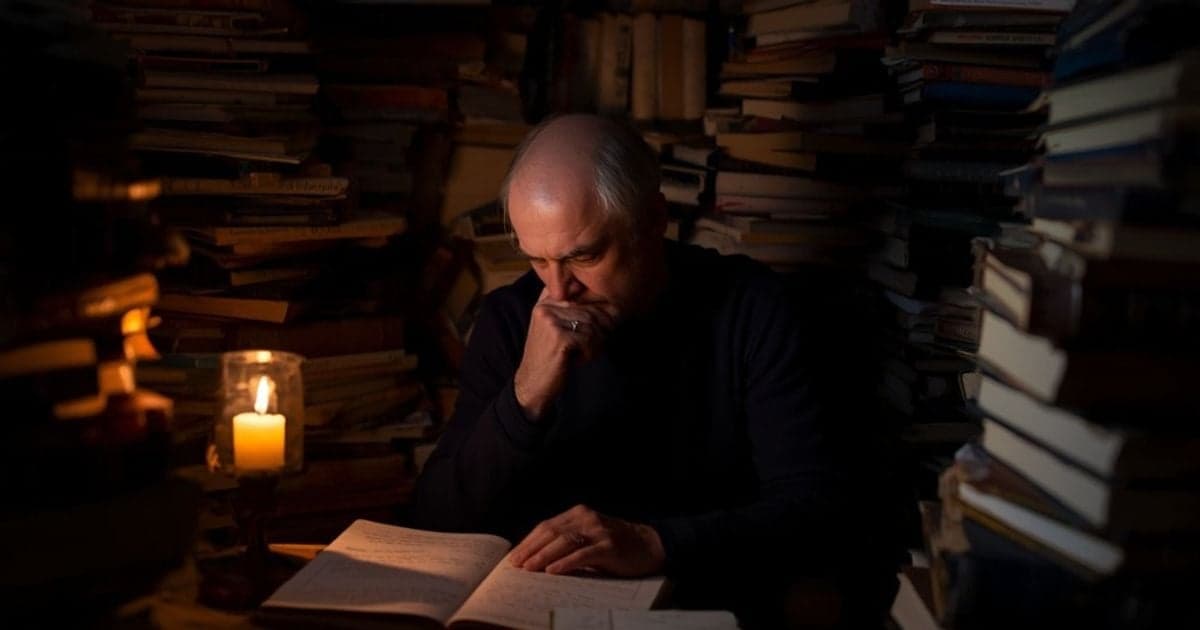
He had been certain the day before that he should be the first to arrive. He was right about that, but for the wrong reason. The dinner had been changed from five to six o'clock and no one had thought to tell him. He sits alone for an hour in a room with an unlaid table, two gloomy strangers eating in silence, shrieks of French laughter coming from somewhere further away. The waiter doesn't bring candles until six. He is so miserable, so wretched, that when they finally arrive all together he is overjoyed to see them, as though they were his deliverers, and even forgets it is incumbent upon him to show resentment.
Zverkov walks in first. The Underground Man had prepared all day for thin, shrill laughs and insipid jokes. Instead he gets something worse: circumspect courtesy. Zverkov draws himself up, walks over with a slight jaunty bend from the waist, shakes his hand with the careful politeness of a General receiving a minor petitioner. As though in giving him his hand he were warding off something. His opening line: "I was surprised to hear of your desire to join us. You fight shy of us. You shouldn't. We are not such terrible people as you think. Well, anyway, I am glad to renew our acquaintance." Then turns carelessly to put down his hat on the window. The Underground Man is gasping. Not mockery, something worse: Zverkov genuinely seems to believe he is superior and is doing him a favour by acknowledging him.
Trudolyubov asks Simonov whether he informed the Underground Man about the changed hour. "No, I didn't. I forgot." No apology. Zverkov: "So you've been here a whole hour? Oh, poor fellow!", ironic, as though this is extremely funny. Ferfitchkin's nasty little snigger like a puppy yapping. The Underground Man snaps at Ferfitchkin. Simonov comes in, announces the champagne is capitally frozen, and mentions he didn't know where to find the Underground Man, clearly has something against him from the previous day.
They sit down. Zverkov, trying to be friendly and cheer him up, begins cross-examining him: government office? good berth? what made him leave his original job? what is his salary? Each answer is worse. "It is not very handsome," Zverkov observes majestically. "You can't afford to dine at cafés on that," adds Ferfitchkin insolently. "Very poor," agrees Trudolyubov. Zverkov: "And how thin you have grown! How you have changed!", with a shade of venom, scanning him and his attire with insolent compassion.
The Underground Man's inner retreat: "These are not the people for me! What a fool I have made of myself! They imagine they are doing me an honour. I must get up at once, take my hat and simply go without a word. Damn my trousers, Zverkov noticed the yellow stain on the knee as soon as he came in. Damn the seven roubles!" Of course he remained. He drank sherry and Lafitte by the glassful. He was quickly affected. His annoyance increased as the wine went to his head.
While he watches from the side, they have forgotten him entirely. Zverkov holds the floor, a story about an exuberant lady he led on to declaring her love, with the help of an intimate friend, Prince Kolya, who had three thousand serfs. The Underground Man cuts in suddenly: "And yet this Kolya, who has three thousand serfs, has not put in an appearance tonight to see you off." A minute of silence. Trudolyubov: "You are drunk already." Zverkov examines him as though he were an insect. Simonov hastily fills the glasses.
The toast. When they all raise their glasses to Zverkov, the Underground Man sits with his untouched. Trudolyubov loses patience: why isn't he drinking? He announces he wants to make a speech separately, on his own account, and then drink. "Spiteful brute!" mutters Simonov. "Silence! Now for a display of wit!" shouts Ferfitchkin. Zverkov waits very gravely, knowing what is coming.
The speech: he hates phrases, phrasemongers and men in corsets, that's the first point. Second: he hates ribaldry and ribald talkers. Third: he loves justice, truth and honesty. He loves thought, Monsieur Zverkov; he loves true comradeship on an equal footing. "But, however, why not? I will drink your health too, Mr. Zverkov. Seduce the Circassian girls, shoot the enemies of the fatherland and ... to your health, Monsieur Zverkov!"
Zverkov stands up, bows, says: "I am very much obliged to you." He is frightfully offended and pale. Trudolyubov's fist on the table. Ferfitchkin wants a punch in his face. Simonov wants him turned out. Zverkov solemnly checks the indignation: he can show for himself how much value he attaches to these words. The Underground Man challenges Ferfitchkin to a duel. Everyone, including Ferfitchkin, is prostrate with laughter.
From eight o'clock until eleven: three hours. He paces from the table to the stove and back again, on the far side of the room, while they move to the sofa and gather around Zverkov with reverence. They talk of the Caucasus, true passion, snug berths, a hussar's enormous income, a Princess none of them has ever seen; then Shakespeare's being immortal. He paces. He thumps with his heels. They pay no attention. He is three times soaked with sweat and dry again. Once, only once, when Zverkov is talking about Shakespeare, the Underground Man gives a contemptuous laugh in such an affected, disgusting way that they all break off and watch him in silence for two minutes. Then cease to notice him again.
At intervals, an acute pang: in ten years, twenty years, forty years, he will remember these filthiest, most ludicrous, most awful moments of his life with loathing and humiliation. No one could have gone out of his way to degrade himself more shamelessly. He knows this fully. And yet he keeps pacing.
At eleven, Zverkov calls them to leave, "there!" The Underground Man is harassed, exhausted, in a fever, hair soaked with perspiration. He turns to Zverkov: "I beg your pardon. Ferfitchkin, yours too, and everyone's: I have insulted you all." Ferfitchkin: "A duel is not in your line, old man." He insists he's not afraid of a duel, he'll fight tomorrow after they are reconciled, he'll fire into the air. Simonov: "He is comforting himself." Trudolyubov: "He's simply raving." He asks for Zverkov's friendship. Zverkov: "Insulted? You insulted me? Understand, sir, that you never, under any circumstances, could possibly insult me."
He stands as though spat upon. They file out noisily. Simonov remains to tip the waiters. The Underground Man goes up to him: "Simonov! Give me six roubles!" Simonov stares in amazement. Is he coming with them? Yes. "I've no money", a scornful laugh, moving to go. He clutches Simonov's overcoat. "I saw you had money. If you knew, if you knew why I am asking! My whole future, my whole plans depend upon it!" Simonov pulls it out and almost flings it: "Take it, if you have no sense of shame!" And runs to catch up with the others.
He is left alone. Disorder, remains of dinner, a broken wine-glass on the floor, spilt wine, cigarette ends, fumes of drink and delirium in his brain, an agonising misery in his heart, and the waiter, who has seen and heard all and is looking inquisitively at his face. "I am going there! Either they shall all go down on their knees to beg for my friendship, or I will give Zverkov a slap in the face!"