Chapter 16
The Sledge Ride to Reckoning
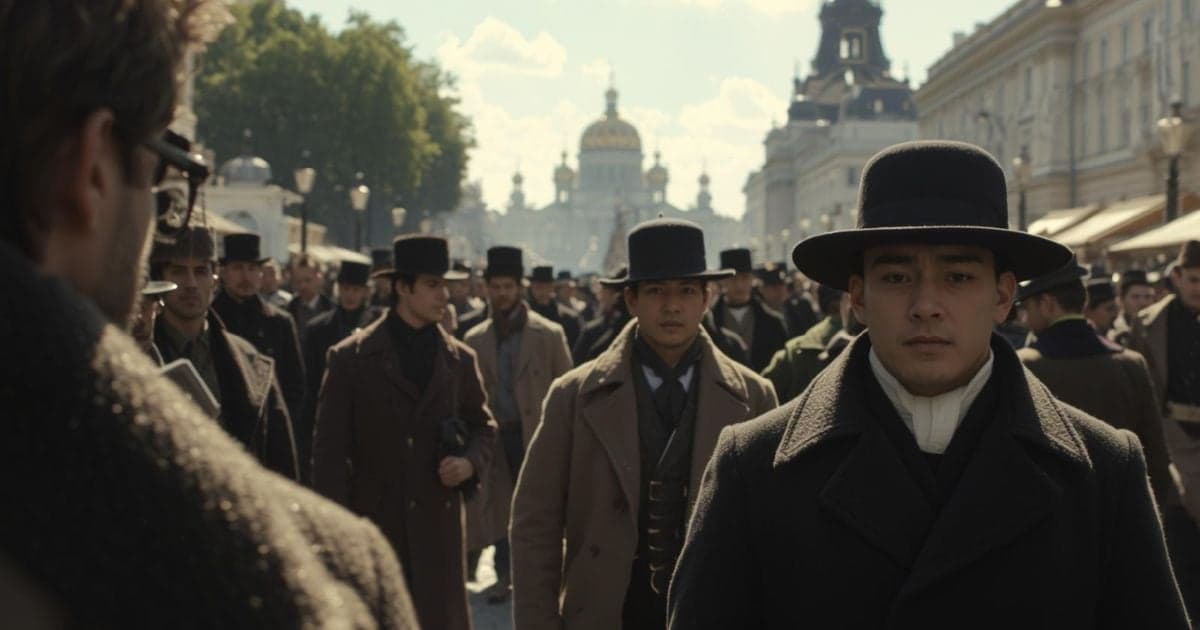
PART II — À Propos of the Wet Snow Chapter V “So this is it, this is it at last—contact with real life,” I muttered as I ran headlong downstairs. “This is very different from the Pope’s leaving Rome and going to Brazil, very different from the ball on Lake Como!” “You are a scoundrel,” a thought flashed through my mind, “if you laugh at this now.” “No matter!” I cried, answering myself. “Now everything is lost!” There was no trace to be seen of them, but that made no difference—I knew where they had gone. At the steps was…
Public-domain chapter text, formatted for reading.
Master this chapter. Complete your experience
Purchase the complete book to access all chapters and support classic literature
Available in paperback, hardcover, and e-book formats
Now let's explore the literary elements.
Key Quotes & Analysis
"So this is it, this is it at last—contact with real life. This is very different from the Pope's leaving Rome and going to Brazil, very different from the ball on Lake Como!"
Context: Running down the stairs after Zverkov and the others, throwing himself into a sledge
The Lake Como fantasy from Chapter 13 is named directly — and dismissed. The grandiose dreams are not just wrong in content; they are the wrong mode of being entirely. Real life, as it turns out, is a snowy street, a borrowed six roubles, and a plan that makes no sense.
In Today's Words:
This was it, the contact with real life I had been dreaming about, the actual encounter with people and circumstances rather than the rehearsal versions in my apartment. And it felt nothing like the rehearsal. It felt like something had gone wrong at a very fundamental level and I could not identify exactly where.
"They won't go down on their knees to beg for my friendship. That is a mirage, cheap mirage, revolting, romantic and fantastical—that's another ball on Lake Como. And so I am bound to slap Zverkov's face! It is my duty to."
Context: Working out the logic of what he must do, inside the racing sledge
The reasoning is internally coherent. If reconciliation is fantasy, then the only alternative within his honour-code framework is the slap. He is not being irrational — he is working through a system of logic that happens to be catastrophically misapplied to the situation.
In Today's Words:
They were never going to kneel for my friendship. I had known this for some time but kept the dream available as a motivation to keep moving. When I finally said it plainly, even to myself, the dream did not disappear so much as it shrank into something more appropriately sized for the evening I was actually having.
"I was actually on the point of tears, though I knew perfectly well at that moment that all this was out of Pushkin's Silvio and Lermontov's Masquerade."
Context: After the fifteen-year revenge fantasy — returning from Siberia, his hollow cheeks, firing into the air
He knows where the script comes from. He names the sources. This doesn't stop him feeling it — being moved by it — until the shame catches up with the emotion. Knowing that his suffering is borrowed from literature does not make the suffering less real. It just makes it also humiliating.
In Today's Words:
The tears were genuine, even though I knew perfectly well that the situation I was crying about was partially constructed, that I had plagiarized the feeling from literature, and that it would pass in a few minutes and leave nothing useful behind. Both things were true simultaneously, and neither cancelled the other.
"I felt as though I had been saved from death and was conscious of this, joyfully, all over: I should have given that slap, I should certainly, certainly have given it! But now they were not here and ... everything had vanished and changed!"
Context: Arriving at the brothel to find Zverkov and the others already gone
The relief is total — and it reveals what the whole ride actually was. He never wanted to give the slap. He wanted the drama of wanting to give it. The absence of Zverkov doesn't frustrate him; it releases him. He had been performing righteous fury for no one but himself.
In Today's Words:
They had gone and I was relieved, which told me something I had not wanted to know about myself. I had spent the entire evening desperately trying to remain connected to people whose absence now felt like oxygen finally returning to a room that had been too crowded.
Thematic Threads
Self-Deception
In This Chapter
The Underground Man recognizes his fantasies come from literature yet continues indulging them
Development
Evolved from earlier passive self-awareness to active participation in his own delusions
In Your Life:
You might catch yourself rehearsing arguments you know you'll never have but can't stop planning.
Social Performance
In This Chapter
He wants to appear 'revolting' to the prostitute, performing even his self-disgust
Development
Deepened from earlier social awkwardness to deliberately crafted repulsiveness
In Your Life:
You might find yourself performing your worst qualities when you feel judged or rejected.
Literary Influence
In This Chapter
His revenge fantasies explicitly mirror Pushkin and Lermontov's romantic heroes
Development
First direct acknowledgment of how literature shapes his behavior patterns
In Your Life:
You might notice your relationship expectations come from movies rather than real experience.
Anticlimax
In This Chapter
All his dramatic preparation leads to finding his targets already gone
Development
Introduced here as the gap between internal drama and external reality
In Your Life:
You might spend hours preparing for confrontations that never materialize as expected.
Shame Cycles
In This Chapter
He feels ashamed of his literary fantasies but cannot stop creating them
Development
Intensified from general self-consciousness to specific shame about his mental processes
In Your Life:
You might feel embarrassed about your daydreams yet find yourself returning to them compulsively.
You now have the context. Time to form your own thoughts.
Discussion Questions
This is not a test. Five prompts guide you through the chapter, from how it opens to how it closes, so you notice context and rhythm rather than facts to memorize. Sit with each question in your own words. When you see "One way to read it," treat it as a starting point, not the only answer.
- 1
After the dinner the Underground Man follows Zverkov and the others through the snow to a brothel. What is he trying to achieve by continuing to follow people who have made clear they do not want him?
analysis • surfaceOne way to read it
He cannot end the evening on his terms while it has concluded on theirs. Following them is the only way to extend a situation where he still has a chance, however remote, to say or do something that changes his standing. The impossibility does not reduce the compulsion.
- 2
He rehearses an apology to Zverkov and an insult to Zverkov in the same internal speech, almost simultaneously. What does this dual rehearsal reveal about his actual emotional state?
analysis • mediumOne way to read it
He wants both outcomes at once: to be reconciled and to be vindicated. Neither is possible, and the simultaneous rehearsal of both is the chapter's clearest image of his paralysis. He is not confused about what he wants; he wants incompatible things with equal urgency.
- 3
He describes following the group as an action he knows he will regret and cannot stop. Where in your own experience have you done something knowing you would regret it? What was the logic underneath?
application • mediumOne way to read it
The chapter implies the logic is usually about foreclosure: stopping feels like accepting the situation as final. Continuing, even badly, keeps a door technically open. The anticipated regret is an acceptable price for not having to acknowledge that the door was already closed.
- 4
He arrives at the brothel looking for Zverkov and finds Liza instead. What does this transition, from group encounter to individual encounter, reveal about what the Underground Man actually needs?
application • deepOne way to read it
The group encounter was about status and recognition in a hierarchy that had already rejected him. The encounter with Liza falls outside that hierarchy, which means he can speak differently, perhaps more honestly, perhaps more cruelly, without the constraints the others imposed on him.
- 5
The chapter ends with him arriving at the brothel in frenzied humiliation. What does the arc from dinner to brothel tell us about how shame compounds when it has no resolution?
reflection • deepOne way to read it
Each failed attempt to recover dignity requires a more desperate measure. The brothel is not a retreat; it is the Underground Man following the logic of his wound to its next destination, unable to stop moving because stopping means sitting with what the evening has confirmed about him.
Critical Thinking Exercise
Track Your Internal Theater
For the next 24 hours, notice when you catch yourself spinning elaborate mental scenarios—rehearsing conversations, planning confrontations, or replaying grievances. Each time, briefly note: What triggered it? How long did you spend on it? What were you hoping to accomplish? At the end, review your notes and identify your most common patterns.
Consider:
- •Pay attention to when these mental dramas feel most compelling—during commutes, before sleep, or after conflicts
- •Notice whether you're preparing for something real or just venting emotional energy
- •Observe how these internal scenarios make you feel versus how they actually help you
Journaling Prompt
Write about your biggest 'mental theater' pattern. What situations trigger your most elaborate internal dramas? How much time and energy do you spend on scenarios that never play out as imagined? What would you do with that mental energy if you redirected it toward actual problem-solving?
Coming Up Next...
Chapter 17: The Underground Man Meets Liza
The Underground Man's encounter with this unnamed young woman will become the most significant relationship in his story. What begins as a chance meeting in a brothel will force him to confront deeper truths about himself than any imagined duel ever could.